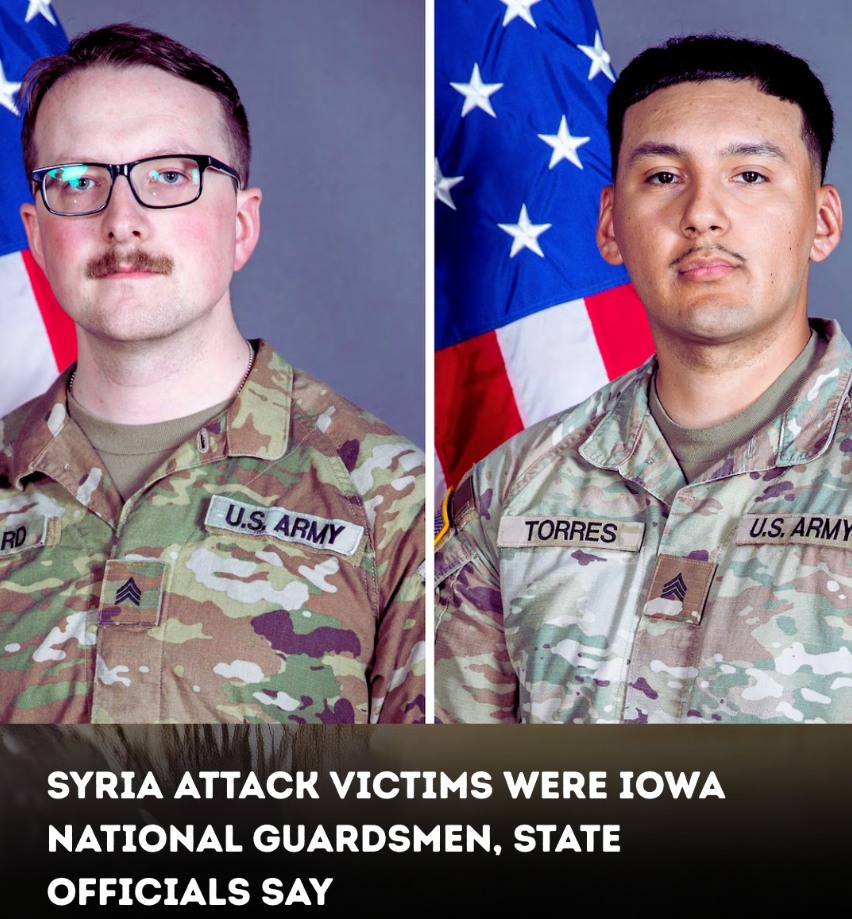
The news hit Iowa like a punch to the chest, reverberating through towns and cities with a weight that seemed almost physical. Two young soldiers, gone in an instant, thousands of miles from the familiar cornfields and quiet streets of their home state. Families shattered in ways that words could not fully capture. A state suddenly united in mourning, grappling with the incomprehensible loss, while leaders struggled to craft statements that could provide solace, even though they knew there were no words capable of fully conveying the depth of grief. Every news cycle, every social media post, seemed to amplify the tragedy, reminding communities that the war was not some distant abstraction—it had arrived at their doorstep in the form of sons, brothers, neighbors, and friends. As details of the ambush, the mission, and the final, harrowing moments slowly emerged, the people of Iowa were forced to confront a reality they had hoped would remain abstract, a reality that was terrifyingly, heartbreakingly real.
Sgt. Edgar Brian Torres Tovar, 25, from Des Moines, and Sgt. William Nathaniel Howard, 29, from Marshalltown, were more than just names on a roster—they were stories, ambitions, and memories that had been nurtured in the heartland. They wore the same uniform, stood side by side in service to their country, but carried with them different dreams, different visions of life beyond the military. Edgar had grown up in the neighborhoods of Des Moines, the rhythm of the city streets shaping his early years. Friends remember his laughter, the way he could light up a room with a story, a joke, a simple act of kindness. He had enlisted with a quiet determination, motivated by a sense of duty and a desire to see the world beyond Iowa, but always with an eye toward returning home to the place he loved. William, from Marshalltown, carried the calm, steady presence of a Midwestern boy raised on honesty and hard work. He was the kind of person who would spend hours helping a neighbor fix a roof or coach a little league team, the sort of individual whose integrity was evident in every interaction. Both men had volunteered for a mission that would rarely make headlines, a quiet, dangerous engagement with local leaders in Syria designed to counter the threat of ISIS. They knew the risks, yet faced them with professionalism, courage, and a devotion to something larger than themselves.
The ambush that claimed their lives was sudden, violent, and indiscriminate. Alongside the two soldiers, an American civilian was killed, and three others wounded. What began as a routine engagement, a meeting meant to build trust and coordinate efforts in a volatile region, was transformed in an instant into a scene of chaos and devastation. The reports trickled back slowly, each new detail more chilling than the last: the moments of confusion, the frantic calls for support, the bravery displayed as lives were put at risk to save others. In Iowa, as the news spread, the air seemed to thicken with grief. Local news stations cut into programming, radio hosts faltered mid-sentence, and families with loved ones in uniform held their breath, hoping against hope that their own door would not be knocked by the same fate.
Back home, the symbols of loss were immediate and visible. Flags at the state capitol and city halls were lowered to half-staff, fluttering in the autumn wind as if mourning alongside every Iowan who felt the ache of absence. Governor Kim Reynolds and Maj. Gen. Stephen Osborn faced the unenviable task of addressing a grieving public, their statements careful, measured, yet inevitably inadequate against the raw magnitude of loss. They spoke of sacrifice, courage, and honor, but even the most eloquent words could not fill the spaces left in living rooms across the state, where families clung to phones, desperate for messages from their deployed loved ones, praying silently that their name would not be the next read aloud in a somber press conference. Nearly 1,800 Iowa National Guard soldiers were deployed in the region, each one a potential target, each one a reminder that the distant conflicts on foreign soil were not so distant after all. Every knock at the door, every unexpected phone call now carried the weight of fear, the possibility of news that no parent, sibling, or spouse should ever have to receive.
In Des Moines, Edgar’s mother sat in the quiet of her kitchen, the hum of the refrigerator a stark contrast to the chaos swirling in her mind. She traced the outline of his baby pictures on the fridge, remembering a boy who had once dreamed of baseball fields and summer fairs, a boy whose laughter had filled her home. Now that same boy was gone, leaving behind a silence that threatened to swallow everything. Friends brought casseroles and offered awkward condolences, but no meal could soothe the emptiness that echoed through the rooms. In Marshalltown, William’s father paced the hardwood floors of his living room, clutching a worn leather jacket that smelled faintly of his son’s cologne. He remembered teaching him to ride a bike, the first time he cut the grass, the first day of school. All those memories were now tinged with sorrow, a cruel reminder of the life that would never continue.
The larger communities in Des Moines and Marshalltown organized vigils, bringing together strangers bound only by the shared knowledge of sacrifice and the fragility of life. Candlelight illuminated faces streaked with tears, prayers were offered in whispered voices that carried through the cold night, and flags were held tight as a symbol of unity. Veterans spoke of courage and honor, while younger soldiers and friends vowed to carry forward the legacy of those lost. Local media covered the events with sensitivity, but no article, no photograph could truly convey the weight of two lives cut short, the ripple effects that would be felt in classrooms, workplaces, and dinner tables for years to come.
Across the state, the psychological toll of the ambush was palpable. Deployed families reached out for counseling, churches offered prayer circles, and schools incorporated moments of remembrance into their day. In small towns, students lowered their voices when military families walked by, showing respect in ways both small and profound. The grief was not just personal; it was communal, a collective heartbeat of sorrow and reverence. Editorials debated policy, military strategy, and deployment protocols, but underlying every discussion was a shared recognition of human cost, the realization that behind every statistic is a life, a family, a story abruptly ended.
And yet, even in the shadow of tragedy, threads of courage and resilience emerged. Stories surfaced of soldiers who had saved others in the chaos, medics who risked everything to protect civilians, and communities in Iowa who came together to support the families. These acts, small and large, offered glimmers of hope, proof that humanity persists even amid loss. The state, shaken and sorrowful, found ways to honor Edgar and William—not just as soldiers, but as sons, friends, and community members whose dreams, laughter, and determination would not be forgotten.
In the days and weeks that followed, Iowa grappled with questions that had no answers: How do you prepare for loss on this scale? How do you find meaning when life’s most precious gifts are taken without warning? Town halls and prayer vigils multiplied, Facebook groups were formed to provide emotional support, and legislators discussed memorials to honor the fallen. Through it all, one undeniable truth remained: the sacrifice of Sgt. Edgar Brian Torres Tovar and Sgt. William Nathaniel Howard was not just a headline; it was a profound, collective loss that would forever shape the communities that raised them. Their bravery, courage, and humanity became a mirror in which Iowans saw both the fragility and the resilience of life.