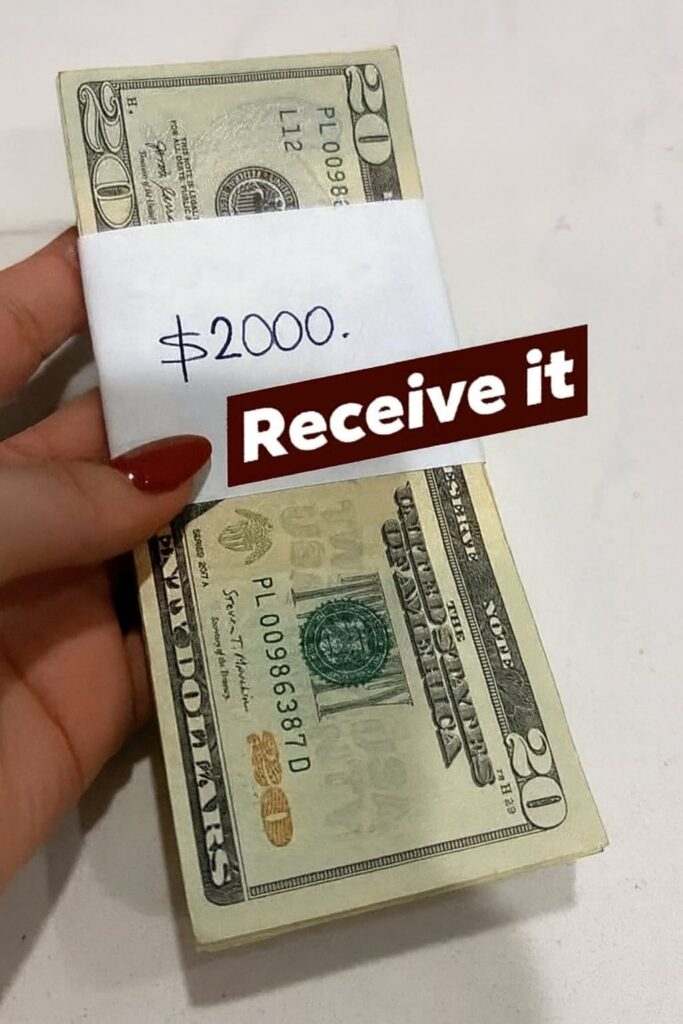
The message landed on Mason’s phone just as the sun cracked the horizon: “The $2,000 Trump payment is out. Check the list to see if your name is on it.” No sender ID. No traceable metadata. Just a statement dropped into his notifications like a baited hook. It had the tone of a political push, the structure of a scam, and just enough ambiguity to make the average person hesitate before deleting it.
He stared at it while his coffee machine sputtered to life behind him. He wasn’t the type to chase wishful payouts or fall for stimulus clickbait, but the wording was calculated—“payment,” “list,” “eligibility.” Words engineered to jolt the survival instinct, especially in an economy where two grand meant breathing room. He dismissed it at first, chalking it up to the same garbage that floods everyone’s phone at random. But the phrasing stuck with him longer than it should have, crawling into the back of his mind. It wasn’t the money—it was the implication that his name might be attached to something without his consent.
By noon the irritation had grown into unease. Mason hated unresolved signals. He functioned on data, not hunches, and this message had the uncanny quality of something probing for a reaction. That alone made him uneasy enough to start digging. He didn’t touch the link—that would’ve been suicidal—but he dove through financial forums, scam trackers, political threads, and watchdog pages. He expected to find nothing. Instead, he found hundreds of people describing the same text.
Some insisted it was tied to a new relief program. Others claimed it was a phishing campaign built to harvest data from the financially strained. A more paranoid cluster swore there was an actual eligibility roster circulating, some algorithm-driven list ranking citizens by economic vulnerability or credit risk.
Every explanation sounded bad. None sounded true. The noise only confirmed he had entered a fog of misinformation where no one knew what they were talking about, yet everyone felt the need to guess.
By the time he clocked out that evening, he’d convinced himself to move on. But when he reached his front door, a white envelope was waiting. No stamp. No return address. Hand-delivered. His name was printed in rigid, mechanical block letters across the front.
Inside: a single sheet of paper.
“Your eligibility status has been updated. Confirm your placement.”
His pulse tightened. That phrase—eligibility status—was too deliberate. Bureaucratic. Not the kind of thing scammers wrote unless they had a script. And whoever delivered this had walked right up to his house. That alone pushed this into territory he didn’t like.
He checked his porch camera. At 3:42 a.m., a hooded figure walked into frame, placed the envelope on the mat, and walked away. No hesitation. No rush. No vehicle. Just a person completing a task.
He felt something cold simmer beneath his ribs.
Later that night, while combing through deeper corners of the forums, he noticed a recurring username: LedgerWatch. They didn’t speculate—they corrected people. Their tone wasn’t hysterical like the others. It was precise, like someone who’d seen behind the curtain. And people treated their comments like gospel.
So Mason messaged them.
The reply came instantly.
“You received the envelope. You want to know if the list is real.”
Mason blinked. He hadn’t mentioned the envelope.
He typed: “What is this?”
The response arrived before he finished exhaling.
“A pre-screening protocol. The payment is irrelevant. The list tracks behavioral responses to financial stimulus prompts.”
He read it twice. Behavioral responses. Stimulus prompts. Pre-screening. Not a scam—something worse. Something systemic.
LedgerWatch sent an address and a final instruction:
“Ask for the registrar.”
Everything in him said stay home, destroy the envelope, forget this ever happened. But curiosity and anxiety make a potent mix, and now he needed to know how his name ended up in someone’s data stream.
The address led to a neglected municipal building that looked abandoned from the street. No signage. No posted hours. But one hallway glowed with a single working light. At the end sat an older woman behind a fold-out table. No computer. Just stacks of paper and a pen.
Before he introduced himself, she slid a document toward him: a long list of names, hundreds of them. Some highlighted. Some crossed out. Some freshly added.
“These are the individuals who responded to the prompts,” she said.
He studied her face. Steady. Unapologetic.
“This is some kind of scam, right?” he asked.
She shook her head. “Not a scam. An assessment model. We identify who reacts to the idea of unexpected funds. Who searches. Who ignores. Who attempts to claim benefits they never qualified for. It’s a stress test on consumer psychology. Financial institutions pay heavily for this kind of predictive behavior mapping.”
The word institutions hit him like a dull blade. Banks. Credit bureaus. Political research groups. Anyone who could profit from forecasting how people behave under economic pressure.
“You weren’t on the list,” she continued, “until you engaged. That puts you in the responsive category. Curious, skeptical, but still drawn in. A high-value data point.”
A cold wave moved through him. “So this is surveillance.”
“It’s analysis,” she said. “And you opted in the moment you went looking for answers.”
She wrote his name into an empty field on the sheet. A single stroke of a pen, and he was part of whatever machine this was.
He felt the walls shrink around him. He didn’t wait for an explanation, or a warning, or whatever came next. He walked out and didn’t look back. The night air felt heavier than before, the world smaller.
The real scheme wasn’t about a $2,000 payment. The message was bait. The envelope was confirmation. The building was the backend. And the currency wasn’t cash—it was human behavior during moments of financial uncertainty.
He’d stepped into the trap without meaning to. He’d shown them exactly how he reacted to the lure of money—cautious, analytical, but engaged. Enough engagement to mark him.
He drove home with the unshakable knowledge that someone, somewhere, had logged his response like a transaction.
He had never cared about the money.
But now someone cared about him.