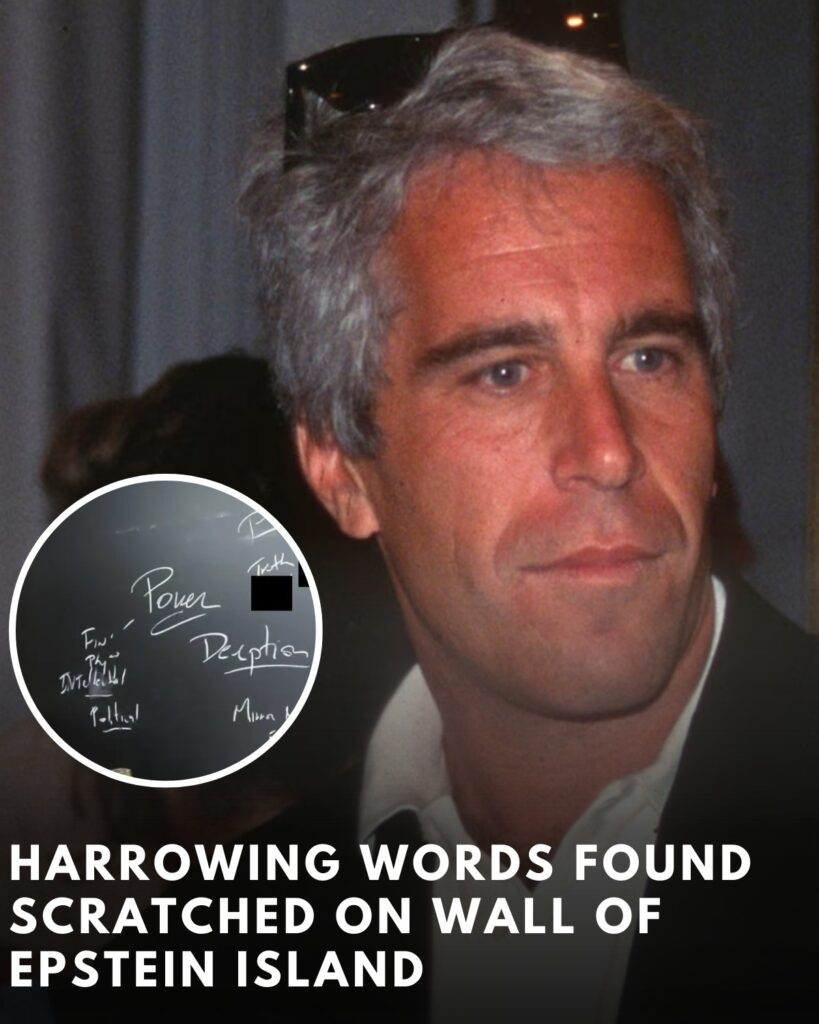
The release of “never before seen” photographs and videos from Jeffrey Epstein’s private island has drawn renewed attention to one image in particular: a blackboard inside one of the estate’s rooms, covered in unsettling handwritten words, some of which have been obscured by thick black redactions. The picture, published as part of a cache of more than 150 images from Little Saint James, shows the chalkboard mounted on a wall above a small desk in a tastefully furnished room with armchairs and a patterned rug. Across the board, words appear scrawled in different areas, including “truth”, “music”, “deception” and “power”, while other sections appear to contain phrases or names that have been deliberately blacked out before the photograph was made public.
The image forms part of a trove of material released online by Democratic members of the United States House Oversight Committee, who said they were publishing “never-before-seen photos and videos of Epstein’s private island” showing a “harrowing look behind Epstein’s closed doors”. The committee obtained the files from the Department of Justice in the US Virgin Islands, which had previously pursued a civil case against Epstein’s estate over alleged trafficking of women and girls to the island.
In the photographs, the blackboard appears heavily used, its surface smudged and crowded. Zoomed-in versions, released alongside the wider room shots, show individual words written in white chalk. In addition to “truth”, “power”, “music” and “deception”, close-ups reveal fragments such as “political”, “intellectual”, “fin” and “phy”, which appear to be shorthand or partial words. Around these are thick black rectangles masking whole lines of text. Officials have not said who wrote the words, what the redacted entries contained, or when the board was used.
The decision to obscure parts of the chalkboard has fuelled public speculation online, where social media users have tried to enhance and interpret the blurred or hidden text. Some have suggested the board may have listed names or coded references to people who visited the island, while others believe it may have contained notes for projects or ideas. None of those interpretations has been verified, and investigators have not endorsed any of the theories. For now, the board’s precise purpose, and the reason certain words have been concealed, remain unanswered questions in an already opaque case.
The chalkboard is only one detail among many in the newly released images, but it has resonated because it appears to present a stark, almost symbolic snapshot of the themes that have come to define Epstein’s network: power, deception, politics and secrecy. Other photographs from the same cache show an array of unsettling scenes inside the Caribbean compound. One image shows a room dominated by what looks like a dentist’s chair surrounded by masks depicting male faces on the walls. Another captures rows of masks mounted on a wall elsewhere on the property. Further pictures show bedrooms, a large bathroom with furniture, storage rooms packed with boxes, and exterior views of the island’s distinctive striped “temple” building, sundial and cow statue.

According to the committee, the photographs and videos were taken during searches of Little Saint James carried out after Epstein’s death, and were later shared with lawmakers by authorities in the US Virgin Islands. A memo from federal investigators previously stated that the raid on the island in 2019 yielded “more than 300 gigabytes of data and physical evidence”, underscoring the scale of material amassed from the secluded property.
Little Saint James, sometimes dubbed “Paedophile Island” by locals, was one of two private islands owned by Epstein in the Caribbean. He bought the smaller island in 1998 and later acquired the larger neighbouring Great Saint James. Prosecutors and accusers have long alleged that Little Saint James served as a hub for sexual exploitation, where Epstein and associates flew in underage girls and young women for abuse away from public scrutiny. A civil lawsuit filed by the government of the US Virgin Islands after his death described the island as “the perfect hideaway” used to traffic girls “for sexual servitude, child abuse and sexual assault”.

The island’s isolation formed part of Epstein’s own pitch to potential business partners. In a 2012 presentation cited in official documents, he reportedly described the territory as “perfect” because it was “so isolated”, underscoring how the remoteness that once appealed to wealthy visitors also made it difficult for law enforcement to monitor what happened there. The newly released photos show the interior of the buildings largely intact, with beds neatly made and rooms furnished, adding to the impression of a place frozen in time after its owner’s abrupt fall from power.
Epstein, a financier with extensive connections to prominent figures in politics, business and academia, was arrested in 2019 on federal sex trafficking charges alleging he exploited dozens of underage girls at his homes in New York and Florida. He died in a New York jail that August in what was ruled a suicide. His longtime associate Ghislaine Maxwell was later convicted of sex trafficking and related offences and is serving a 20-year prison sentence. Survivors and their lawyers have repeatedly argued that others who moved in Epstein’s circles have yet to be held accountable.
The release of the island photographs is part of a broader push in Washington for transparency over the full extent of Epstein’s operations and client network. In recent weeks, Congress has passed the bipartisan Epstein Files Transparency Act, which requires the Justice Department to release all unclassified documents and records relating to Epstein within thirty days. The law, which passed the House of Representatives by an overwhelming margin and was approved by the Senate, was signed by President Donald Trump on 19 November. It obliges the department to provide the material in a searchable format, while permitting redactions to protect ongoing investigations and the identities of victims.
The photos from Little Saint James pre-date that legal deadline and were released separately by Democratic members of the House Oversight Committee, who have argued that visual evidence from the island should be made available to the public. They have framed the disclosure as an early step towards fuller transparency, saying the images offer a rare look inside a property that has loomed large in allegations from victims but was previously known to the broader public mainly through aerial shots and limited leaks.
Among the images, the blackboard stands out because it appears to hint at the inner life of the island’s operations rather than simply documenting rooms and furnishings. While the photographs of bedrooms, bathrooms and recreational spaces suggest a luxurious retreat, the board’s combination of abstract concepts and redacted lines has invited scrutiny from lawyers, journalists and online commentators alike. Lawyers for accusers have previously said that Epstein kept detailed records, with one lawsuit alleging he maintained a computerised database to track girls who could be sent to the island. The chalkboard, though its specific purpose is unknown, fits a broader picture of an environment where planning and control were central.
Survivors of Epstein’s abuse have said that public access to more of the evidence gathered by authorities is essential to understanding how his network functioned and who enabled it. Annie Farmer, one of the best-known accusers, has urged federal judges to authorise the release of court records from both Epstein’s and Maxwell’s cases, arguing through her lawyer that greater openness “will lead to justice”. She and other victims have also called for careful handling of any disclosures to ensure their own identities and personal information remain protected.
The Justice Department, meanwhile, has asked judges for permission to release grand jury materials and other sensitive documents in line with the new law, signalling that it expects a significant tranche of information to become public in December. At the same time, lawmakers from both parties have pressed Attorney General Pam Bondi to brief them on what she has described as “new and additional” evidence related to Epstein, warning that any delays or excessive redactions could undermine the spirit of the transparency act.
In that context, the blackboard photograph has acquired a symbolic weight beyond its immediate contents. For many members of the public, the partially obscured words epitomise the lingering secrecy surrounding Epstein’s dealings with powerful figures. Campaigners for transparency have pointed to the redactions on the board as an example of how key pieces of information may still be withheld, even as politicians promise sweeping disclosure. Officials, however, maintain that some details must remain hidden to safeguard victims and protect any ongoing inquiries.
The new material has also revived questions about who visited Little Saint James and how much is known about their activities there. Court filings and previous document releases have detailed flights and social connections linking Epstein to a roster of high-profile names. Some have acknowledged knowing Epstein but deny wrongdoing; others say they were unaware of his criminal behaviour. The forthcoming document dump, coupled with images like the blackboard, may shed further light on those relationships, although there is no guarantee that all speculation about specific individuals will be resolved.
Beyond the political arguments, the photographs have had a visceral impact on survivors and the public because they render tangible the setting in which alleged crimes took place. The dentist-style chair and masks suggest a space configured for activities that remain unexplained. Bedrooms and bathrooms arranged with hotel-like neatness contrast with the allegations of coercion and abuse that victims say unfolded within those walls. The chalkboard, with its stark references to “power” and “deception”, appears to echo the themes of manipulation and control that run through accounts given by women who encountered Epstein.
As the deadline approaches for the Justice Department to comply with the Epstein Files Transparency Act, campaigners expect further evidence from the island and other properties to emerge. That may include travel logs, staff lists, financial records and additional photographs or video. Each new disclosure is likely to be combed for clues in the same way the chalkboard image has been, with online communities seizing on details that may or may not carry wider significance. Officials and victim advocates have warned that while public scrutiny is vital, rushing to conclusions based on isolated fragments risks misidentifying innocent people or misinterpreting evidence.
For now, the blackboard on Little Saint James remains a small but haunting artefact within a sprawling and still unfolding story. It offers a glimpse into a room on an island that survivors say was a central stage for exploitation, yet its most revealing lines are literally blacked out. Whether forthcoming files will fill in those blanks, or whether key details will stay buried even as more material is released, will be a key test of how far authorities are willing and able to go in exposing the full extent of Jeffrey Epstein’s world.