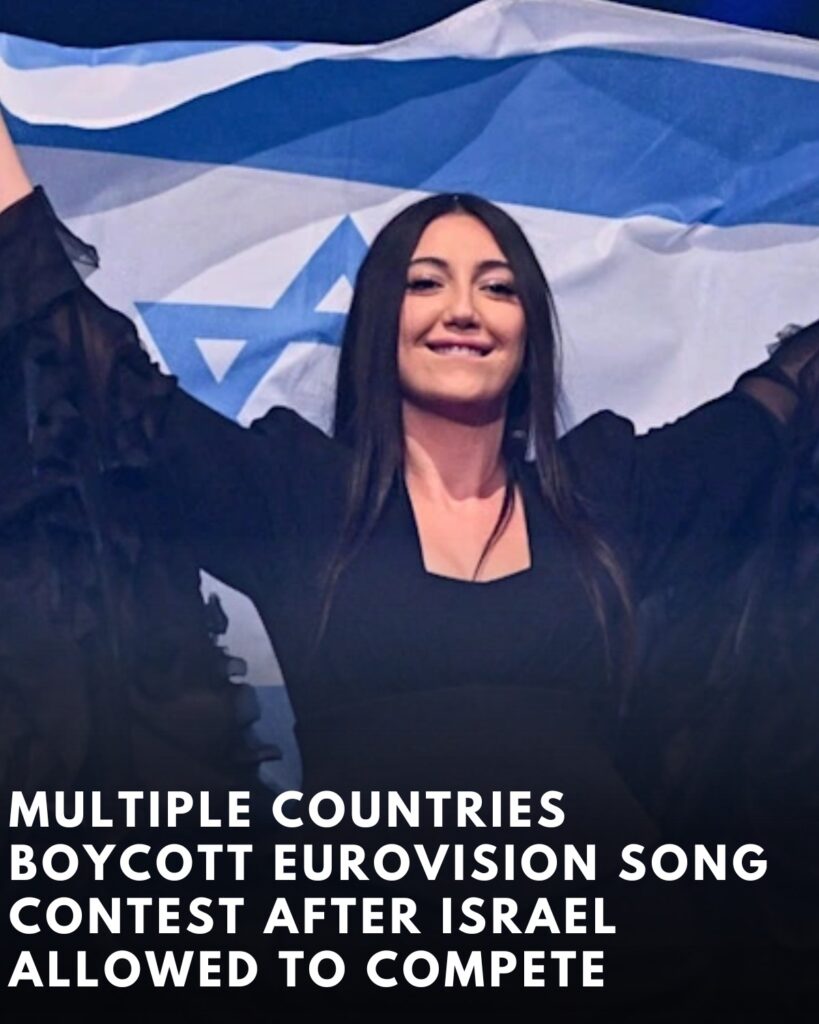
Ireland, Spain, the Netherlands and Slovenia have announced that they will withdraw from the 2026 Eurovision Song Contest after Israel was cleared to take part in next year’s competition despite months of lobbying for its exclusion over the war in Gaza and concerns about the integrity of the public vote.
The decision to pull out was triggered by a meeting of the European Broadcasting Union (EBU) general assembly in Geneva, where broadcasters debated whether to hold a fresh vote on Israel’s participation. No such vote was ultimately held. Instead, members approved a package of new rules aimed at curbing attempts by governments and third parties to disproportionately promote entries and influence televoting outcomes. A statement from the EBU said that “a large majority of members agreed that there was no need for a further vote on participation and that the Eurovision song contest 2026 should proceed as planned, with the additional safeguards in place.”
For several broadcasters, that outcome crossed a red line. Ireland’s public broadcaster RTÉ confirmed that it would neither take part in nor air the 2026 contest, which is due to be held in Vienna after Austria’s victory in this year’s competition. In a statement, RTÉ said it felt that Ireland’s participation “remains unconscionable given the appalling loss of lives in Gaza and the humanitarian crisis there, which continues to put the lives of so many civilians at risk.”
Spain’s national broadcaster RTVE followed suit, invoking a decision it said had already been taken in anticipation of Israel’s continued involvement. According to RTVE, “The board of directors of RTVE agreed last September that Spain would withdraw from Eurovision if Israel was part of it. This withdrawal also means that RTVE will not broadcast the Eurovision 2026 final… nor the preliminary semi-finals.”
RTVE went further in its criticism of how the EBU handled the issue. It said the process that led to the Geneva decision was “insufficient” and had generated “distrust”. The broadcaster said its request for a specific vote on Israel’s participation had been turned down, adding: “The EBU presidency has denied RTVE’s request for a specific vote on Israel’s participation. This decision increases RTVE’s distrust of the festival’s organisation and confirms the political pressure surrounding it.”

The Spanish government publicly backed RTVE’s stance. Culture minister Ernest Urtasun described Israel’s inclusion as unacceptable in light of the conduct of its military campaign. “You can’t whitewash Israel given the genocide in Gaza. Culture should be on the side of peace and justice. I’m proud of an RTVE that puts human rights before any economic interest,” he said in a statement supporting the boycott.
Broadcasters in the Netherlands and Slovenia then confirmed that they would also abandon next year’s contest. Dutch public broadcaster Avrotros said it had weighed up different perspectives before concluding that participation was no longer compatible with its values. In its statement, Avrotros said that “after weighing all perspectives, Avrotros concludes that, under the current circumstances, participation cannot be reconciled with the public values that are fundamental to our organisation,” and added that “participation under the current circumstances is incompatible with the public values that are essential to us.”
RTVSLO, Slovenia’s national broadcaster, which had been the first to signal that it might boycott the contest if Israel remained in the line-up, confirmed that it would stay away in 2026. RTVSLO said that sending an entry “would conflict with its values of peace, equality and respect.”
The four withdrawals mark one of the most serious ruptures in Eurovision’s recent history and underline how the continuing war in Gaza has spilled over into cultural and entertainment arenas across Europe. Since Israel’s military response to the 7 October 2023 Hamas attacks, which killed around 1,200 people in Israel and saw hundreds taken hostage, the subsequent campaign in Gaza has drawn sustained criticism from governments, international organisations and campaign groups over the scale of Palestinian civilian casualties and the humanitarian crisis in the territory.
Those concerns drove repeated calls this year for Israel to be suspended from Eurovision, in a debate often compared with Russia’s expulsion from the contest after its full-scale invasion of Ukraine in 2022. Israel has taken part in Eurovision since 1973 and has won the competition four times, most recently in 2018. It has continued to participate throughout the Gaza war, arguing that Eurovision is a cultural platform that should remain separate from political disputes.
Israel’s 2025 entry, performed in Basel, topped the public televote and finished second overall once national jury scores were taken into account, a result that some broadcasters felt was shaped by intensive mobilisation campaigns among supporters. In Geneva, EBU members did not hold a direct vote on whether Israel should be allowed to compete in 2026. Instead, they adopted new rules designed to prevent what the EBU described as “disproportionate” promotion of entries by states or organised groups seeking to sway the outcome. Sixty-five per cent of delegates voted in favour of the rule changes and against any further discussion on Israel’s participation, while 23% opposed the package and 10% abstained.
Those changes were presented as a compromise intended to address concerns about voting integrity without singling out any country. For RTÉ, RTVE, Avrotros and RTVSLO, they were not enough. All four linked their decisions explicitly to Israel’s participation and to the humanitarian situation in Gaza, casting their withdrawal as a matter of principle rather than a dispute over technical rules.
At the same time, several major European broadcasters signalled that they would remain in the competition and backed the EBU’s stance. The BBC said it supported the collective decision taken by members, stating: “We support the collective decision made by members of the EBU. This is about enforcing the rules of the EBU and being inclusive.” Germany’s regional broadcaster SWR, which is responsible for the country’s participation, confirmed that it would continue to take part, saying before the meeting that the Israeli broadcaster Kan “meets all the requirements associated with participation” and stressing that Eurovision is “a competition organised by EBU broadcasters, not by governments.”
Broadcasters in Norway, Sweden, Finland, Denmark and Iceland also supported the rule changes and signalled an intention, at least for now, to stay in Eurovision. In a joint statement they said they “supported” the EBU’s decision to “address critical shortcomings” in the voting system, while urging continued discussion on how to protect the contest’s credibility in the future. Iceland’s RÚV, which had previously threatened a boycott, said it would consider its position at a board meeting, highlighting that further withdrawals remain possible.
From Israel’s perspective, the outcome in Geneva was welcomed as a vindication of its right to take part in international cultural events. President Isaac Herzog wrote on X that Israel “deserves to be represented on every stage around the world.” He added: “I am pleased that Israel will once again participate in the Eurovision song contest, and I hope that the competition will remain one that champions culture, music, friendship between nations, and cross-border cultural understanding.”
The dispute places the EBU in a sensitive position. As the umbrella body for Europe’s public broadcasters, it has repeatedly insisted that Eurovision is a non-political event and that its rules are applied consistently to participating broadcasters rather than their national governments. It has argued that banning Israel would undermine that framework, particularly given that Kan, the Israeli public broadcaster, has not been found to be in breach of Eurovision’s formal participation criteria. At the same time, the decision to exclude Russia in 2022 established a precedent for taking geopolitical events into account when deciding who can compete.
The boycotting broadcasters have framed their move as limited to the 2026 edition and tied specifically to the current war. RTÉ, RTVE, Avrotros and RTVSLO have not ruled out returning in future years, but their statements strongly suggest that any change would depend on both developments in Gaza and the EBU’s handling of political pressure around the contest. For now, their withdrawal will mean no entries from Ireland, Spain, the Netherlands or Slovenia in Vienna and no live broadcasts of the semi-finals or final on their channels.
The absence of those countries will be felt in a competition that has long drawn its appeal from the breadth of its participation as much as from the music itself. Ireland remains the most successful nation in Eurovision history, with seven wins, while Spain, the Netherlands and Slovenia each have established fan bases and have hosted or won the contest in past decades. Their decision to step away underscores the extent to which global conflicts and human rights arguments are increasingly shaping choices in the cultural sector.
Within their own domestic audiences, the moves are likely to be closely scrutinised. Supporters of the boycotts have presented them as a necessary response to what they see as a failure to hold Israel to account for civilian deaths and destruction in Gaza. Critics, including some politicians and viewers in various countries, argue that Eurovision should remain a cultural space detached from geopolitical disputes and that the withdrawals risk entrenching divisions rather than promoting dialogue. Those debates are unfolding alongside wider controversies over cultural boycotts, including festivals and events in Europe where artists and institutions have faced pressure over their positions on the Israel–Palestine conflict.
For the EBU, the Geneva decision and its aftermath have set the course for the 70th edition of the song contest, scheduled for Vienna in 2026 following the victory of Austrian singer JJ this year. The organisation will now have to navigate the practical consequences of four missing delegations, while also facing the possibility that more broadcasters may reassess their involvement as the situation in Gaza and international opinion continue to evolve. For the boycotting countries, the move represents a high-profile statement that, in their view, participation in Eurovision alongside Israel at this moment would be incompatible with their values and with the public service mandates they are meant to uphold.