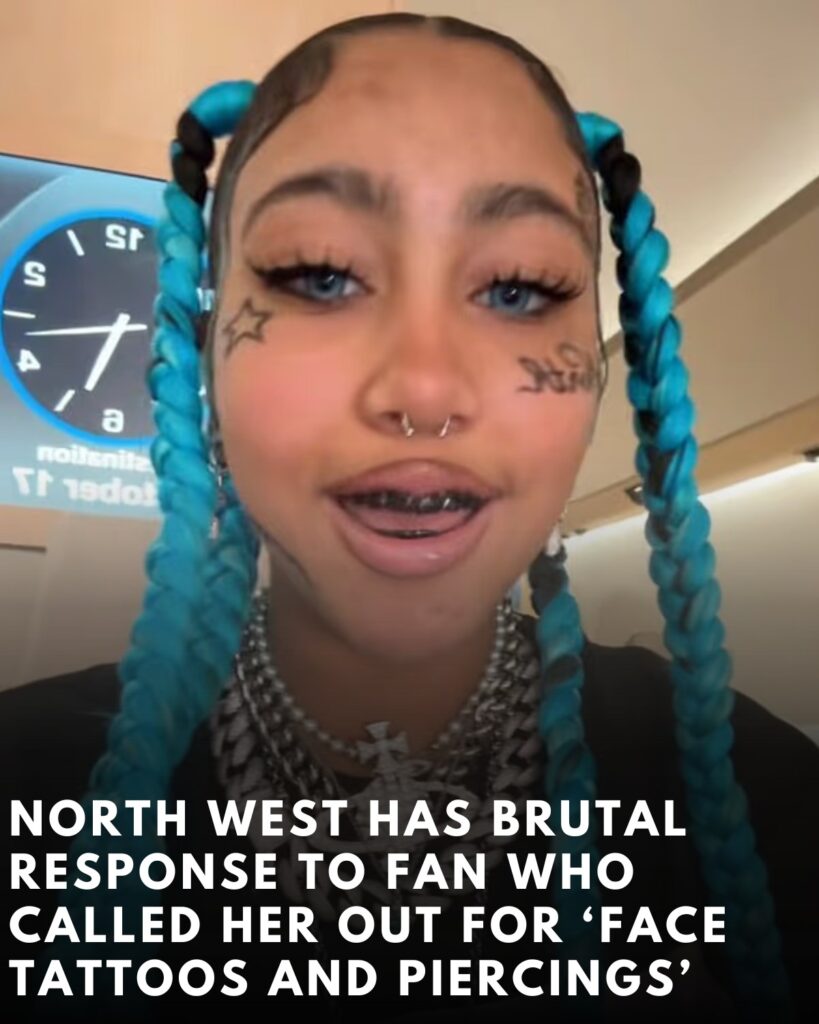
The clip of North West in heavy make-up with faux piercings and face tattoos has triggered a familiar cycle for the Kardashian family—viral focus on an image, a wave of criticism and defence online, and then a response from within the family that attempts to place the moment back in context. The video, posted on the verified TikTok account Kim and North, showed the 12-year-old with blue braided extensions, dark grillz, heavy lashes, and what appeared to be a septum ring and tattoo designs across her cheeks and forehead. The visuals prompted a surge of commentary across social platforms about whether the styling was appropriate for a pre-teen, while others noted it was close to Halloween and clearly costumed. In the days that followed, Kim Kardashian publicly addressed the reaction, calling the backlash “such a non-issue,” and described her daughter as largely unfazed by the criticism.
Kardashian’s first public response appeared in a social-media comment thread beneath a repost highlighting concern about North’s look. She wrote, “This is such a non-issue,” adding an emoji to underline her view that the discourse had become disproportionate to what, in her telling, was a playful, temporary look. The remark was widely circulated and became the touchstone of coverage across entertainment feeds as it distilled her position into five words.
The original TikTok—shared to an audience accustomed to North’s frequent experiments with hair, make-up and performance—had its comments turned off. A still grabbed from the video, however, ricocheted around X, Instagram and Reddit, where remarks ranged from scolding to supportive. Among posts collated by publishers and fan accounts, some users argued that the styling suggested “poor parenting” and was “scary,” while others countered that pre-teens routinely try out dramatic looks and that the difference here was the family’s visibility. The debate quickly flipped from a discussion of one child’s costume choices to a broader argument about the boundaries of self-expression, parental oversight online, and the ethics of mass commentary on the appearance of a minor.
Kardashian then expanded on her stance in interviews and podcast appearances, providing context for the imagery and her approach to raising a pre-teen in a family constantly in the public eye. She has said that North enjoys creative expression, including fashion and special-effects make-up, and is studying those skills. She added that her daughter is “really mature” in certain respects and is not easily rattled by outside opinion. Kardashian also acknowledged that parenting decisions sometimes play out in public and that she has made mistakes that she would not repeat, citing instances where she allowed looks she later decided were inappropriate for North’s age. She framed the viral face-art and piercings as part of a seasonal, costume-style experiment rather than a permanent or lifestyle change, and said her daughter largely shrugged off the online reaction.
For those unfamiliar with the cadence of the family’s social output, the images looked stark. North’s look combined blue contact lenses and braids with black dental grillz and drawn-on motifs, captured in a short video that emphasised the transformation. At a glance—especially when removed from the original source and re-shared without the costume context—some viewers assumed permanence. Kardashian’s insistence that everything was temporary and part of dress-up is consistent with the caption North used on TikTok—“Fake piercings and fake tatts 4 life”—and it matches the family’s history of leaning into theatrical presentation around holidays and photo shoots. The temporary nature of the styling became a key part of Kardashian’s argument that the furore was inflated.
Online, the response tracked familiar lines. Critics focused on age and parental decision-making, some accusing Kardashian of permitting a stylisation that they said blurred childhood boundaries, while supporters argued that dressing up at 12 is commonplace and that the intensity of the reaction says more about the public’s fixation on the family than the child’s choices. One user’s remark—“She is her daddy’s daughter… Let baby girl live”—captured the pro-expression mood among defenders who also noted North’s longstanding flair for performance. The more critical comments reflected an anxiety that social media and wealth accelerate adult aesthetics for children. Because the video’s comments were off, much of the visible discourse occurred on reposts and in media comment sections rather than on the original TikTok itself.

Kardashian’s recent media remarks also referenced an earlier episode that fed into the present argument. Over the summer, images circulated of North wearing what appeared to be a dermal piercing during a trip to Rome. Reaction again turned on whether the look was real and appropriate. Kardashian has since described that as a “learning moment,” saying on a podcast that she told herself, “we’re never wearing that again,” acknowledging that, as a mother, she is “learning at the same time” and that those decisions sometimes unfold publicly. That framing—an evolving parenting approach under scrutiny—underpins how she has presented the latest controversy.
The setting of the most recent video is also material to understanding why some saw it differently than a lifestyle statement. The clip surfaced in the run-up to Halloween, when platforms are awash with special-effects make-up, faux piercings and tattoo art. Costume posts often lean into hyper-stylised aesthetics and are intended to be transgressive or uncanny for effect. Kardashian has specifically invoked that context to argue that the reaction lacked proportion, as if the imagery were being judged as a fixed identity rather than a one-off look. The distinction matters in public discourse: temporary, theatrical choices traditionally fall under a wide latitude, while permanent alterations on minors raise different debates and, in many jurisdictions, legal barriers. The family and multiple entertainment outlets have stressed that the items on North’s face in the video were not permanent.
Beyond the immediate back-and-forth, the episode illustrates the compression of public and private space for celebrity children. North West has grown up on-camera across reality television, red carpets, and now social video, and her presence often intersects with two highly engaged fandoms—her mother’s and her father’s. That dual exposure magnifies reactions whenever she appears in material that invites aesthetic judgments. Kardashian’s comment that North was unbothered—“such a non-issue,” in her phrasing—may accurately reflect the pre-teen’s resilience, but it also telegraphs a strategy: deprive the controversy of oxygen, assert a straightforward context, and move on. Whether that approach dampens or accelerates cycles of commentary depends on how widely the clarifying information penetrates the repost economy, where images are frequently detached from their original captions and timelines.
The age question remains the fulcrum of debate. Some of the more severe criticism framed the look as a signal of “poor parenting” or a loss of childhood, comments that spread rapidly when collated by news sites and fan pages. Advocates for giving children room to experiment countered that the line between dress-up and identity should be maintained, and that adults projecting anxieties onto a 12-year-old’s costume crosses into unnecessary policing. Kardashian’s account supports the latter view; she has said North enjoys make-up and fashion as creative outlets and is learning technical skills, positioning the video as an example of a hobby executed with resources few pre-teens possess rather than as a parental endorsement of permanent body modification. The polarity of reactions underscores why content moderation choices—such as turning off comments—are common for high-profile families balancing engagement with the risk of exposing a child to a torrent of unfiltered adult opinion.
There is also a reputational management component. Kardashian has spent years calibrating the presentation of her children on social platforms, sometimes withdrawing or limiting posts after flashpoints. By acknowledging on a podcast that she has “made mistakes” and is “learning,” she pre-emptively takes responsibility for the evolution of boundaries while resisting the idea that any single image should trigger a moral panic. That rhetorical blend—contrition about the past and firmness about the present—has become a hallmark of how she addresses controversies. In this instance, it allowed her to concede that some styling decisions crossed lines she would not cross again while maintaining that the latest video fell squarely within acceptable, temporary play.
For observers outside the Kardashians’ day-to-day orbit, the episode is notable less for the specifics of one video and more for what it reveals about the dynamics of audience reaction in 2025. A short clip of a child in costume, unremarkable in a school or a private setting, becomes a flashpoint once it enters a feed that blends celebrity coverage, culture-war commentary, and algorithmic amplification. The same image can be read as harmless experimentation or as evidence of parental negligence depending on the viewer’s priors, and each reading finds validation in an online echo chamber. Kardashian’s effort to anchor the narrative with a blunt, repeatable line—“such a non-issue”—is a practical communications tactic in that environment: it supplies a quote for headlines and sets a baseline interpretation for supporters to reference. Whether it persuades critics is secondary to establishing the family’s official account of what viewers saw.
North’s own caption—“Fake piercings and fake tatts 4 life”—is the most direct statement attached to the imagery and, in effect, answers the factual question that fuelled much of the anxiety. The emphasis on “fake” undercuts claims that the family is normalising permanent modification for a child, while the exaggerated phrasing signals that the persona on screen is performative. In that sense, the video sits comfortably within TikTok’s theatrical grammar, where characters and looks are tried on and discarded within days. The circulation of screenshots without the caption helps explain why a portion of the audience interpreted the look as more permanent than it was.
There is no indication from the family’s public comments that any part of the look was real or lasting. The timing around Halloween, the caption’s explicit framing, and Kardashian’s statements across outlets all point to a temporary costume. What endures, instead, is the pattern: a Kardashian-adjacent image travels, audiences divide, and the family moves to assert authorship over the narrative with a set of clarifying quotes. That pattern has been visible before—Kardashian referenced the Rome episode as one she would not repeat—and it is likely to recur as her children age into more independent use of social platforms. For now, her account is that a dressing-up exercise went viral, her daughter took it in stride, and the storm of opinion swirling around a 12-year-old’s face paint says more about the internet than it does about North.
What this brief controversy ultimately demonstrates is the fragility of context in the attention economy. When viewers encounter a high-contrast facial close-up stripped of caption and timing, they are left to fill in the blanks, often with assumptions that conform to their pre-existing views about a public family. Kardashian’s response—short, dismissive of the panic, and backed by a fuller explanation in interviews—sought to restore that context. As far as the family is concerned, the matter is closed: the tattoos and piercings were fake, the look was for fun, and, in Kardashian’s words, the entire episode was “such a non-issue.”