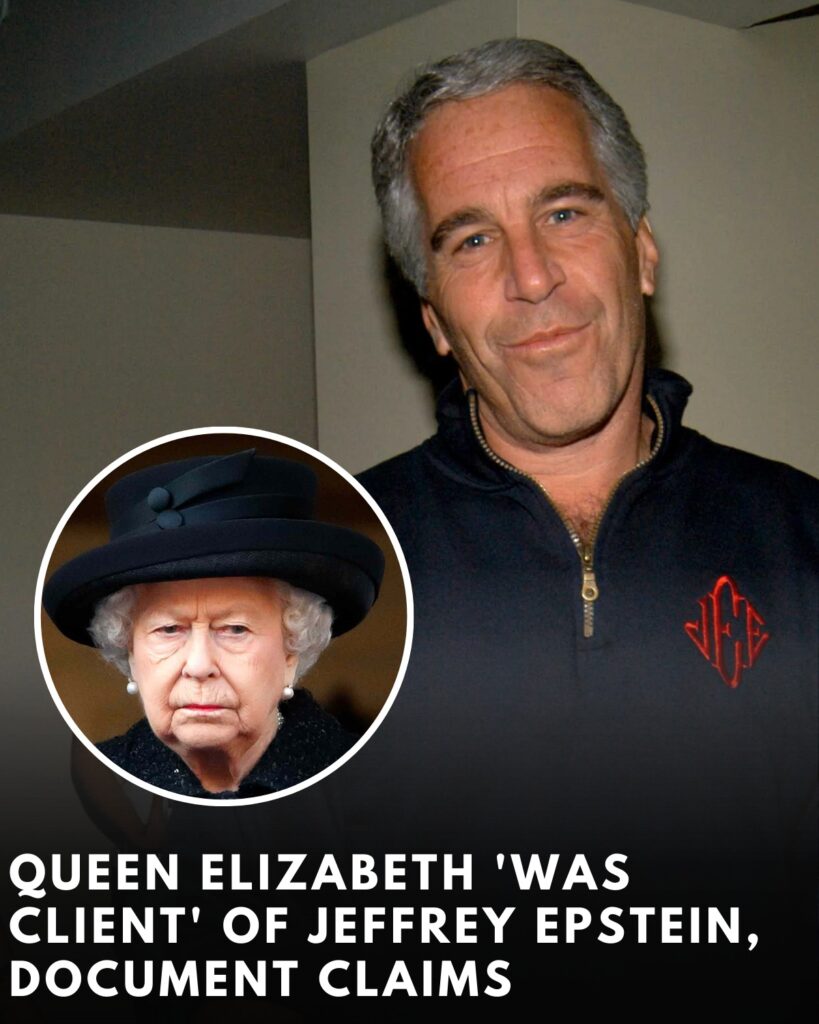
The late Queen Elizabeth II has been drawn into the widening fallout from the release of thousands of documents linked to Jeffrey Epstein, after a Nobel Prize-winning physicist was quoted in newly highlighted material saying he believed the disgraced financier’s “clients include the Queen of England” and that Epstein had “given the Queen financial advice.”
The claims emerge from material associated with the Epstein estate that was turned over to the United States House Oversight Committee and recently made public as part of a large batch of correspondence and files. British media reports, including coverage by the Daily Express and the Daily Star, say one of roughly 23,000 documents contains comments attributed to Murray Gell-Mann, the American physicist who won the Nobel Prize in 1969. In that material, Gell-Mann is recorded as saying he was “under the impression that Epstein’s clients include the Queen of England” and that he “understood that Epstein had given the Queen financial advice.”
The suggestion that Epstein, a convicted sex offender who died in a New York jail in 2019, might have had a professional relationship with the British monarch is presented in the documents as Gell-Mann’s understanding rather than as a formal list of clients or a verified record of financial arrangements. There is no indication in the released material of any direct communication between Epstein and the Queen, nor any documentary evidence such as contracts, payment instructions or palace correspondence that would normally accompany a formal advisory role. The newly public references instead centre on how Gell-Mann and others in Epstein’s circle perceived his standing among the wealthy and powerful.
The wording about Epstein’s “clients” dates back at least two decades. In a 2003 profile of Epstein for Vanity Fair, Gell-Mann was quoted as saying he was under the impression that Epstein’s clients included the Queen of England, in a passage describing Epstein’s social and financial connections to billionaires and prominent figures. That earlier article, written long before Epstein’s 2019 arrest on federal sex trafficking charges, portrayed Gell-Mann as one of several scientists who benefitted from Epstein’s donations and who spoke admiringly of his enthusiasm for theoretical physics and his ability to attract influential people.
In the material now circulating from the House Oversight release, that same impression has been given renewed prominence and linked explicitly to the idea that Epstein offered financial guidance to the monarch. According to British press reports, one of the newly public documents records Gell-Mann as saying he “understood that Epstein had given the Queen financial advice,” a formulation that again reflects his understanding rather than first-hand evidence.
The documents do not spell out what kind of advice Epstein is alleged to have given or when any such advisory role is said to have taken place. The British sovereign’s personal wealth and the assets of the Duchy of Lancaster have traditionally been managed by established financial institutions and specialist advisers appointed through formal channels. There is nothing in the publicly available material from the Epstein files to show that Epstein was ever formally appointed to any such position, and the material released so far does not include letters, legal retainers or financial records naming Queen Elizabeth II as a client.

However, the resurfaced comments sit against a backdrop of well-documented ties between Epstein and the Queen’s second son, Andrew, the Duke of York, who is now styled Andrew Mountbatten-Windsor after being stripped of his royal and military titles. The documents highlighted in recent reporting repeat a series of episodes that have already been documented elsewhere, including in the 2016 book “Filthy Rich” by James Patterson and investigators who examined Epstein’s network.
Those accounts describe Epstein being invited to Windsor Castle in 2000 for an event celebrating the Queen’s birthday, and later the same year flying to Sandringham, the royal estate in Norfolk, for a party Andrew hosted to mark Ghislaine Maxwell’s thirty-ninth birthday. Maxwell, a long-time associate of Epstein, is currently serving a 20-year sentence in the United States after being convicted of child sex trafficking and other offences in connection with his abuse of underage girls.
Newly public files from the Epstein estate and the House Oversight release echo that timeline, stating that around the turn of the millennium Andrew and Maxwell “were hardly ever apart,” travelling together to Palm Beach, attending a fashion show in New York and appearing at a fundraiser for the London Symphony Orchestra. The same material notes that on several of these occasions Epstein was also present, and that Andrew invited both Epstein and Maxwell to royal properties as part of those social engagements.
Those social links between Andrew and Epstein have been a long-running source of scandal for the monarchy. Epstein was first investigated in Florida in 2005 and, in 2008, pleaded guilty in a controversial plea deal to procuring a minor for prostitution and soliciting a prostitute, serving a 13-month sentence with work-release privileges. After his rearrest in 2019 on federal sex trafficking charges involving underage girls in Florida and New York, attention returned to the royal connection. A now-infamous photograph of Andrew with his arm around the waist of Virginia Giuffre, then Virginia Roberts, became emblematic of the allegations. Giuffre has alleged that she was trafficked by Epstein and forced to have sex with the prince, claims Andrew has consistently and emphatically denied.
In 2022, Andrew reached a confidential civil settlement with Giuffre in a case brought in the United States, while admitting no liability. Buckingham Palace later announced that he would no longer carry out public duties and that his military affiliations and royal patronages had been returned to the Queen. Following King Charles III’s accession, court circulars and official communications have referred to him without the style “His Royal Highness,” and recent reporting notes that he is now formally identified in some contexts as Andrew Mountbatten-Windsor.
The newly amplified references to the late Queen within the Epstein files therefore come at a time when scrutiny of the broader royal connection remains intense. However, there is a clear distinction in the documents between detailed travel records and event descriptions concerning Andrew, Maxwell and Epstein, which include flight logs and dated references to Windsor Castle and Sandringham, and the more speculative comments about the Queen’s supposed client relationship. The remarks attributed to Gell-Mann are presented as his impression and understanding, rather than as material drawn from banking records or internal client lists.
Gell-Mann, who died in May 2019, was a towering figure in twentieth-century physics, best known for developing the quark model of subatomic particles and for his work on the theory of the strong nuclear force, which earned him the Nobel Prize in Physics in 1969. He was also part of Epstein’s circle of scientists and intellectuals. In his 1994 book “The Quark and the Jaguar,” he acknowledged financial support from Epstein via the Santa Fe Institute, a research organisation where both men were involved. Subsequent reports have said that Gell-Mann contributed a birthday message for Epstein to a volume titled “The First Fifty Years” in 2003 and attended a scientific gathering on Epstein’s private island in 2011.
The resurfaced passages now attracting attention form part of that broader picture of how figures in Epstein’s orbit saw him as a fixer for the ultra-rich. Vanity Fair’s 2003 profile noted that some businessmen were unclear about how Epstein actually made his money but nevertheless relied on him to manage their fortunes. (Vanity Fair) The House Oversight documents, which cover a period from roughly 2011 to 2018, show Epstein continuing to cultivate relationships with high-profile individuals and to discuss possible structures for donor-advised funds and other vehicles aimed at wealthy clients.
There is no suggestion in the public material that the Queen herself was involved in arranging meetings, emails or financial instruments with Epstein, and none of the released documents has been presented as a formal “client list” in the sense sought by campaigners pressing for full transparency over who, exactly, entrusted funds to the financier. Commentators examining the files have stressed that the passages about Gell-Mann’s impressions should not be confused with hard records of client accounts, and that the documents released by the House Oversight Committee so far are uneven in detail and drawn from a range of sources, including biographies, third-party correspondence and internal memos.
Buckingham Palace has not publicly responded to the specific suggestion that Epstein “had given the Queen financial advice.” According to the Daily Express, the newspaper contacted the palace and representatives for Andrew Mountbatten-Windsor for comment but did not receive any substantive reply; the palace reportedly declined to comment, while Andrew’s camp did not respond. There have been no official statements from the Royal Household acknowledging any direct relationship between the Queen and Epstein beyond the fact that he was a guest at events in which Andrew played a central organising role.
The late Queen, who died in September 2022 at the age of 96, spent much of her reign carefully protecting the monarchy’s political neutrality and avoiding entanglement in public controversy. While her family members have often found themselves under intense scrutiny, she maintained a strict public silence on most personal matters and almost never responded to individual allegations in the press. The suggestion, based on second-hand impressions recorded in documents linked to a disgraced financier, that she might have been one of his clients now poses a posthumous reputational challenge that, for the moment, remains unanswered from within the royal household itself.
For investigators, journalists and members of the public combing through the thousands of pages of Epstein-related material, the references to the Queen are likely to be one of many strands that require careful scrutiny, corroboration and context. The House Oversight files, standing alongside flight logs, court records and criminal proceedings already in the public domain, have already confirmed and expanded on aspects of Epstein’s dealings with political, financial and social elites. The material surrounding Gell-Mann’s comments, however, underlines both the breadth of the financier’s claimed connections and the difficulty of separating boast, perception and rumour from verifiable fact when assessing the full extent of his influence.