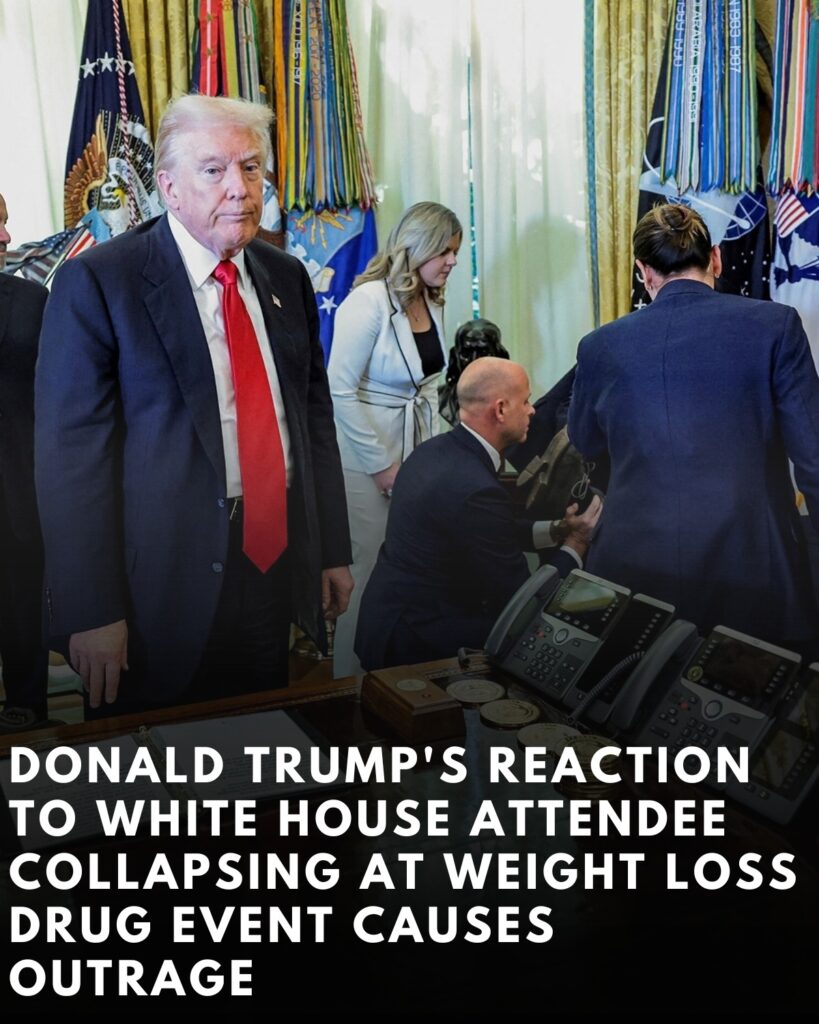
An Oval Office announcement on cutting the cost of weight-loss medicines was briefly halted after a man collapsed just feet from President Donald Trump, prompting staff to usher reporters out as medical personnel moved in and a video clip of the President’s still reaction drew intense scrutiny online. The incident occurred on Thursday as Eli Lilly chief executive David Ricks was speaking during a White House event convened to unveil a pricing and coverage deal with Eli Lilly and Novo Nordisk for GLP-1 drugs such as Wegovy, Ozempic and Zepbound. In live footage, a man standing near the Resolute Desk lost balance and began to fall while those around him, including Dr Mehmet Oz, turned and reached to support him. The White House Medical Unit responded immediately. Karoline Leavitt, the White House press secretary, told reporters shortly afterwards that “a representative with one of the companies fainted,” adding that the medical team “quickly jumped into action” and that “the gentleman is OK.” The briefing resumed later the same day.
The collapse happened during a choreographed set of remarks promoting the administration’s agreement with the two drug makers to bring down list prices and expand access through Medicare, Medicaid and a direct purchase channel branded TrumpRx. Ricks had been outlining the weight-loss initiative when the man faltered. As aides moved toward the back of the room, security instructed the press corps to leave and cut the livestream. Outside outlets later carried short clips that showed the moment of the fall and the hurried response inside the Oval Office. When proceedings restarted, Trump told attendees the man had “got a little bit light-headed” and had been taken to receive care, saying he was “fine.”
Multiple videos published by broadcasters and digital outlets show Dr Oz, who now serves as administrator of the Centres for Medicare & Medicaid Services, rising from his chair and moving toward the man as others eased him to the floor. The White House said the individual was a representative of one of the companies present; his identity was not released. The interruption lasted roughly an hour before the event resumed, with officials reiterating that the person was in stable condition.
The dramatic pause unfolded against the backdrop of a policy announcement the administration has pitched as a signature step on prescription costs. Earlier in the day, the White House had set out a fact sheet detailing headline prices that would, if implemented as described, reduce monthly out-of-pocket costs for popular GLP-1 drugs from around a thousand dollars to figures in the mid-hundreds for cash buyers, with Medicare beneficiaries paying a capped co-pay and new oral formulations expected to debut at lower prices upon approval. Independent reporting by wire services and major outlets summarised the contours of the agreement and the timing of coverage changes and direct-purchase options, with the administration asserting “Most-Favoured Nation” style commitments designed to align U.S. prices more closely with those in other wealthy countries.
The moment of the collapse became the most widely shared clip from the Oval Office, overshadowing the substance of the policy. Several videos captured the President initially seated, then standing behind the desk as aides and guests turned toward the commotion. Online, reaction focused on his expression and bearing during the seconds after the fall, with satirical programmes and partisan commentators highlighting the image of a motionless leader as others rendered aid. The segment was amplified by late-night satire and political figures on social platforms, while supporters pointed to subsequent comments from Oz and the White House indicating that Trump had checked on the situation and allowed medical staff to work. The split mirrored familiar lines of interpretation that have accompanied past viral moments from official events.
Within hours, questions circulated about the identity of the person who fainted. Early captions and social media posts speculated that the individual was a Novo Nordisk executive, a claim the company moved to knock down, saying that only two named representatives were in the Oval Office and that the person who suffered the medical episode was not one of them. Newsrooms that had run the name issued clarifications as the White House stuck to its characterisation of the man as a representative of “one of the companies present,” declining to provide further personal details. The lack of a confirmed identity did little to slow the spread of the video, but it set a clearer official line: the man was a guest at the event, he fainted, and he was later reported to be fine.
The presence of Oz and of Health and Human Services Secretary Robert F. Kennedy Jr. lent additional public profile to the scene. In the moments after the fall, Oz could be seen pivoting to help. Separate footage showed Kennedy moving away from the desk; later accounts from the White House said he left to summon additional assistance while staff and physicians tended to the guest inside the room. The White House’s depiction aligned with broader descriptions from international broadcasters and national outlets that the response was swift and that the event’s stoppage was primarily to clear the room and allow medical assessment.
As attention centred on the collapse, the administration attempted to return focus to the pricing measures at the heart of the gathering. The White House fact sheet and subsequent briefings outlined a suite of promises: Medicare coverage for certain obesity indications, $50 co-pays for eligible beneficiaries, discounted cash prices via a federal portal, and a glidepath for further reductions over two years, with special pricing envisaged for pill formulations pending Food and Drug Administration reviews. Reporting by Reuters and the Associated Press put numbers around the initiative, noting effects for Medicare, Medicaid and uninsured consumers, and flagged the broader political aim to address the cost-of-living pressures that have made GLP-1 affordability a recurring public issue. The companies’ shares moved in the wake of the announcement as analysts weighed implications for revenue and market expansion.
For those in the room, the day’s narrative turned on a sudden medical scare and a fast return to script. After the pause, Trump resumed his pitch and assured attendees and viewers that the person who had gone down was receiving care and would be alright. Leavitt’s line, repeated in statements and in briefings to reporters, remained simple: the White House medical team acted quickly, and the man was okay. A number of outlets carried the same statement verbatim and added that the media had been escorted out at the moment of the fall, consistent with standard practice when an unplanned emergency unfolds in tight quarters around the President.
The episode recalled another fainting incident earlier in the year involving a member of Oz’s family during a separate White House appearance. That, too, was resolved without lasting injury and was used by officials at the time to underline the availability of on-site medical support at high-profile events. Thursday’s occurrence fit that pattern. In contemporaneous clips posted by international broadcasters and local stations, security voices can be heard instructing cameras to stop recording while medical staff moved toward the guest; in one widely circulated piece of audio captured before the feed was cut, a voice can be heard calling out, “Are you OK?” and repeating a given name. From there, the record is supplemented by official statements and the restarted briefing, in which the President recapped events and pressed on with the policy announcement.
Context around the drugs at issue helps explain why the White House had assembled executives and senior health officials for a marquee announcement. GLP-1 medicines such as Wegovy and Zepbound have surged in demand over the past two years, credited in clinical trials with double-digit percentage weight loss and accompanying improvements in cardiovascular risk markers for some patients. Cost and patchy coverage have been the major barriers to uptake, with list prices often above a thousand dollars per month and limitations in payer policies, especially for obesity rather than diabetes indications. By promising direct-purchase channels at lower prices and expanding Medicare coverage with set co-pays, the administration is seeking to widen access while asserting that long-term savings from reduced obesity-related illness would offset public outlay. Whether the model delivers in practice will depend on regulatory timelines for new formulations, the durability of manufacturer commitments and how private insurers respond to government pricing signals.
While officials emphasised policy, the optics of the interruption dominated social media. A compilation segment from a U.S. satirical news show juxtaposed the clip of Trump standing still with commentary accusing him of detachment, a framing amplified by partisan accounts. That portrayal prompted counter-claims from administration allies highlighting Oz’s report that the President followed up and that remaining still in the first seconds of a medical emergency can be appropriate when trained responders are present. The debate illustrated how a brief, ambiguous slice of video can become a proxy for wider arguments about leadership style, even as the underlying facts—an attendee fainted, the White House medical team intervened, and the man was declared okay—were not in dispute by nightfall.
By the end of the day, the official public record consisted of the White House statement describing a fainting episode, the President’s assurance that the guest had become light-headed and was receiving care, and independent footage of Oz and others attending to the man. The policy package that occasioned the event remained on the table, with timelines for coverage changes and pricing milestones set out in administration documents and in wire reports. The individual who collapsed had not been publicly identified, and speculation that a named Novo Nordisk executive was involved was countered by the company’s denial that he was present. With no further medical details released, the account from the White House stood: the man was examined, stabilised and, in the press secretary’s words, “OK.” The larger question, for patients and payers more than for partisans, is whether the day’s headline promise—lower costs and broader coverage for widely sought anti-obesity medicines—will materialise as described once the cameras are off and the rules take effect.