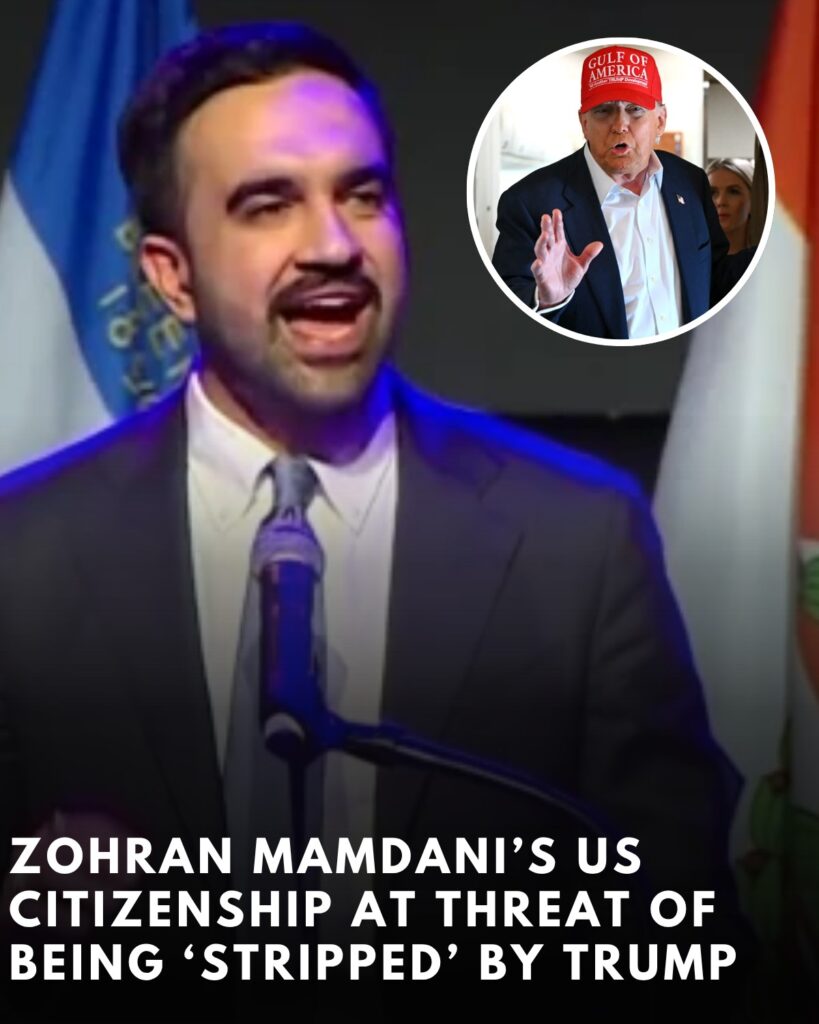
Zohran Mamdani’s historic election as New York City’s next mayor has rapidly escalated into a confrontation over immigration, citizenship and the limits of presidential power, after Donald Trump and allied Republicans suggested he could be arrested, deported and stripped of his United States nationality.
Mamdani, a 34 year old Democratic socialist and state assembly member, won the New York mayoral race after first defeating former governor Andrew Cuomo in the Democratic primary. His victory made him the city’s first Muslim mayor, its first mayor of South Asian heritage, the first born in Africa and the first Millennial to hold the office.
Born in Uganda to Indian parents, Mamdani moved to the United States in 1998 when he was seven and became a naturalised US citizen in 2018. Those basic facts have not been disputed by federal authorities. Yet in recent months his status has been pulled into national politics as Trump and several Republican lawmakers have openly questioned whether he should have been granted citizenship at all.
Trump began intensifying his attacks in the summer, after Mamdani secured the Democratic nomination and pledged to resist federal immigration raids in New York City. In his victory speech, Mamdani had vowed to “stop masked ICE agents from deporting our neighbours,” positioning himself as a firm opponent of aggressive federal immigration enforcement.
Asked at a subsequent press briefing what he would do if a New York mayor attempted to block Immigration and Customs Enforcement operations, Trump replied: “Well then, we’ll have to arrest him.” He also told reporters that the United States did not “need a communist in this country” and said he would be watching Mamdani “very carefully.”
In other remarks, Trump went further, speculating that Mamdani might not be lawfully in the country at all. “We’re going to be watching that very carefully, and a lot of people are saying he’s here illegally,” he said, promising to “look at everything.” The president also used his social media platform to brand Mamdani a “communist” and argued that New York would depend on federal money that he controlled.

Those comments coincided with a campaign on Capitol Hill to challenge Mamdani’s naturalisation. Representative Andy Ogles of Tennessee asked Attorney General Pam Bondi to open an investigation into whether Mamdani had committed naturalisation fraud, alleging that he might have concealed support for terrorism or failed to declare involvement in what Ogles described as communist activities.
Ogles pointed to a 2017 rap lyric in which Mamdani referenced the “Holy Land Five,” a group of men from the Holy Land Foundation charity who were convicted in 2008 of providing material support to Hamas. Supporters of Mamdani and some legal experts have argued that the lyric amounted to political expression, not evidence of material support. Ogles and Florida state representative Randy Fine have also argued that Mamdani’s membership in the Democratic Socialists of America should have been disclosed as communist affiliation.
Immigration specialists say that claim mischaracterises both US law and the organisation itself. The federal naturalisation form asks applicants whether they have ever been members of a communist or totalitarian party. Scholars of US political history note that democratic socialism emerged as a distinct ideology that accepts representative democracy and does not require state ownership of all means of production, unlike traditional communist parties.
PolitiFact, which reviewed the allegations, reported that it found no credible evidence Mamdani lied on his citizenship application. Immigration lawyer Jeremy McKinney told the outlet that denaturalisation is a “rare remedy” that demands proof of either illegal procurement of citizenship or a deliberate, material falsehood that would have changed the outcome of the application. He said he had seen no such proof in Mamdani’s case.
Despite that, Ogles and Fine have framed the push as part of a broader concern about perceived threats from immigrants. Fine has called for a review of “every naturalization of the past 30 years” beginning with Mamdani, arguing that the United States faces an “enemy within” from people who came to the country to “destroy it.” Muslim advocacy groups and Democratic politicians have condemned the rhetoric as racist and Islamophobic.
The Trump administration has not announced any formal legal action against Mamdani but has signalled that it is considering the matter. The Guardian reported that White House press secretary Karoline Leavitt suggested the president was looking at the possibility of stripping Mamdani’s citizenship, following Ogles’s request to the Justice Department.The department has acknowledged receiving the congressman’s letter but there is no public indication of pending denaturalisation proceedings.
Under US law, citizenship can be revoked only by judicial order, either through a criminal case for naturalisation fraud or a civil lawsuit brought by the government. In both scenarios, officials must prove that the person made a false statement or misrepresented a material fact on their application, and that the truth would have led to a denial of citizenship. The civil standard is “clear and convincing evidence,” while criminal prosecutions require proof beyond a reasonable doubt.
Legal academics who study denaturalisation say the bar is deliberately high and the remedy has historically been used sparingly, most notably to remove former Nazis who entered the United States after the Second World War or people associated with terrorism. Cassandra Burke Robertson, a professor at Case Western Reserve University, told Al Jazeera it was “extraordinarily unlikely” that a case against Mamdani would succeed and warned that the larger risk lay in discouraging other naturalised citizens from speaking out for fear of retaliation.
Even so, the Trump administration has signalled a tougher stance on denaturalisation. In June, the Justice Department issued guidance instructing lawyers to prioritise such cases involving alleged national security threats, gang members and other categories officials consider significant.Civil liberties groups argue that combining that policy shift with inflammatory political rhetoric sends an intimidating message to immigrant communities.
Mamdani has responded publicly to the president’s remarks and to the calls for his deportation. In a statement posted on X, he wrote that the president had threatened to have him “arrested, stripped of my citizenship, put in a detention camp and deported,” not for breaking the law but because he refused to allow ICE to “terrorize our city.”He described the statements as “an attack on our democracy” and an attempt to warn New Yorkers that if they speak up, “they will come for you.”
In an interview with MSNBC during the campaign, Mamdani said he believed Islamophobia was “endemic” in US politics and argued that it had been normalised to the point that calling it out was treated as an overreaction rather than a description of reality. He has also insisted that Muslims “belong here in the city,” casting his candidacy and subsequent victory as proof of that claim.
The political backlash has not been limited to questions of citizenship. The New York Young Republican Club has invoked a provision of the Fourteenth Amendment that bars from office individuals who have engaged in insurrection or rebellion or given “aid or comfort” to America’s enemies. The group has argued that Mamdani’s past support for certain Palestinian causes and his pledge to resist immigration raids amount to such aid and comfort and suggested that Congress could vote to declare him ineligible for office. Constitutional scholars note that any such move would face significant legal hurdles and would require a two thirds majority in both chambers of Congress, an outcome they regard as highly improbable.
The rhetoric around Mamdani’s case has unfolded against a broader national debate about immigration enforcement and the treatment of sanctuary cities. Trump has repeatedly attacked local officials who limit cooperation with federal immigration authorities, while his administration has expanded operations by ICE in metropolitan areas such as New York. Tom Homan, a Trump immigration adviser and former acting ICE director, has promised that federal agents will “flood the zone” in New York regardless of local resistance and has urged Mamdani to “get out of the way.”
Supporters of Mamdani argue that the attempt to tie local policy disputes to denaturalisation is a dangerous escalation. Civil rights groups say it risks blurring the line between legitimate political disagreement and accusations of disloyalty, particularly when directed at a Muslim, African born elected official. Organisations such as the Council on American Islamic Relations have described the push to investigate his citizenship as racist and anti Muslim, and several Democratic figures, including New York leaders, have condemned Trump’s threats and voiced support for Mamdani’s right to serve as mayor.
For now, Mamdani is preparing to take office while facing the possibility that federal officials could continue to question his citizenship and his authority as mayor. If his naturalisation were ever revoked by a court, his status would revert to lawful permanent resident, which under US law would disqualify him from serving as mayor of New York City. There is no sign that such a case is imminent, but the threat itself has become a focal point in a wider struggle over who is considered fully American and how far a president can go in targeting political opponents who were born abroad.
Mamdani has said he will not change course. In his public statement responding to Trump’s comments, he framed the confrontation as a test of democratic norms and of the willingness of New Yorkers to stand with communities targeted by immigration enforcement. As he prepares to lead the country’s largest city, the dispute over his citizenship has become a symbol of the tensions surrounding immigration, religion and dissent in contemporary American politics, and of the growing debate over whether the power to grant citizenship can ever safely be paired with the power to take it away.