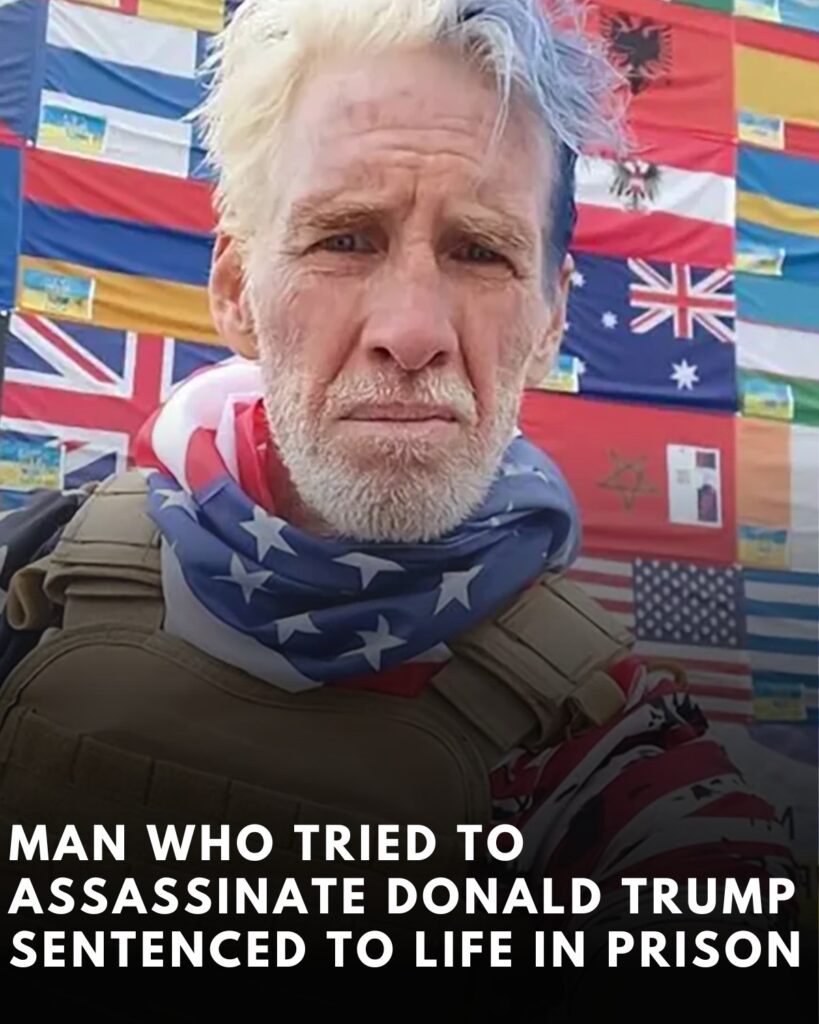
Ryan Wesley Routh, a 59 year old American man convicted of attempting to assassinate former United States president Donald Trump during the 2024 election campaign, has been sentenced to life in federal prison following a case that authorities described as one of the most serious threats to a major presidential candidate in modern US history.
The sentence was handed down on February 4 after a federal jury found Routh guilty on multiple charges stemming from an armed plot to kill Trump while he was playing golf at his private club in West Palm Beach, Florida. The judge imposed a life sentence without the possibility of parole, along with an additional seven years for firearms offences, concluding that the attack was premeditated, meticulously planned, and intended to cause fatal harm.
The attempted assassination took place on September 15, 2024, at Trump International Golf Club, a location frequently used by Trump during the campaign. According to evidence presented at trial, Routh positioned himself in dense shrubbery along the perimeter of the course, armed with a semi automatic rifle fitted with a scope. Prosecutors said he had selected a vantage point that provided a clear line of sight toward areas where Trump was expected to pass during his round.
The plot was disrupted when a United States Secret Service agent conducting a routine security sweep ahead of Trump noticed the barrel of a rifle protruding from the bushes. The agent immediately opened fire, prompting Routh to abandon his position and flee the scene. Law enforcement later recovered the rifle, ammunition, body armour plates, and a camera mounted on a tripod aimed toward the fairway, which prosecutors said was intended to record the attack.
Routh was arrested later that day after being stopped by police several miles from the golf course. Investigators said he was carrying multiple mobile phones and had attempted to discard evidence while fleeing. Subsequent forensic analysis and digital records placed him in the vicinity of Trump’s properties on several occasions in the months leading up to the incident.
Federal prosecutors told the court that Routh had spent months tracking Trump’s movements, studying his public schedule, and preparing for an opportunity to carry out the attack. Evidence presented to jurors included travel records, online searches, handwritten notes, and surveillance equipment, all of which were used to demonstrate intent and long term planning. Prosecutors argued that the attack was not impulsive but the culmination of sustained preparation.
During the trial, Routh chose to represent himself after rejecting multiple court appointed defence attorneys. The judge repeatedly warned him of the risks of self representation, but Routh insisted on conducting his own defence. Court observers described his behaviour as erratic at times, with frequent interruptions and disjointed arguments. He denied intending to kill Trump, claiming instead that his actions were misunderstood, but jurors rejected that account.
The trial was briefly disrupted when Routh attempted to harm himself in the courtroom as the verdict was being read. Court officials intervened immediately, and proceedings resumed after he was restrained and assessed by medical staff. The incident was later cited by prosecutors as further evidence of instability and lack of remorse.
At sentencing, prosecutors said the case went beyond an attempted murder and represented a direct attack on the democratic process. They argued that the assassination of a leading presidential candidate would have plunged the country into chaos and undermined public trust in democratic institutions. The judge agreed, stating that the severity of the crime justified the harshest sentence available under federal law.
The defence requested a significantly shorter sentence, arguing that no shots were fired by Routh and that Trump was never physically harmed. The judge rejected that argument, noting that the only reason the attack failed was the vigilance of the Secret Service. She said the law did not require a bullet to be fired for an attempted assassination to occur, only intent and a substantial step toward carrying it out.
Investigators also introduced evidence of a handwritten letter written months before the attack in which Routh described his desire to kill Trump and apologised in advance for potentially failing. Prosecutors said the letter, which was recovered during the investigation, removed any doubt about motive or intent. The judge cited the letter as particularly compelling evidence during sentencing.
Routh’s background was examined extensively during the proceedings. Born in North Carolina in 1966, he had lived in several states and spent time abroad. Court records showed no consistent employment history in recent years. He had no previous convictions for violent offences but had a history of unstable behaviour and fixation on political grievances. Prosecutors said his actions reflected radicalisation driven by personal beliefs rather than membership in any organised group.
The attempted assassination came during an already volatile period in the 2024 US election cycle. Earlier that year, Trump had survived a separate shooting incident at a campaign rally in Pennsylvania, where a bullet grazed his ear. That incident heightened security concerns nationwide and prompted a review of protective measures for political candidates.
Following the Florida incident, the Secret Service increased security protocols around Trump and other high profile figures. Senior officials later said the agent who spotted the rifle acted in accordance with training and prevented what could have been a catastrophic event. The agency has not disclosed further operational details, citing security concerns.
The case also had wider legal consequences beyond the attempted assassination itself. During the investigation, federal agents searched properties linked to Routh and his family. In a separate and unrelated case, his adult son was later charged and convicted on child exploitation offences uncovered during those searches. Authorities stressed that those charges were not connected to the assassination plot but arose from evidence discovered during lawful searches.
Throughout the proceedings, Trump did not attend court but was kept informed by security officials. He later issued brief public remarks praising law enforcement for preventing the attack and reiterating his confidence in the justice system. His campaign declined to comment on the sentence beyond acknowledging the outcome.
The life sentence brings to a close one of the most closely watched federal criminal cases of recent years. Justice Department officials said the outcome sent a clear message that political violence would be met with the strongest possible response. They described the sentence as necessary to protect public officials and preserve democratic stability.
Routh will spend the remainder of his life in federal custody, with no eligibility for parole. He was transferred immediately following sentencing to a high security facility. Officials said there was no indication of additional co conspirators and that the threat associated with the case had been neutralised.
As the United States continues to grapple with rising political tensions, the case has become a reference point for the dangers facing public figures and the challenges of safeguarding democratic processes. Authorities said the prevention of the attack underscored the importance of intelligence sharing, vigilance, and coordinated security efforts in an increasingly polarised environment.