
For much of his adult life, Donald Trump Jr. has existed in a complicated public space.
To supporters, he was the loyal heir—outspoken, combative, unapologetically aligned with his father’s worldview. To critics, he was often reduced to a predictable extension of a larger political machine, loud but derivative, visible yet somehow still standing in someone else’s shadow.
That perception did not change overnight.
It changed in a single moment.
The setting was a private gathering held in a room defined by opulence and discretion. Gilded walls reflected the glow of chandeliers. Music drifted softly through the air. It was the kind of evening where reputations were protected by politeness and disagreements were buried beneath practiced smiles.
Donald Trump Jr. was not the focus of the room. He rarely was. Conversations flowed past him, not toward him. He listened more than he spoke, observing with a restraint few expected from someone so accustomed to public confrontation.
Then a comment was made.

It was not delivered loudly, nor intended for the entire room to hear. It carried the casual confidence of someone who assumed agreement—the kind of remark shaped by years of headlines, caricatures, and assumptions about Donald Trump. It was dismissive. Distorting. Familiar.
For a brief moment, nothing happened.
Then Donald Trump Jr. spoke.
“You don’t get to say his name like that.”
The sentence cut through the room with surgical precision.
He did not raise his voice. He did not gesture. He did not seek attention. Yet the effect was immediate. Laughter stopped. Conversations dissolved. Even the faint clink of crystal glasses seemed to hesitate, as if the room itself had recognized a shift.
All eyes turned toward him.
He stood tall, leaning slightly forward, his expression composed but unmistakably firm. There was no anger in his posture—only resolve, forged quietly over years spent watching narratives form and harden without challenge.
“You mistook silence for weakness,” he continued, his tone steady, controlled. “You turned loyalty into distortion. Conviction into scandal. You decided who he was without ever listening.”
The air grew heavy.
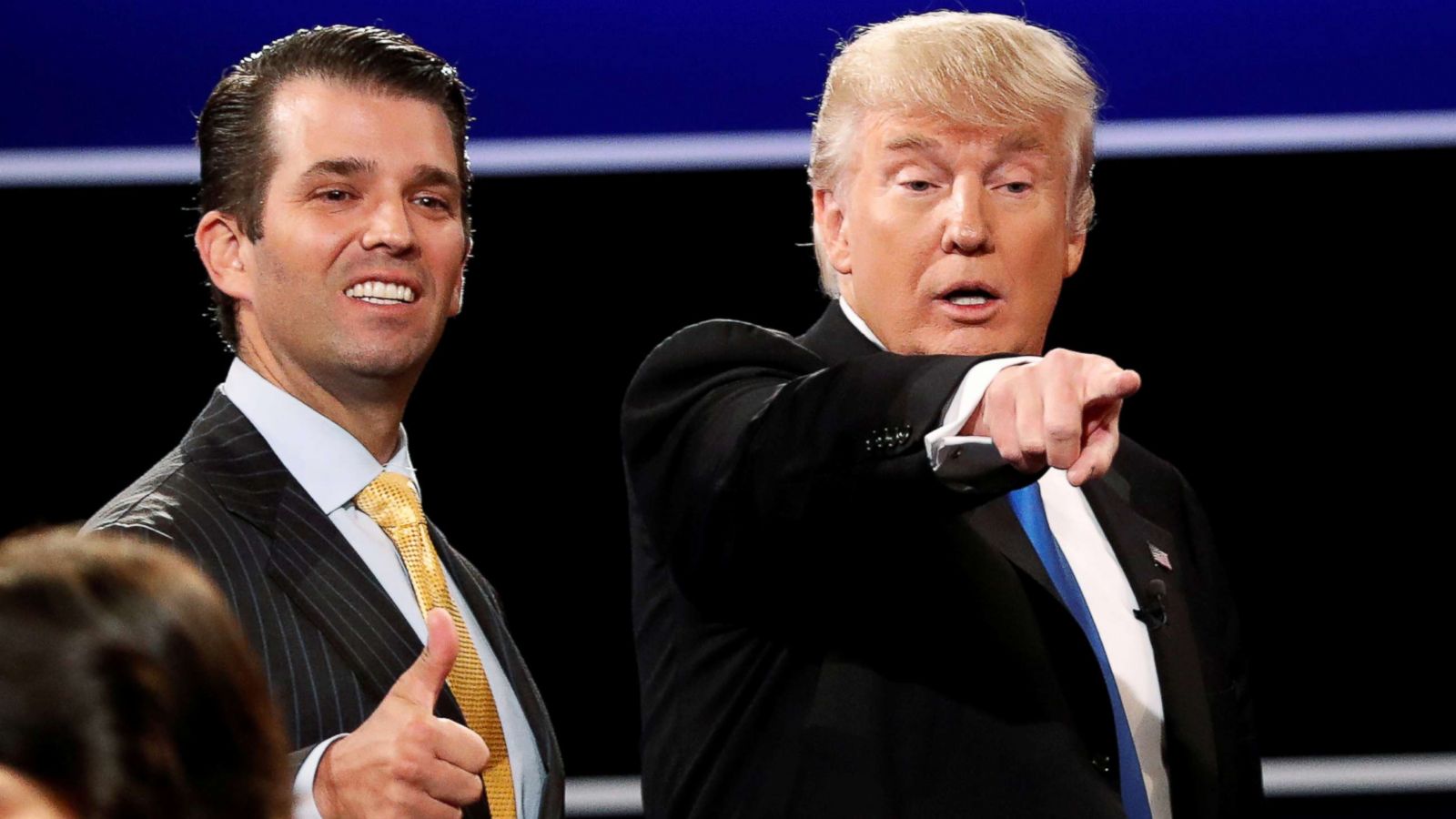
A musician faltered. Someone’s hand tightened around a glass. This was no longer a casual exchange. An invisible boundary had been crossed, and everyone in the room knew it.
Across the space, Donald Trump looked up.
Those who noticed later described the moment as subtle but striking. His expression did not change dramatically, yet something in his posture shifted—attention sharpening, presence fully engaged. For a fleeting second, the usual rhythm of the room seemed to slow, as if time itself needed to recalibrate.
Donald Trump Jr.’s voice softened then, but the steel beneath it remained intact.
“I was raised by a man who never bent to the noise,” he said. “He didn’t hide us from pressure. He prepared us for it. He taught us how to stand our ground.”
Silence followed.
Not the awkward kind that demands relief, but the deliberate kind that settles when something irreversible has just occurred. No one interrupted. No one laughed it off. The room held still, absorbing the weight of what had been said.
For years, Donald Trump Jr. had been viewed as a constant presence—visible, vocal, yet rarely taken seriously as his own force. He was assumed to be reacting, echoing, amplifying. That night, something changed.
This was not reaction.
It was declaration.

He finished speaking and stepped back, offering no explanation and seeking no applause. He did not demand an apology. He did not linger. The message had been delivered, and it did not require reinforcement.
The atmosphere that followed was noticeably altered. Conversations resumed cautiously, voices lowered, laughter restrained. The evening continued, but the emotional center had shifted. Something raw and unscripted had cut through the polished surface.
For those present, the moment lingered long after the gathering ended.
In the days that followed, guests would replay the exchange in their minds. Some framed it as loyalty. Others saw it as a boundary finally enforced. Nearly all agreed on one point: Donald Trump Jr. had stepped into a role that could no longer be dismissed as secondary.
He was no longer simply the son reacting to attacks on a powerful father. He was a man articulating his own line—clear, firm, and unmistakable.
For Donald Trump, the moment carried its own quiet significance.
He has spent decades commanding rooms, shaping narratives through volume, momentum, and confrontation. That night, he did none of that. He did not interrupt. He did not escalate. He watched as his son spoke—not as a proxy, but as an independent voice formed under pressure.
It was a generational moment, unfolding without ceremony.
No cameras captured it. No transcript recorded the exact wording. Yet its impact was undeniable.
In a culture saturated with noise, outrage, and performance, the power of that moment lay in its restraint. Donald Trump Jr. did not shout to be heard. He did not provoke to dominate. He spoke once, clearly, and allowed silence to do the rest.
The man often described as predictable, partisan, and loud was gone.
In his place stood someone unmistakably present—grounded, deliberate, unapologetic.
The tolerance that had defined years of quiet observation ended in that instant. Not to provoke attention, but to close a narrative that no longer belonged to others.
The shadow had lifted.
And what emerged was not an echo—but a storm that chose its moment carefully, and made it count.