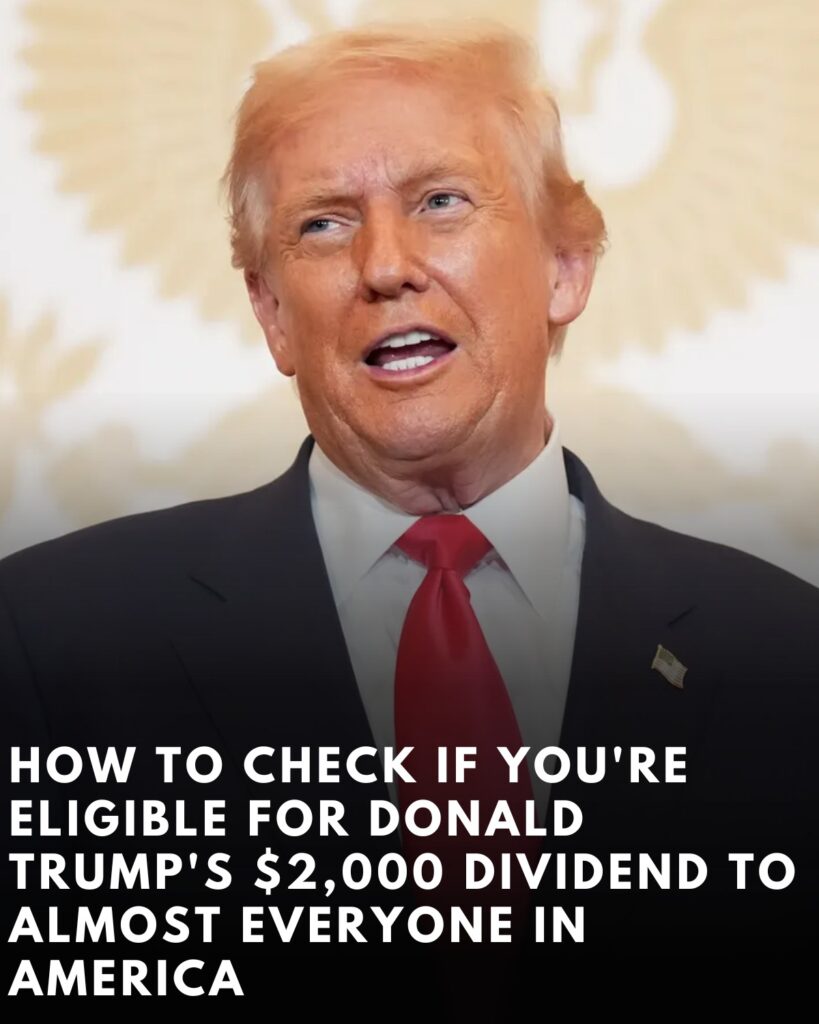
President Donald Trump has said that most Americans will receive a cash “dividend” of at least $2,000 funded by federal tariff revenues, a promise he made in a burst of posts on his Truth Social account over the weekend as his administration defends the legality of its sweeping trade measures and faces questions about how such payments would be structured or approved.
In the posts, the president framed tariffs as a central pillar of his economic program and directly attacked critics, writing: “People that are against Tariffs are FOOLS!” He added that the United States is “taking in Trillions of Dollars” from the levies and said that “a dividend of at least $2,000 a person (not including high-income people!) will be paid to everyone,” without specifying when the payments would be made or how “high-income” would be defined. The messages repeated his broader claims about record stock market levels, strong retirement accounts and rising domestic investment.
The proposal—described variously by the president and allies as a “dividend,” “rebate” or “check”—has appeared intermittently in Trump’s public remarks since midsummer and resurfaced in more definitive language this month. The White House has not released a policy paper, legislative text or timeline for implementation, and the president’s aides have offered differing descriptions of what form any benefit might take. Treasury Secretary Scott Bessent has acknowledged the idea in media interviews but suggested that any “dividend” could be delivered through tax relief rather than a direct cash transfer, such as eliminating or reducing taxes on tips or overtime.
The lack of formal details leaves basic questions unanswered. The president’s posts say the payment would go to “everyone” except high-income households, implying a broad-based benefit similar to the pandemic-era Economic Impact Payments that were distributed in 2020 and 2021. But there has been no statement on the income thresholds, phase-outs, eligibility for dependents or non-filers, or whether the Internal Revenue Service would use tax returns or another system to verify recipients. The administration has also not addressed whether Congress would be asked to authorize and appropriate funds, or whether the White House believes existing authorities—via tariff statute or emergency powers—could be used to finance the payments without new legislation.
Trump links the proposed payment to the money the government collects at the border when importers pay tariffs. In his posts he argued that those receipts are so large that they will not only finance household payments but also help reduce the national debt, which he pegged at roughly $37–38 trillion. Publicly available figures suggest a more complicated picture. Estimates reported by mainstream outlets indicate tariff collections in 2025 have been substantial—measured in the hundreds of billions of dollars—but remain well below the amounts required to fund a $2,000 payment to most Americans once income limits are applied. Independent tallies cited by economists and budget analysts place the likely gross revenue far short of the $300 billion-plus that a nationwide payment would cost, and net revenue would be smaller once tax interactions and refunds are considered.
The president’s tariff regime itself is in flux. The Supreme Court heard arguments last week on challenges to his use of emergency authority to impose broad, across-the-board levies, a case that could determine the scope of a president’s power to set trade barriers without explicit congressional approval. Some coverage has noted that if key elements of the program are struck down, the government could be required to unwind portions of the tariffs or issue refunds to importers—developments that would further complicate any plan to convert tariff proceeds into household checks. The administration, meanwhile, has insisted that the tariffs are essential to its economic strategy and has characterized judicial scrutiny as a test of presidential authority.
The idea of distributing tariff revenue to households is not entirely new in Washington. Senator Josh Hawley previously floated a smaller “American Worker Dividend” that would rebate a portion of tariff proceeds—on the order of several hundred dollars per person—to help offset higher consumer costs. Trump’s latest posts envision a significantly larger sum and a broader recipient pool. While the White House has not tied the proposal to specific legislation, the president’s language frames the payout as a direct return to citizens from trade measures he says have driven investment and strengthened domestic manufacturing.
The promise comes at a politically charged moment. Trump’s declaration appeared amid a shutdown fight in Washington and on the heels of a weekend at his Florida residence that drew criticism from opponents as federal employees and contractors braced for delayed pay. The posts suggested urgency—“will be paid,” he wrote—yet avoided a calendar, enforcement mechanism or budget line. For Americans, the ambiguity has fostered both anticipation and scepticism on social media, where users asked how eligibility would work and whether the statements would translate into legislation or executive action.
Economists and tax experts have highlighted practical hurdles. Even if tariff collections were set aside for household transfers, the U.S. budget process would require Congress to authorize spending or create a statutory mechanism to earmark those receipts. Analysts also point out that tariffs tend to act as a tax on imports that businesses can pass through to consumers via higher prices, complicating the claim that they create “free” money for redistribution. During the pandemic, three rounds of stimulus checks were financed through borrowing approved by Congress and cost hundreds of billions of dollars; any new program of similar scale would face comparable fiscal trade-offs.
Supporters of the proposal argue that a one-time “dividend” could provide immediate relief to households facing high living costs and would visibly link Trump’s trade policy to a concrete benefit. They also note that any income cap would channel payments toward low- and middle-income families, magnifying the marginal effect on spending. Critics counter that repeated references to “trillions” in tariff revenue overstate actual collections and that using those receipts for broad transfers would be difficult while litigation is pending. Bessent’s suggestion that the benefit might arrive as tax relief rather than checks underscores the fluidity of the proposal’s design and the possibility that the administration could pivot toward measures Congress has previously considered, such as exclusions or credits for certain categories of income.
The White House has not offered clarifications on administrative logistics should a cash payment move forward. During past federal relief efforts, the IRS relied on tax-return data and, in some cases, Social Security records to direct payments via direct deposit or mailed checks, supported by substantial appropriations for agency staffing and technology. Absent legislation, it is unclear what data source or federal pipeline the administration would use, what agency would operate the program, how fraud would be managed, and how Americans who do not typically file taxes would be reached. Those operational questions grow more pointed the longer the policy remains a social-media pledge rather than a formal proposal.
The president’s rhetoric presents the plan as a straightforward return of funds to citizens, but the composition of tariff revenue is complex. Collections depend on the volume and mix of imports, the precise schedules for different products and countries, exemptions and waivers granted to specific industries, and the behaviour of supply chains adapting to the levies. Industry groups have warned that volatile import flows and court-ordered refunds could shrink or delay revenue, while budget analysts say that the net fiscal gain from tariffs is not equal to gross collections because of offsetting effects in the tax code. Those caveats, raised by outside experts in recent coverage, illustrate why precise cost and funding comparisons remain contested even among specialists.
Trump’s message nonetheless drew immediate attention because of the headline figure and the echoes of the pandemic-era checks that arrived in household bank accounts. The $2,000 number exceeds the size of individual payments in most earlier rounds of relief, and the promise that “most Americans” would qualify suggests a scope wide enough to touch tens of millions of households. While the president has frequently emphasized the tariffs’ role in his economic agenda—arguing they protect U.S. production and strengthen leverage in international negotiations—the pledge to redistribute proceeds frames the trade regime in populist terms, as a tool to deliver direct financial benefits rather than simply reshape industrial incentives.
For now, the only specifics are those in the Truth Social statements. They say the dividend would be “at least” $2,000, that “high-income people” would be excluded, and that the payments would be justified by the scale of tariff revenue and the broader health of the economy. They also fold the pledge into a broader defence of presidential authority over trade, a question that is currently before the courts. Until the administration publishes a formal plan or Congress advances legislation, the pledge remains a political statement—clear enough to be understood by voters but not yet accompanied by the legal or financial architecture that would turn it into policy.
The debate unfolding around the posts illustrates the intersection of fast-moving social-media communication and the slower, rule-bound processes of federal budgeting and lawmaking. Trump’s supporters see a simple proposition: tariffs bring in money; that money should be shared with the public. The legal and fiscal backdrop points to a more involved path, one that will require the administration to reconcile the revenue projections in the president’s messages with actual collections, and to map a payment design onto a statutory framework that can withstand court challenges. As those steps play out—through court rulings, agency guidance or legislative negotiations—the promise of $2,000 “for almost everyone” remains a prominent, if still provisional, marker of the administration’s economic message.
In the absence of official guidance, Americans looking for concrete information about timing or eligibility have little more than the president’s words. The administration has not named an agency lead, announced an application process, or indicated whether any payments would be automatic. Bessent’s remarks suggest the White House could test multiple delivery mechanisms, from direct payments to targeted tax changes, but each would need legal grounding and administrative capacity. With the Supreme Court weighing elements of the tariff framework and fiscal analysts questioning the revenue math, the political stakes are high: a successful rollout would translate a signature trade policy into a visible household benefit; a stalled or scaled-back version could turn the $2,000 figure into another polarising flashpoint.
What is certain is that the pledge has vaulted tariffs—typically a technical issue of customs schedules and trade law—into a front-page promise of household cash. Whether that promise becomes a check, a tax change or a talking point will depend on events outside a social-media feed: the Supreme Court’s ruling, the administration’s ability to present a plan, and Congress’s willingness to write it into law. Until then, the proposal sits where it began, in a viral post from the president declaring that opponents of tariffs are “fools” and that a $2,000 dividend is on the way.