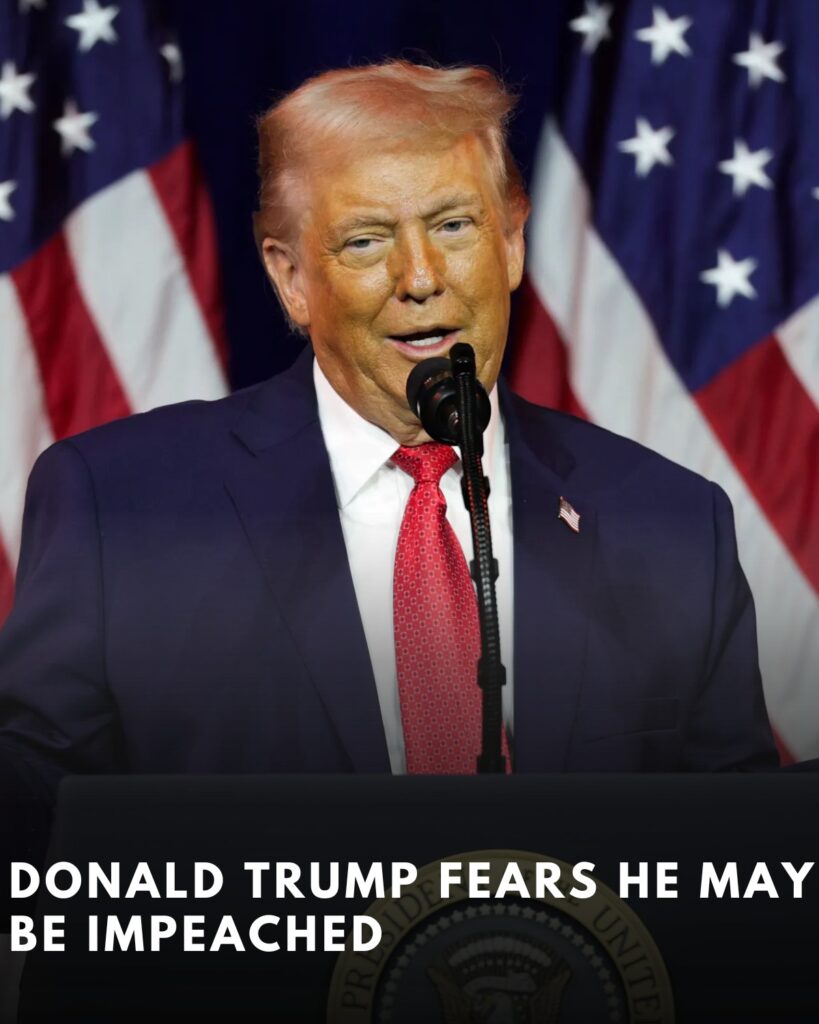
US President Donald Trump warned Republican lawmakers that he believes he would face a third impeachment if the party loses control of Congress in the 2026 midterm elections, using an address to House Republicans to press for unity as his agenda heads toward a major political test in November.
Speaking at a Republican retreat in Washington, Trump told lawmakers that retaining the House majority was critical to preventing Democrats from launching impeachment proceedings. “You gotta win the midterms ’cause, if we don’t win the midterms, it’s just gonna be I mean, they’ll find a reason to impeach me,” Trump said. “I’ll get impeached.”
Trump’s remarks came as every seat in the House of Representatives and a third of the Senate will be contested in November, with control of both chambers expected to determine whether his administration can continue to pass legislation with limited internal resistance, or whether it could be slowed by investigations and legislative roadblocks. Republicans currently hold a narrow majority in the House, a margin that has left party leaders repeatedly dependent on near-unanimous attendance and fragile compromises to advance legislation.
The midterm elections have historically been difficult for incumbent presidents. Trump acknowledged that pattern in his speech, telling lawmakers the political dynamic was hard to explain even when a president believes his policies are popular. “They say that when you win the presidency, you lose the midterm,” Trump said. “I wish you could explain to me what the hell’s going on with the mind of the public.”
The retreat was held at the John F. Kennedy Center for the Performing Arts in Washington, an institution created by Congress and long tied to official civic events in the capital. Reuters reported that Trump delivered an unstructured speech lasting about 84 minutes, ranging across politics and his personal reflections.
In his pitch to lawmakers, Trump urged Republicans to present a unified message on several issues he has used repeatedly as campaign themes, including what he described as “election integrity,” healthcare, and gender-related policies. He also prodded members of the House conference to put aside internal disagreements that have periodically threatened party cohesion in close votes.
Trump made only limited public remarks during the retreat about cost-of-living pressures, despite those issues often dominating voter concerns in election years. Reuters reported he said Republicans should argue that inflation was inherited from Democrats and point to strong gains in US stock markets, while he otherwise spent more time pressing lawmakers to sharpen messaging on culture and social issues.
The president’s comments about impeachment also followed renewed debate in Washington over the scope of executive power and the ability of Congress to act as a check on the White House. Reuters reported that Trump has moved to expand his capacity to act unilaterally in areas including immigration, military action and federal regulation, and that he faces an upcoming Supreme Court ruling related to his use of tariffs and the constitutional separation of powers.
Trump was impeached twice during his first term, each time by a House controlled by Democrats, and acquitted by the Senate. In 2019, he was impeached over his Ukraine policy. In 2021, he was impeached after the January 6 attack on the US Capitol by his supporters, with Democrats accusing him of incitement in the aftermath of his false claims about the 2020 election. The Senate did not convict him in either trial.
The Constitution gives the House of Representatives the power to impeach federal officials for “treason, bribery or other high crimes and misdemeanors,” and assigns the Senate the responsibility to hold a trial. A president can be removed from office only if two-thirds of senators vote to convict. No US president has ever been removed by Senate conviction, though Richard Nixon resigned in 1974 before the House voted on articles of impeachment related to Watergate.
In raising the prospect of impeachment again, Trump suggested Democrats would pursue the process for political reasons if they regain control of the House. Al Jazeera reported that some Democrats have previously called for impeachment over alleged misconduct, including disputes about military actions and the extent of congressional authorisation, though any proposals would be unlikely to advance while the party remains in the minority.
Reuters reported that some House Democrats have already introduced articles of impeachment related to Trump’s second term, accusations that the White House has denied. The report also noted that Trump’s relationship with the House Republican conference remains central to his ability to govern, with lawmakers often deferring to his priorities, while occasional signs of independence have appeared on specific legislative fights.
In the same speech, Trump predicted his party would beat the usual midterm pattern and achieve what he described as an “epic” victory. “We’re going to make history and break records with the epic midterm victory that we’re going to pull off,” he said, according to Al Jazeera.
But he also voiced frustration with what he portrayed as political headwinds and the discipline of the opposition. He contrasted Republican internal disputes with Democratic unity, and complained about the public mood despite what he described as superior policy. Al Jazeera reported he said: “I wish you could explain to me what the hell is going on with the mind of the public, because we have the right policy,” before adding: “They [Democrats] have horrible policy. They do stick together.”
The timing of Trump’s warning also intersected with a week of heightened political focus on the anniversary of the January 6 attack, which continues to shape debates about political violence and accountability in the United States. Reuters reported that Trump made only brief mention of the 2021 attack during his remarks, while Democrats marked the anniversary by accusing Republicans of attempting to downplay the events.
Trump’s message to House Republicans placed the midterms at the centre of both his political survival and his legislative ambitions. A loss of the House would hand Democrats the committee gavels and subpoena powers that typically come with a majority, providing a pathway to investigations and potentially impeachment proceedings, even if conviction in the Senate would still require a two-thirds vote.
For Republicans, the president’s comments underscored how tightly November’s election results could shape the remainder of his term. With narrow margins in Congress, a small shift in seats could determine whether his party can continue passing legislation and blocking Democratic initiatives, or whether the administration faces a hostile House ready to scrutinise its actions, revive impeachment debates and restrict the president’s room for manoeuvre.