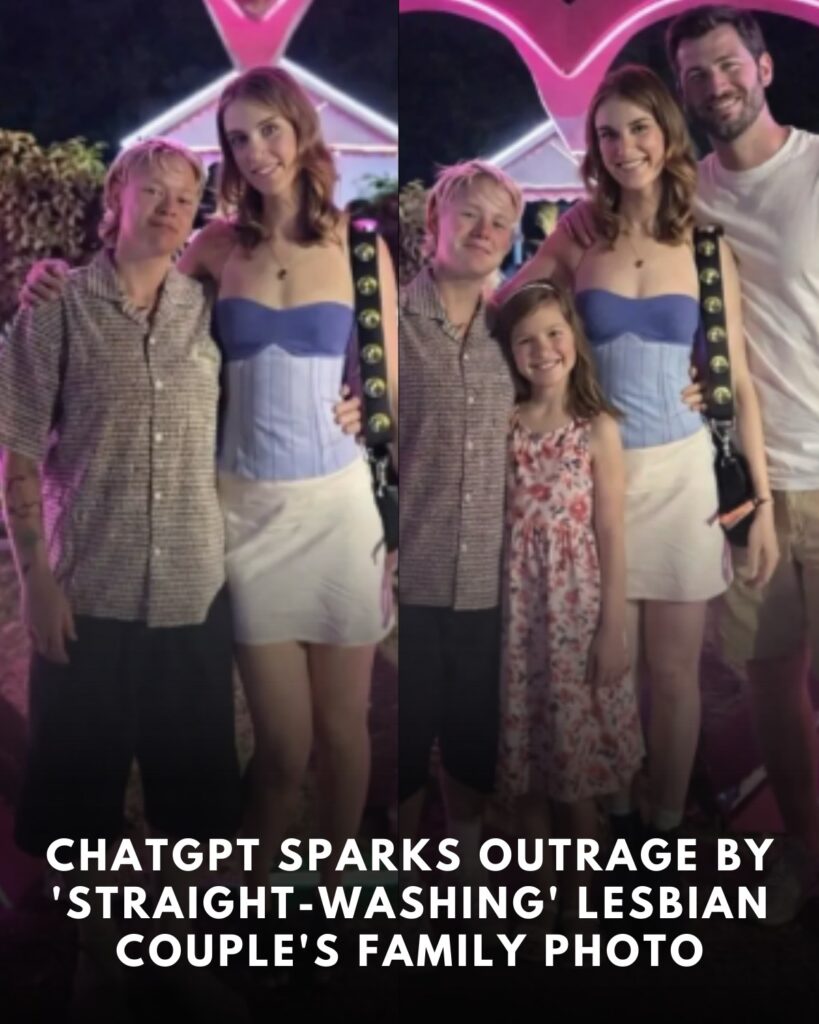
A viral social media post showing a lesbian couple’s attempt to use ChatGPT to imagine a future family has triggered a wider debate about how generative AI handles gender, sexuality and the idea of what a family is supposed to look like. In the image shared online, the original photo showed two women standing together, while the AI-generated result produced a more conventional family portrait that included a man and a young girl, turning what appeared to be a same-sex couple into a heterosexual family unit. Reposts of the image described it as an example of AI “defaulting” to a straight household rather than reflecting the relationship it had been given.
The story spread because it sat at the intersection of two fast-moving online trends. One is the growing use of AI image tools to create stylised portraits, romantic pictures and “future family” scenes from uploaded photos. Another is the tendency for those same tools to produce results that can feel uncanny, overly polished or conceptually wrong even when the source material is straightforward. In this case, the problem was not an extra finger or a distorted face. It was the fact that the generated picture appeared to rewrite the couple’s relationship itself, replacing one of the women with a male partner and presenting a family structure the users had not asked for. Reposts describing the incident said the system included a man who was not part of the relationship at all.
That made the image more than just another amusing AI mishap. Family photographs, whether real or synthetic, carry emotional weight. They are often used to represent love, identity, aspiration and belonging. When a user uploads a couple photo and asks a model to imagine children or a future household, the request is intensely personal even if it is made as part of a light-hearted trend. A result that inserts a father into a family built around two mothers can be read as a technical error, but it can also land as something more pointed, especially for users who already feel that their relationships are underrepresented or misunderstood in mainstream culture. The widely shared captions around the image framed it that way, describing the outcome as a failure to reflect the couple’s real family.
The broader concern is not speculative. UNESCO said in 2024 that its study of major large language models found “worrying tendencies” toward gender bias, as well as homophobia and racial stereotyping. The organisation said women were associated far more often with words such as “home”, “family” and “children”, while male names were more commonly linked to “business”, “executive”, “salary” and “career”. UNESCO said the study showed “unequivocal evidence of bias against women” in generated content and warned that even small biases could amplify inequalities when tools are used at scale in everyday life.
The US National Institute of Standards and Technology has also warned that bias in AI is not simply a glitch that can be erased with a patch. In its framework on managing bias in artificial intelligence, NIST said bias is neither new nor unique to AI and that it is “not possible to achieve zero risk of bias” in an AI system. It identified systemic, statistical and human sources of bias, and said these problems can chip away at public trust if they are not measured, understood and managed properly. That helps explain why an image like this can resonate so quickly. People are not only reacting to one odd picture. They are reacting to the sense that a machine has reproduced a familiar social assumption and done so with apparent confidence.
Generative image tools are now built for exactly this kind of task. OpenAI’s developer documentation says its image systems can generate pictures from text prompts and edit existing images using new instructions, with support for image inputs inside multi-step conversations. OpenAI has also promoted newer image models as being more accurate, more context-aware and better at following instructions and transforming uploaded images. That promise is a major part of why users try intimate prompts involving family, children and future life scenarios. The appeal lies in the idea that the model will not simply make a pretty picture, but will understand the social meaning of the scene it is being asked to create.
What happened in the viral lesbian-couple image suggests how fragile that promise can still be. Generative systems do not “understand” families in a human sense. They infer patterns from training data, prompt wording, image cues and probabilities. When those systems are asked to fill in gaps, they can lean on dominant visual conventions rather than the specifics a user thinks are obvious. In a culture where stock imagery, film, advertising and historical photo archives have long centred heterosexual couples as the default family unit, the model can end up reproducing that bias in a way that feels less like creativity and more like correction. UNESCO’s warning that generative systems can encode regressive stereotypes is directly relevant to that kind of failure.
The incident also says something about the speed with which AI mistakes now travel. A family image that might once have been shared privately between friends can now be reposted across Facebook, Instagram, Threads and X within hours, stripped of context and turned into a talking point about politics, technology or culture. Some users treated the image as funny. Others treated it as evidence that AI tools remain deeply shaped by assumptions about what is normal, legible or desirable. Because the picture concerned sexuality and parenthood, the reactions were sharper than they might have been for a more generic visual error. The image did not just get the composition wrong. For many viewers, it got the family wrong.
That is why the story has endured beyond the usual lifecycle of a viral AI joke. It highlights a tension that is likely to grow as image generators become more common in everyday life. These tools are marketed as personal, expressive and precise. They invite people to imagine weddings, babies, old age, holidays and family memories that do not yet exist. But when the systems behind them still rely on patterns shaped by old stereotypes, they can produce images that feel not imaginative but reductive. The viral post involving the lesbian couple became a flashpoint because it showed, in one glance, the gap between what users mean when they ask AI to picture their future and what the technology may still assume that future ought to be.