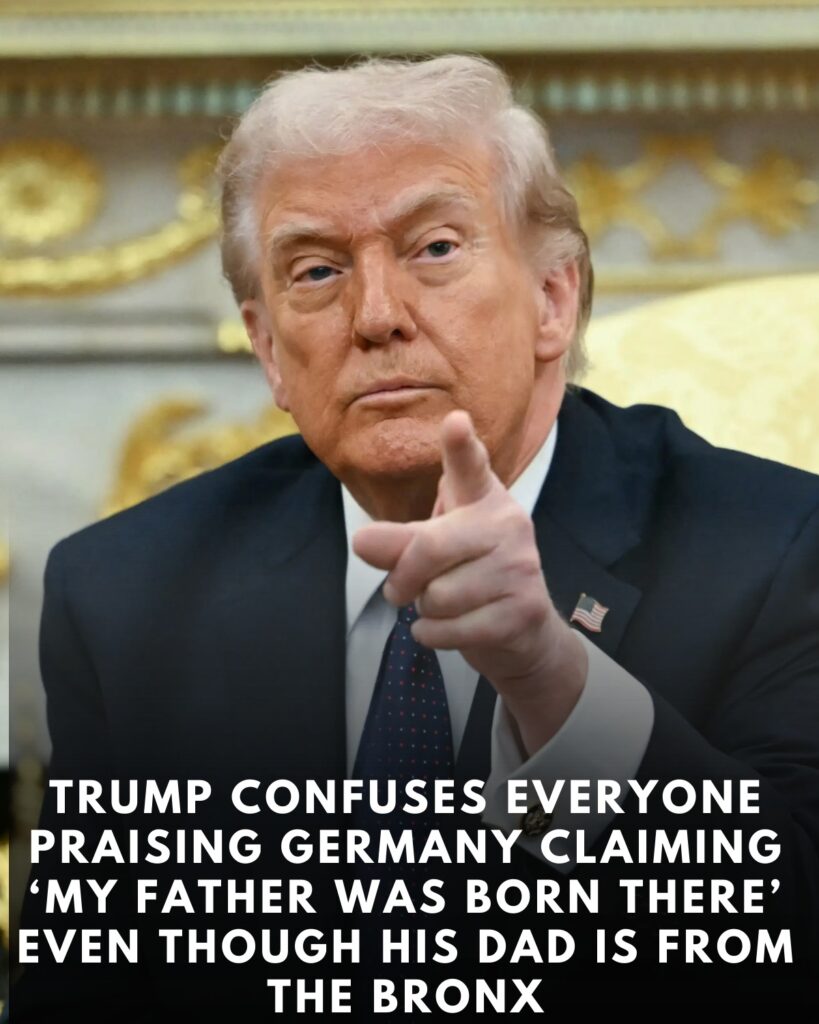
Donald Trump has prompted fresh questions about his family background after remarks made during a White House meeting with Germany’s new chancellor, Friedrich Merz, in which the US president appeared to suggest his father was born abroad.
The comments came as Trump hosted Merz for talks that ranged from trade to security and the war in Ukraine. At one point in the Oval Office exchange, Trump spoke about his personal connection to Europe and said: “My mother was born there. My father was born there.”
The remark quickly drew attention because Trump’s father, Fred Trump, was born in New York City. Biographical accounts record Frederick Christ Trump’s birth in 1905 in the Bronx, before he grew the family’s property business in New York’s outer boroughs.
The confusion has also revived scrutiny of Trump’s past descriptions of his family history. Trump has previously claimed that his father was born in Germany, despite the documented US birthplace.
Fred Trump’s parents were German immigrants. His father, Frederick Trump, was born in Kallstadt in what is now Germany and emigrated to the United States, later returning to New York in 1905 after authorities in Bavaria ordered him to leave Germany. Accounts of the family’s movements note that Fred Trump was born later that year in the Bronx.
Trump’s mother, Mary Anne MacLeod, was born in Scotland and moved to the United States as a young adult before marrying Fred Trump in the 1930s.
The episode unfolded against a wider backdrop of diplomatic friction and high-stakes messaging from the White House. During the same stretch of conversations around the Merz visit, Trump also took aim at Spain over defence and trade disputes, threatening sweeping economic retaliation.
Spanish Prime Minister Pedro Sánchez has resisted pressure over military cooperation and has argued against being pushed into decisions by fear of US reprisals, saying Spain would not “be complicit in something that is bad for the world” and contrary to its interests.
The family-history remark has mattered politically because it touches on a theme Trump has long used in public life: presenting himself as a figure with a personal link to Europe while promoting nationalist policies at home. His supporters have often treated such references as rhetorical flourishes, while critics have argued they show a pattern of loose language about basic facts, including those involving his own biography. (People.com)
In this case, the record is clear that Trump’s paternal line is rooted in Germany through his grandfather, not his father. Sources describing the Trump family’s genealogy consistently place Fred Trump’s birth in New York, while documenting his parents’ German origins and the family’s return to the United States in 1905.
Trump has not issued any formal clarification about what he meant in the Oval Office exchange, and the White House did not immediately provide an explanation in the publicly available readouts of the meeting. But the remark has nonetheless become a flashpoint in a news cycle already dominated by questions about alliances, trade pressure, and the language used by leaders in the middle of diplomatic negotiations.