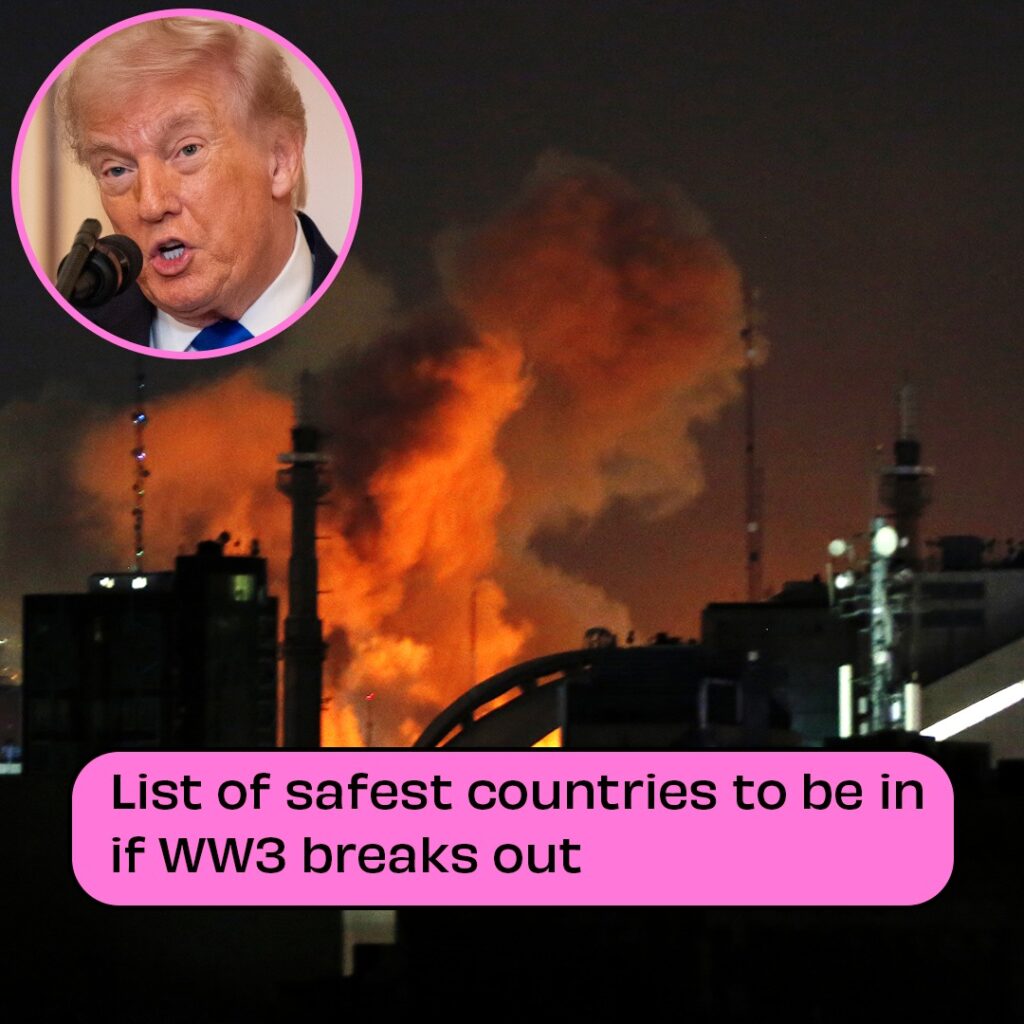
The joint attacks by the United States and Israel on Iran killed Supreme Leader Ayatollah Ali Khamenei, set off retaliatory strikes across the region and sent shockwaves well beyond it.
Violence spread on Sunday (1 March), reaching more locations as the death toll climbed.
The joint US-Israeli strikes on Iran, which started on Saturday (28 February), stoked fears of a wider war and damage to the world economy, with global reaction ranging from jubilation to condemnation.
Given the current political climate, many have been left wondering where the safest country would be if WW3 did break out following this weekend’s events.
Experts tend to prioritise political neutrality, low militarisation and geographic isolation as markers of safety, and according to the Institute for Economics & Peace, the top peaceful nations share traits like strong institutions and low conflict involvement.
With that said, however, such experts have made clear that ‘safe’ is relative, as even the most peaceful countries would be affected by fallout from a world war, especially if nuclear weapons were involved.
Antarctica
Antarctica is the most remote continent on Earth, uninhabited except for research stations and far from strategic military targets.
Its isolation and lack of permanent population make it unlikely to be directly involved in conflict, per the Economic Times India.
Iceland
Iceland has been ranked number one on the 2025 Global Peace Index for its minimal militarisation and absence of conflict for decades, per Forbes.
This marks the 17th consecutive year that Iceland has held the top position since the index began in 2008, the BBC adds.
Analysts point to Iceland’s small population and stable society as key safety factors.
New Zealand
Far from major power blocs and conflicts, New Zealand ranks high on peace indices and is seen as geographically sheltered.
Some analysts say its agricultural self-sufficiency and terrain would offer resilience in global turmoil, Forbes outlines.
Annie Jacobsen explained on the Diary of a CEO podcast that New Zealand and Australia are likely to be ‘pretty much what’s left’ in the event of all-out nuclear war.
She added: “You have to imagine people living underground, fighting for food… everywhere except New Zealand and Australia.”
Tuvalu
Tuvalu is a tiny Pacific island state with minimal strategic value in global geopolitics.
The nearest major landmasses are Papua New Guinea and Australia, and they’re more than 3,000km away.
Its remote location and lack of military infrastructure make it an unlikely focus in global war scenarios, VT reports.
Argentina
Experts on conflict survival point to Argentina’s vast size, agricultural capacity and distance from likely theatres of war as factors that could reduce its direct involvement in conflict.
A 2022 study published in Nature Food found that Argentina was one of the few countries whose agriculture would be able to survive the drop in sunlight and temperature of a nuclear winter.
The Times explained this is because it grows resistant crops and has a low population density. There are currently around 159 people per square km in Indonesia, compared to 279 per square kilometre in the UK.
Switzerland
Long-standing neutrality paired with extensive civil defence infrastructure sets Switzerland apart from other nearby nations.
It has a legal requirement for nuclear shelters in buildings and a strong tradition of avoiding war.
That said, if things did escalate to a nuclear war, it may still be too close to at-risk countries to be truly safe.
Indonesia
The vast majority of Indonesia resides in the Southern Hemisphere (@ Didier Marti / Getty Images)
The vast majority of Indonesia resides in the Southern Hemisphere (@ Didier Marti / Getty Images)
While not in the top tier of peace rankings, Indonesia’s non-aligned foreign policy and dispersed archipelago make it less likely to be a priority military target in a global conflict.
Bhutan
Bhutan declared itself neutral in 1971 (Rui T Guedes / 500px / Getty Images)
Bhutan declared itself neutral in 1971 (Rui T Guedes / 500px / Getty Images)
Historically neutral and never involved in international wars, Bhutan’s mountainous terrain and low profile on the world stage make it a commonly cited safe haven in speculative conflict lists.
Chile
Chile’s infastructure and development is considered one of the most advanced in South America (© Marco Bottigelli / Getty Images)
Chile’s infastructure and development is considered one of the most advanced in South America (© Marco Bottigelli / Getty Images)
Distance from major rival powers and strong infrastructure have led analysts to include Chile among safer areas in the Southern Hemisphere in the event of global war.
It also has plenty of natural resources and boasts the longest coastline in the world.
Fiji
Fiji’s landscape and military force are a few factors towards its safety (Westend61 / Getty Images)
Fiji’s landscape and military force are a few factors towards its safety (Westend61 / Getty Images)
Remote and strategically low profile, Fiji’s isolation in the South Pacific places it away from likely conflict hotspots, making it a recurring pick in speculative safe-country lists.
Its rich volcanic soil is also ideal for agriculture.
South Africa
With developed infrastructure, abundant resources and a relatively stable political environment, South Africa is often included in analyses of countries that might be better placed to cope with global upheaval.
Could the earthquake in Iran yesterday have been triggered by a nuclear test?
As Iran is rocked by continued missile strikes from Israel, residents in the Gerash region were also struck by a 4.3 magnitude earthquake in the early hours of Tuesday (3 March).
The quake occurred at a depth of 10km, and no injuries have been reported so far.
On social media, many are speculating the earthquake could have been a covert nuclear test by Iran, but here’s why that is unlikely.Gerash is in southern Iran, which sits on the Zagros fold and thrust belt where the Eurasian and Arabian plates meet. This means earthquakes are not uncommon there.
The same thing actually happened in October 2024 – an earthquake in Iran’s northern Semnan region was widely theorised to be a secret nuclear warhead test.
At the time, Benjamin Fernando, a Johns Hopkins seismologist, said nuclear tests ‘have very different signatures’ to regular earthquakes.
The Comprehensive Nuclear-Test-Ban Treaty Organization (CTBTO) also said at the time the seismic recordings were consistent with other earthquakes in the region.