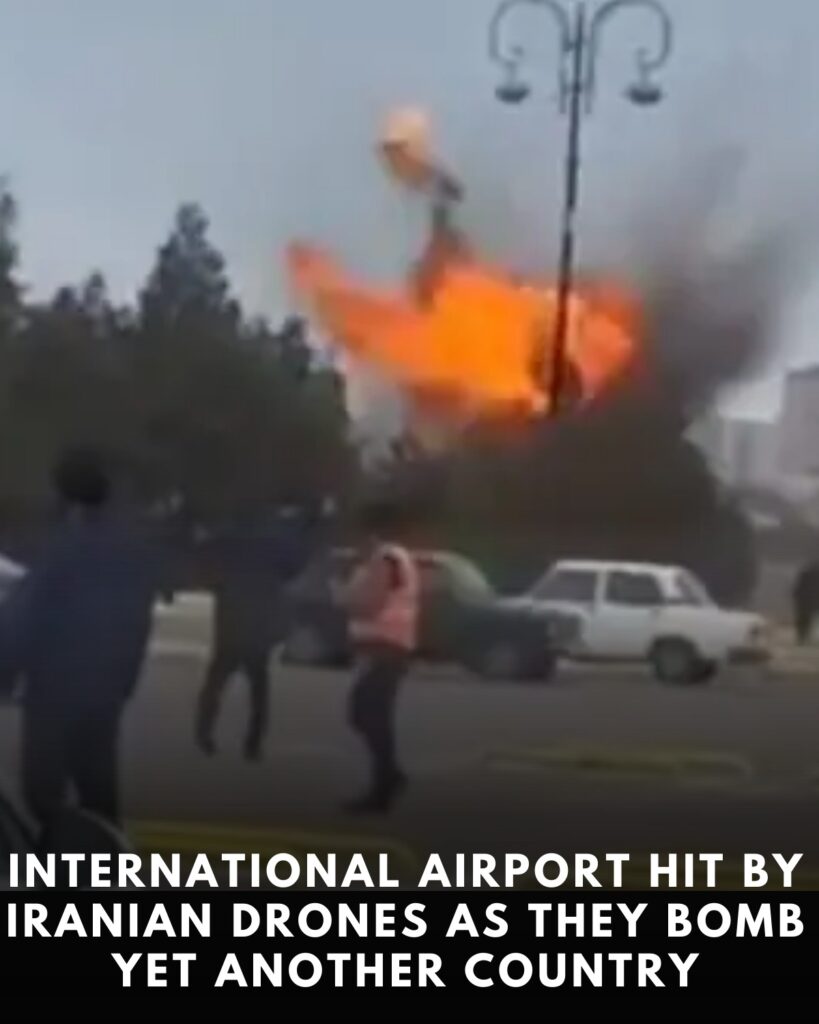
Azerbaijan said Iranian drones struck its territory on Thursday, hitting the terminal building at Nakhchivan International Airport and triggering an explosion that sent thick black smoke into the air, as the war involving Iran, the United States and Israel continued to spill across borders in the region.
Officials in Baku said two civilians were injured in the incidents, with one drone falling on the airport in the Nakhchivan exclave near the Iranian border and another landing close to a school building in the village of Shekarabad. Azerbaijani authorities said the Iranian ambassador in Baku was summoned and a formal protest delivered, as the foreign ministry warned it reserved the right to take retaliatory steps.
Video and photographs circulating on social media showed flames and smoke rising from the airport area, and the foreign ministry said the strike damaged the terminal building. A Reuters report, citing a source close to the Azerbaijani government, said missiles and drones coming from the direction of Iran fell on the grounds of the airport, though the full extent of damage was not immediately clear.

Azerbaijan’s foreign ministry condemned the incident and demanded an explanation from Tehran, saying it “strongly condemns this incident” and “reserves the right to take ‘appropriate response measures’,” according to statements carried by multiple outlets. It said the Iranian envoy was called in to receive a note of protest.
Iran did not immediately acknowledge targeting Azerbaijan. Azerbaijani officials and regional commentators described the incident as part of a widening pattern of Iranian drone and missile activity since the conflict intensified, with Iran launching strikes towards multiple countries in the broader region.
Nakhchivan International Airport sits roughly 10 kilometres from the Iranian frontier, in a territory geographically separated from the rest of Azerbaijan by a strip of Armenia and bordering Iran, Turkey and Armenia. The location makes it a sensitive corridor in regional security, trade and energy routes, and it has become a focal point as hostilities have expanded beyond the main theatres of conflict.
Azerbaijan said schools in the area were closed and lessons cancelled following the drone landing near the school building, while flights were suspended at the airport amid the emergency response. Local authorities did not immediately provide a detailed accounting of disruptions, but the foreign ministry’s statement framed the strike as an escalation requiring diplomatic action and the possibility of a response.
The foreign ministry said the actions “contradict the norms and principles of international law and contribute to increased tension in the region,” language echoed in reporting that described Baku’s effort to signal both condemnation and deterrence while it sought an explanation from Iran.
The incident also raised questions about the risks to civilian infrastructure close to contested borders. Airports, power stations and transport hubs across the region have come under heightened scrutiny from governments and airlines as the conflict has intensified, with officials in several countries issuing advisories and adjusting travel plans as missiles and drones have been reported over multiple air corridors.
Azerbaijan has sought, in public statements, to balance its messaging between the immediate incident in Nakhchivan and the larger regional crisis. The Nakhchivan exclave, accounting for a small portion of Azerbaijan’s territory, has long been strategically important due to its borders with Iran and Turkey, and because it sits along routes that connect the South Caucasus with Anatolia.
International reaction in the hours after the reported strike focused on the danger of further spillover. European leaders have in recent days issued statements condemning what they described as indiscriminate Iranian missile and drone attacks on countries in the region, urging Tehran to halt strikes and warning that the widening scope of attacks threatened civilians and regional stability.
France’s foreign minister, Jean-Noël Barrot, has been among those publicly criticising Iranian strikes on neighbouring states and calling for de-escalation and a return to diplomacy governed by international law. In remarks reported by Reuters earlier in the week, Barrot said France was ready to help Gulf countries targeted by Iranian retaliatory strikes, while also stressing that the initial strikes against Iran should have been debated at the United Nations.
French officials said Barrot had spoken with his Iranian counterpart to condemn strikes on neighbours and to reiterate “France’s commitment to stability in the Middle East, to de-escalation, and to the resumption of a demanding diplomatic dialogue, in compliance with international law, within which the use of force must be framed,” in a statement carried in reporting on Thursday.
Those diplomatic messages have landed against a backdrop of expanding military activity across multiple fronts. Reporting from major international outlets described strikes and counter-strikes reaching beyond Iran and Israel, with governments across Europe and the Middle East monitoring risks to shipping lanes, aviation routes and energy infrastructure.
For Azerbaijan, the immediate focus remained the incidents at the airport and near the school, and the injuries reported by the foreign ministry. Officials have not publicly released the names of those injured, and there has been no independent on-the-ground confirmation of the precise munition type used in the Nakhchivan strike beyond reports describing drones and, in some accounts, missiles falling on the airport grounds from the direction of Iran.
The Azerbaijani government’s decision to summon Iran’s ambassador suggested Baku intended to keep the dispute within formal diplomatic channels while it assessed options. Its warning that it reserved the right to take “appropriate response measures” indicated it was leaving open the possibility of retaliation, though officials did not specify what form such measures might take.
As emergency crews worked near the airport and authorities moved to secure nearby communities, the incidents added another flashpoint to a conflict already reshaping regional security calculations. With drones and missiles reported over an expanding geography, the strike in Nakhchivan underscored how quickly hostilities can reach civilian areas and critical infrastructure, and how smaller states bordering the conflict can be pulled into confrontation even when they are not direct participants in the initial military operations.