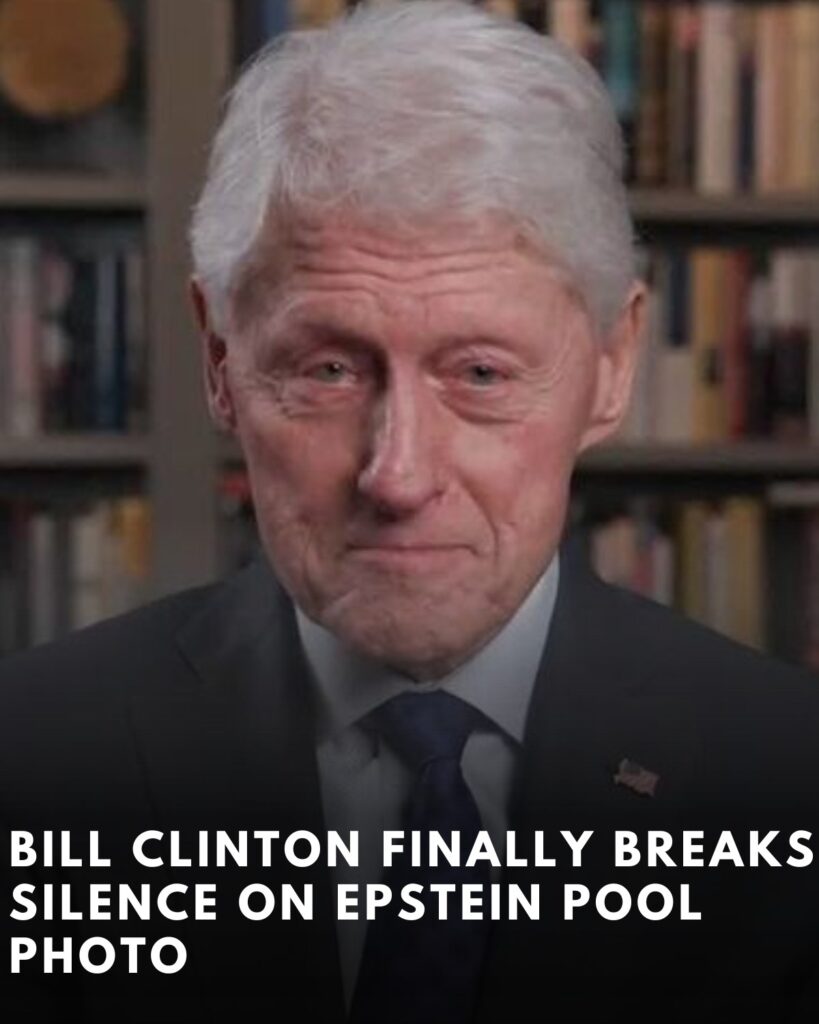
A photograph showing former US President Bill Clinton reclining in a hot tub alongside an unidentified woman, her face obscured in the released image, has drawn renewed attention after appearing in the latest tranche of files connected to the late financier Jeffrey Epstein, prompting Clinton to address it directly under oath during a closed-door deposition for the US House Oversight Committee.
In testimony recorded in Chappaqua, New York, on 27 February, Clinton said he did not believe he knew a picture had been taken at the time, and told lawmakers he was “almost sure” the scene captured in the image occurred at a hotel in Brunei during the final leg of an overseas trip linked to his work on an AIDS initiative.
Clinton, who is 79, described the circumstances as he recalled them, saying he had been in the water only briefly before going to bed. “I don’t think I ever knew the photo was taken,” he said during the roughly four-and-a-half-hour deposition, according to a transcript excerpt reported by People.
The former president told the committee he had met Brunei’s Sultan, Hassanal Bolkiah, during his time in the White House and that the Sultan later offered support for his philanthropic work when he learned Clinton would be visiting the country. Clinton said the Sultan wanted him to stay at a particular hotel and encouraged him to use the pool facilities. “So I did,” Clinton said, adding: “And then I got out and went to bed exhausted.”

The hot tub image is among a broader set of photographs and documents released by the US Department of Justice under a law requiring the publication of unclassified Epstein-related materials in a searchable, downloadable format, subject to protections including victim privacy and other redactions.
Clinton’s deposition, and the subsequent release of videotaped testimony, formed part of a congressional inquiry into Epstein’s network and connections, and into how authorities handled aspects of the case over many years. The House Oversight Committee made public footage of depositions given by both Bill Clinton and Hillary Clinton, with reporting describing the sessions as extensive and contentious at times.
In the deposition material described by People, Clinton said he did not know the identity of the woman in the hot tub photograph, and said he remembered a Secret Service agent being present in the room. He also sought to address questions raised online about the person’s age, stating the woman in the photo was not younger than 18. Clinton said he did not have sexual relations with her.
The hot tub image was not the only photograph involving Clinton mentioned in the latest release. People reported that another picture showed Clinton swimming in a pool with Epstein and Ghislaine Maxwell, Epstein’s former associate who was later convicted in federal court for her role in recruiting and grooming underage girls for Epstein to abuse. Clinton told the committee he had been in the pool and hot tub for a short period before turning in for the night, and said he did not know who had been photographed with him in the water.
The images have circulated widely on social media as the latest releases have placed fresh scrutiny on high-profile names that appear in the files, even in cases where individuals have not been accused of criminal wrongdoing. In People’s account, the newly released material included photos of Clinton alongside a number of celebrities, and the publication noted that some of those named have not been accused of any wrongdoing.

Clinton has long acknowledged limited contact with Epstein in the early 2000s, while repeatedly denying any knowledge of Epstein’s crimes at the time and denying any involvement in sexual misconduct connected to him. In testimony described in a Reuters report, Clinton said he met Epstein through then-US Treasury Secretary Larry Summers, who introduced Epstein as a donor interested in supporting the work of Clinton’s foundation. Clinton told the committee he cut ties with Epstein in 2003, and said he had not visited Epstein’s private island.
The former president’s relationship with Epstein has been examined repeatedly since Epstein’s first criminal case in Florida, where Epstein pleaded guilty in 2008 to state charges involving solicitation. Epstein died in custody in 2019 while awaiting federal trial on sex trafficking charges, a death ruled a suicide by New York City’s medical examiner, though it has remained the subject of persistent conspiracy theories online.
The latest file releases stem from the Epstein Files Transparency Act, signed into law in November 2025, which required the Justice Department to publish unclassified records related to Epstein and associated investigative materials, while allowing redactions for specified reasons.
The Justice Department has said the scale of the material and the need to protect victim information has complicated the pace and completeness of disclosure. In a January 2026 Justice Department announcement, officials said they had published 3.5 million responsive pages in compliance with the law.
Reporting around the releases has also highlighted earlier statements by senior Justice Department officials indicating that the process would unfold in waves rather than in a single dump of records. PBS NewsHour reported in February 2026 that Deputy Attorney General Todd Blanche said the government was addressing concerns about documents that may have included victim information, as additional pages were being made public.
In the People report on Clinton’s deposition, a representative for the former president pointed back to a statement posted on X by Clinton’s deputy chief of staff, Angel Ureña, arguing that the timing and manner of releases were being used for political ends and insisting the matter was not about shielding Clinton. People quoted the statement as saying: “They can release as many grainy 20-plus-year-old photos as they want, but this isn’t about Bill Clinton.”
The statement also drew a distinction between those who severed ties with Epstein before his crimes became widely known and those who continued relationships afterwards, arguing: “There are two types of people here. The first group knew nothing and cut Epstein off before his crimes came to light. The second group continued relationships with him after. We’re in the first.”
The renewed focus on Clinton comes as congressional investigators, survivor advocates, and members of the public continue to press for transparency over Epstein’s relationships and the extent of any facilitation by prominent figures, institutions, or intermediaries. While the appearance of a name or image in released files does not itself establish wrongdoing, the disclosure of photographs, travel records, and other documentation has fuelled further public scrutiny and online speculation, particularly when material is heavily redacted or released without broader context.
For Clinton, the central point he sought to make to investigators, as presented in People’s account, was that the hot tub photo did not depict a secret rendezvous but rather a moment during travel connected to philanthropic work, in a setting where security personnel were present, and involving a person he said he did not know. The former president’s comments, delivered under oath, were framed as an attempt to explain how the image came to exist and to rebut insinuations that have circulated since the files were released.
The House Oversight Committee’s investigation continues amid calls from lawmakers for additional testimony from other figures who had contact with Epstein, and amid continued release of materials by the Justice Department. For now, Clinton’s deposition explanation has placed his account of the hot tub photograph on the record: that he did not know the image was being taken, that he believes it was shot in Brunei during an AIDS initiative trip, and that he did not know the woman captured alongside him in the water.