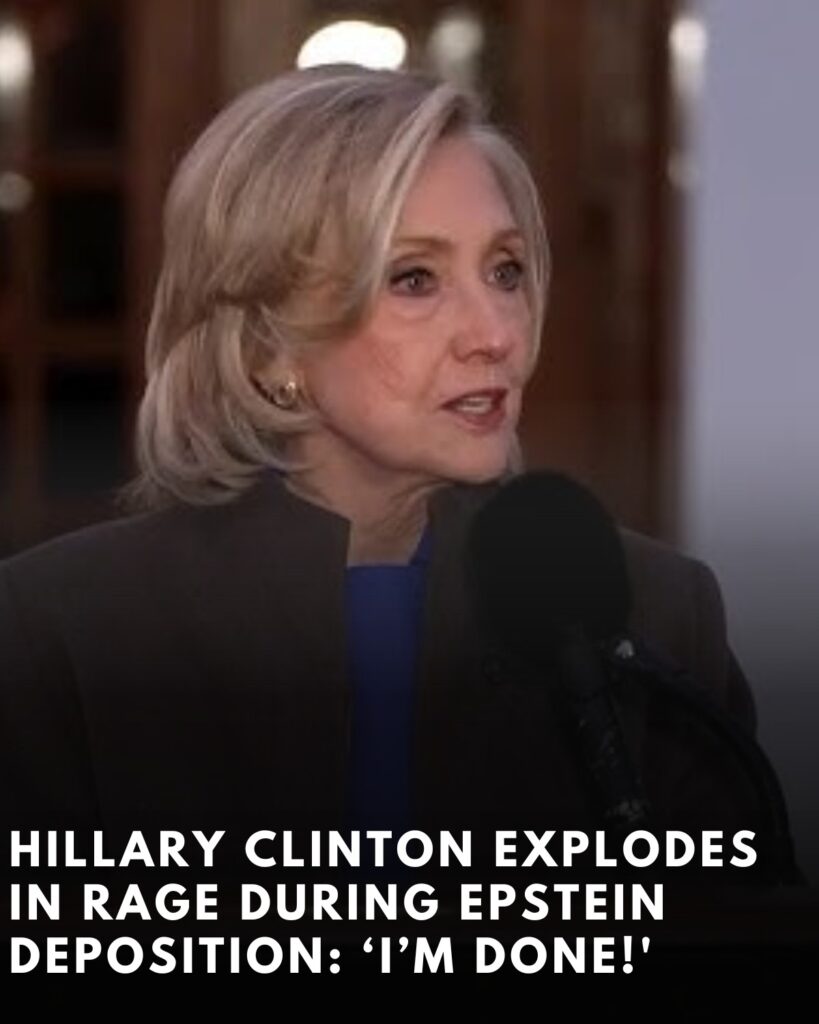
Video recordings of Hillary and Bill Clinton giving sworn evidence to a US House committee investigating Jeffrey Epstein were released this week, showing tense exchanges with Republican lawmakers and a brief disruption after a photograph from inside Hillary Clinton’s closed-door deposition appeared online.
The footage, made public by the House Oversight Committee, includes a moment about 80 minutes into Hillary Clinton’s testimony when she is told that a picture of her in the hearing room has been shared publicly. In the clip, she reacts angrily and threatens to end the session, saying: “I am done with this. If you guys are doing that, I am done. You can hold me in contempt from now until the cows come home. This is just typical behaviour.”
The episode centres on a photograph that appeared on social media during the deposition. Multiple outlets reported that Republican Representative Lauren Boebert, a member of the committee, took the picture and sent it to conservative influencer Benny Johnson, who posted it and said it had been provided by Boebert. Axios reported the deposition was paused while Clinton’s team sought an explanation for how the image was taken and shared, noting that distributing photos from an ongoing closed-door proceeding would violate House rules.
In the released video, Boebert is heard acknowledging she will remove the image. Clinton, still visibly frustrated, insists the timing does not change the issue and says the rules apply to everyone in the room. She then rises from her chair, repeats “I am done,” and the recording indicates the proceedings are briefly halted as the dispute is addressed, before the deposition continues.
The committee’s investigation has unfolded amid renewed political focus on the long-running Epstein case and demands for more disclosure of records connected to the late financier, who faced longstanding allegations of sexual abuse and trafficking of girls. Epstein died in federal custody in New York in August 2019 while awaiting trial on sex trafficking charges; the New York City medical examiner ruled his death a suicide, and a later Justice Department inspector general review detailed systemic failures at the jail.

Hillary Clinton’s deposition, according to reporting on the video release, includes repeated denials that she had involvement with or knowledge of Epstein’s criminal activity. The Guardian reported she said she did not recall meeting Epstein, while also using her appearance to criticise how the Republican-led committee had conducted its work. In her remarks to lawmakers, she accused the panel of selective transparency, saying: “You have held zero public hearings, refused to allow the media to attend them, including today, despite espousing the need for transparency on dozens of occasions.”
She went on to challenge the committee’s choices about witnesses, saying: “You have made little effort to call the people who show up most prominently in the Epstein files. And when you did, not a single Republican member showed up for Les Wexner’s deposition.” She added: “This institutional failure is designed to protect one political party and one public official, rather than to seek truth and justice for the victims and survivors.”
In the deposition account published by the Mirror, Hillary Clinton’s testimony is also described as including criticism of the Justice Department’s handling of certain material connected to Epstein, as well as claims about allegations involving President Donald Trump. The Mirror quoted her as saying a “committee run by elected officials with a commitment to transparency would ensure the full release of all the files”, and that it “would ensure that the lawful redactions of those files protected the victims and survivors, not powerful men and political allies.” The same report quoted her as referring to “reports that DoJ withheld FBI interviews in which a survivor accuses President Trump of heinous crimes,” and calling for Trump to be questioned under oath.
The release also included Bill Clinton’s deposition. The former president has previously acknowledged past contact with Epstein, including travel on Epstein’s private jet, while denying knowledge of criminal conduct. In the newly released testimony, the Guardian reported Bill Clinton told lawmakers: “There’s nothing that I saw when I was around him that made me realize he was trafficking women.”
The Guardian also reported Bill Clinton said he ended his association with Epstein years before Epstein’s 2008 guilty plea in Florida on prostitution-related charges, and that he first remembered meeting Epstein in connection with travel for the Clintons’ humanitarian work. The Epstein case, which first drew major public attention in the mid-2000s, has produced years of civil litigation, criminal investigations and controversy over prosecutorial decisions, including the handling of a 2008 plea agreement in Florida.
The committee’s decision to release the Clintons’ depositions appears aimed at demonstrating progress in its inquiry and responding to pressure from lawmakers and activists who argue more public accountability is needed regarding people in Epstein’s orbit. It has also sharpened partisan tensions around the inquiry itself. Hillary Clinton’s on-camera irritation over the leaked photograph sits alongside her broader complaint, in the same testimony, that the committee’s approach has prioritised political confrontation over what she described as a consistent effort to surface facts and protect victims.
The photograph controversy, however, became the most visible flashpoint from her appearance. In addition to the video clip showing her reaction, news coverage of the leak framed it as an unusual breach of the controlled environment of a closed-door deposition. Axios quoted Clinton spokesman Nick Merrill as saying: “The hearing has been paused briefly while we figure out where the photo came from and why possibly members of Congress are violating House rules.”
The release of the depositions is likely to intensify scrutiny of the committee’s next steps, including what additional witnesses it seeks and what documents it plans to publish. For the Clintons, the footage places their denials and criticisms on the public record in real time, while capturing a moment where procedural conflict overtook the questioning itself. For the committee, the episode highlights the political volatility surrounding any congressional investigation tied to Epstein, even when the stated focus is on accountability for abuse that spanned years and affected dozens of victims.