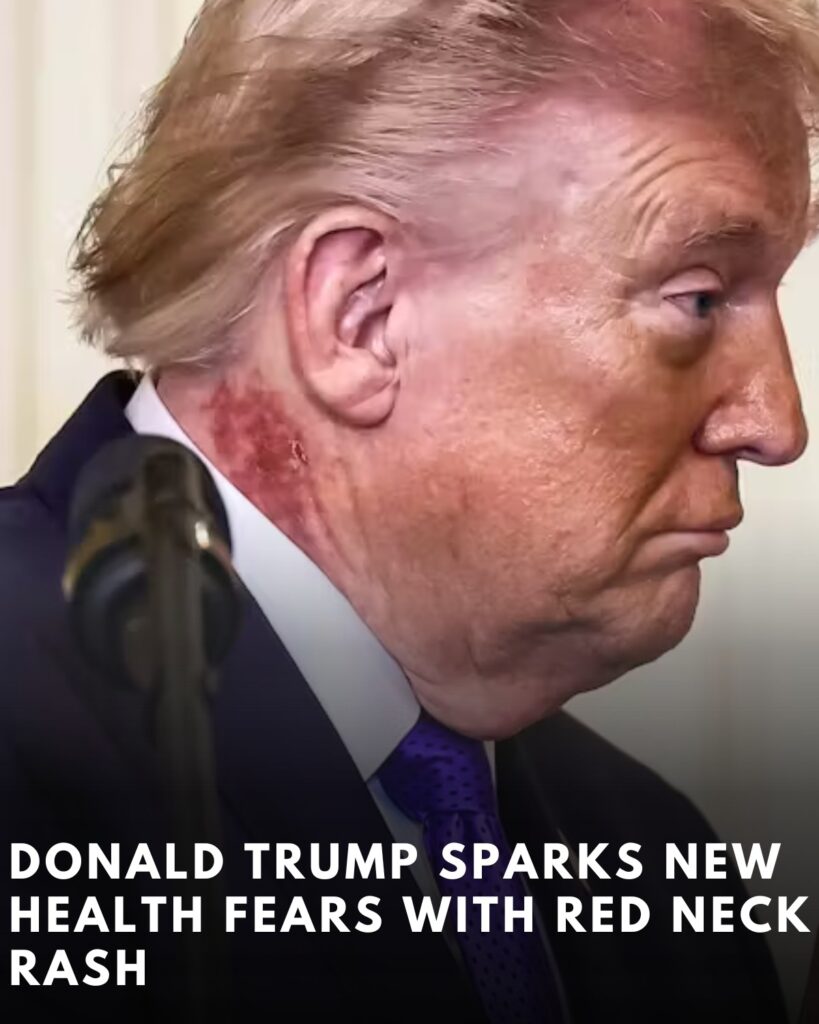
Photographers covering a White House Medal of Honour ceremony on Monday captured close-up images showing a red, blotchy area with peeling skin on the right side of President Donald Trump’s neck, prompting a fresh round of questions about the health of the 79-year-old, the oldest US president ever to take the oath of office.
The White House moved to address the attention around the mark later the same day, attributing it to a topical treatment prescribed by the president’s medical team. In a statement released by the president’s physician, Dr Sean Barbabella, the doctor said Trump was applying a “very common cream” as a “preventative skin treatment”, adding that the course of treatment was expected to last a week and that the visible redness could persist for several weeks.
Officials did not identify the cream or the condition it was intended to prevent. The AP reported that the White House did not immediately answer follow-up questions about what the medication was, when it was started, or what it was meant to ward off.
While the flare-up drew widespread notice because it was apparent in high-resolution photographs taken in the East Room, images from earlier public appearances indicate the redness was not limited to Monday’s ceremony. The AP said zoomed-in photographs from at least as far back as a Board of Peace meeting at the US Institute of Peace on 19 February showed visible redness on Trump’s neck, and it also published images from late February and from the president’s State of the Union address showing similar discolouration.
The White House has released periodic updates on Trump’s health since he returned to office, with the president and his allies frequently pushing back on speculation about his fitness for the role. But Trump’s age has kept his medical status under steady scrutiny, and minor visible signs, such as bruising, have repeatedly become talking points.
In recent months, attention has focused on bruises that have appeared on the backs of Trump’s hands during public events, sometimes prompting questions about whether he had undergone medical procedures or was taking medication that increased the likelihood of bruising. The White House has previously attributed the marks to the president’s packed schedule and frequent handshaking, with spokesperson Karoline Leavitt saying he bruises because he is “constantly working and shaking hands all day every day”.
Trump himself has pointed to his use of aspirin as a contributing factor. In an interview reported by Reuters, Trump acknowledged taking a higher daily dose than his doctors preferred, framing it as a measure to reduce cardiovascular risk. “They say aspirin is good for thinning out the blood, and I don’t want thick blood pouring through my heart,” he told the Wall Street Journal, according to Reuters.
Reuters reported that Trump’s doctor told the Journal the president takes 325 milligrams of aspirin daily for cardiac prevention, a dose higher than the low-dose aspirin regimen commonly discussed in preventive care. The Reuters report also noted that the Mayo Clinic says a low dose is most commonly 81 milligrams, and that daily aspirin use can reduce the chance of heart attack or stroke for some people over 60, while also carrying bleeding risks that are weighed on an individual basis.
The administration has also sought to clarify reporting about imaging tests Trump underwent last year. Reuters reported that questions had been raised after he was said to have had an MRI in October, but Trump and his physician later said he had received a CT scan instead, describing it as preventive screening aimed at ruling out cardiovascular issues, with no abnormalities found.
The AP, citing comments from Barbabella, reported that Trump had MRI imaging on his heart and abdomen in October as part of preventive screening for men his age, and that his October physical at Walter Reed National Military Medical Center concluded he was in overall “exceptional health”.
Monday’s statement about the neck irritation did not link the redness to the president’s aspirin use, and it did not indicate that the mark was the sign of an acute illness. Instead, the physician characterised it as an expected side effect of a short-term topical treatment. Still, the absence of detail about what the cream was intended to prevent left room for continued questions, particularly given that images suggested the redness had been visible in some form for weeks.
The AP reported that Trump’s medical report from his April 2025 physical stated he was taking mometasone cream “as needed” for an unspecified skin condition, indicating that topical medication has appeared in his health disclosures before. The report did not say whether the medication referenced last year was related to the treatment now being used on his neck.
Health has been a recurring political flashpoint in the United States as both parties have confronted the realities of ageing leaders. Reuters noted that Trump, at 79, is the second-oldest person to hold the presidency, behind his Democratic predecessor Joe Biden, who left office at 82 after his age and stamina became central issues during the 2024 election cycle.
Beyond bruising and now the neck redness, the president has faced periodic attention over moments when he appeared to close his eyes during public events, alongside questions about the level of disclosure the White House is willing to provide about routine health matters. In the case of the neck irritation, the administration offered a basic explanation while stopping short of giving specifics that might settle the discussion, such as the name of the medication or the diagnosis.
The focus on visible marks has also intersected with earlier official disclosures. The Guardian reported that the White House previously announced Trump had been diagnosed with chronic venous insufficiency after noticing swelling in his legs, describing it at the time as a “benign and common condition” in people over 70, based on vascular studies that included Doppler ultrasounds.
On Monday, Trump appeared in public as scheduled for the Medal of Honour ceremony, where he awarded the military’s highest decoration. The images from the event, taken as he stood and spoke in the East Room under bright lights and at close range, drew attention precisely because they were captured in the course of a routine presidential engagement, rather than during a medical update.
For now, the White House position is that the redness is temporary and treatment-related, with the president’s doctor expecting it to fade in the coming weeks. In his brief statement, Barbabella did not indicate any change to Trump’s public schedule, and the administration did not suggest that the irritation required any steps beyond the prescribed cream.