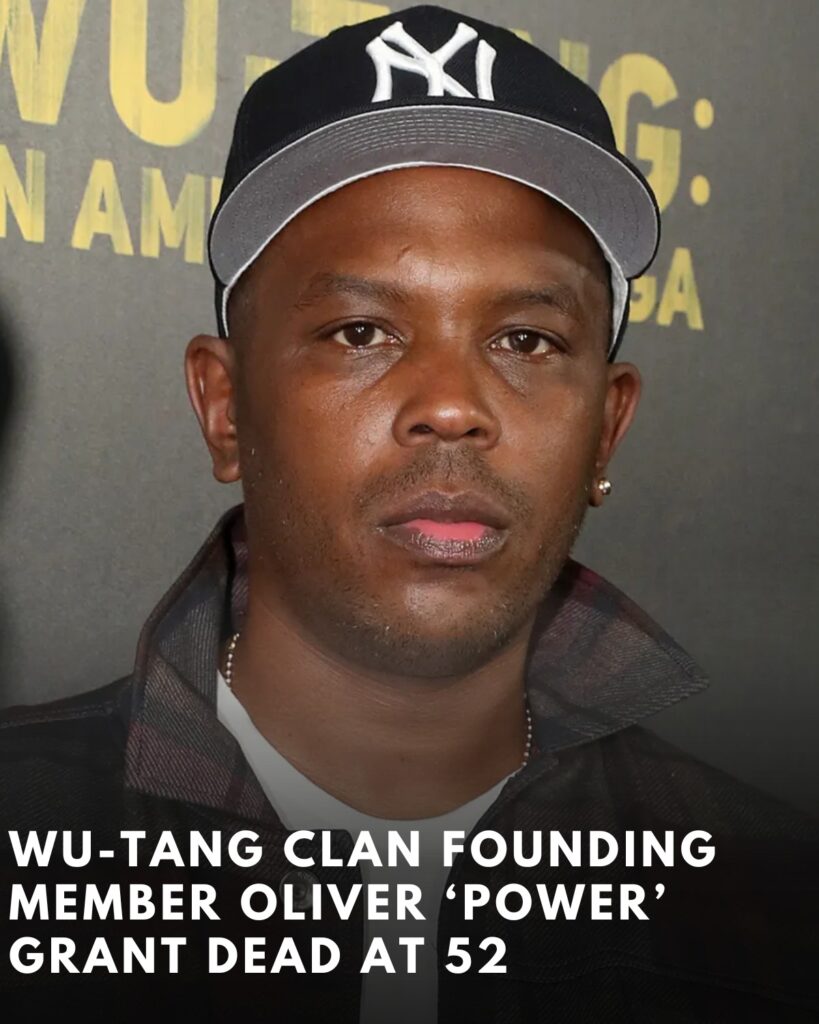
Oliver “Power” Grant, a key behind-the-scenes figure in the rise of the Wu-Tang Clan and the founder of the group’s Wu Wear clothing line, has died aged 52, prompting tributes from members of the influential New York hip-hop collective and wider mourning across the culture that the group helped reshape.
Grant’s death was confirmed through social media posts from Wu-Tang Clan members, including Method Man, who shared a photograph of the pair and wrote: “Paradise my Brother safe Travels!! #pookie #power Bruh I am not ok.” The group’s official channels also acknowledged the loss, posting: “Rest in Power, Power.” No cause of death has been announced.
People close to the group and industry outlets said Grant died on 23 February. In statements and posts shared publicly, Wu-Tang members described him as foundational to what the group became, both as a musical force and as a business empire that extended far beyond records.
GZA, in a tribute posted on Instagram, wrote: “We couldn’t have done it without him. Wu wouldn’t have come to fruition without Power. His passing is a profound loss to us all. My deepest condolences to the fam.” Raekwon, sharing a group photo, wrote: “POWER we been everywhere …. now you everywhere ! the most high is merciful love you.”
Grant, often referred to by his nickname “Power”, was widely credited with helping turn the Wu-Tang Clan from a raw Staten Island rap movement into a global brand associated with independence and ownership. He was not one of the group’s performing MCs, but was closely tied to the collective from its earliest years, working within the inner circle around RZA, GZA, Method Man, Raekwon, Ghostface Killah, Inspectah Deck, U-God and others.
Born in 1973 in Jamaica, Grant later moved to New York and was raised on Staten Island, where he became connected with the artists who would form Wu-Tang Clan. Accounts of his early years place him in the Park Hill housing projects, a setting that also shaped the group’s worldview and the music that followed. Within that neighbourhood network, he gained the nickname “Power”, a moniker later adopted publicly as he took on an increasingly prominent role in the business architecture around the group.
Wu-Tang Clan’s breakthrough came in the early 1990s as hip-hop was changing rapidly, with major labels expanding their reach while regional sounds competed for dominance. The group’s debut album, “Enter the Wu-Tang (36 Chambers)”, released in 1993, became one of the era’s defining records, acclaimed for its gritty production, kung-fu movie samples and a large cast of distinctive voices. Alongside the music, the group built a mythology around itself, positioning the collective as a self-sustaining “clan” with a code, a symbol and a strategy that emphasised individual careers under a shared banner.
Grant was routinely described as part of the engine behind that strategy, working on projects and business ventures that helped turn the group into a long-running enterprise. In later years, he was credited with executive producing Wu-Tang releases and helping to steer brand decisions that reached beyond traditional music promotion.
One of the most visible outcomes of that expansion was Wu Wear, the clothing line that took the group’s logo and identity into fashion retail. The label became a staple of late 1990s and early 2000s streetwear, as hip-hop artists increasingly extended their influence into merchandising and apparel. Grant spoke publicly about the effort and resistance he faced as he attempted to formalise that business.
In a 2011 interview with Passion of the Weiss, Grant recalled the internal scepticism that greeted his plans, saying: “My crew had plenty of skeptics, doubters, and non believers. It wasn’t nothing personal, but I’d say that everyone is an individual and they didn’t really understand what I was doing or what I was initially trying to get across, or where I was coming from. They just hadn’t seen it. It hadn’t been done before, and it led them to be skeptical. I was laying my own trail. First and foremost, yeah it was going to benefit me, but at the end it would benefit all of us.”
He also framed the group’s early business learning as practical and improvised, tied to the realities of their background and the absence of established models for what they were trying to build. In that same interview, Grant said: “Everything that we learned was hard knock life, you figure it out as you go along, and take cues from those that are actively doing things. A lot of it was trial and error. There were no models.”
Those remarks have resurfaced in the wake of his death as fans and commentators revisit the often-unseen labour that helped sustain the group’s cultural impact. Wu-Tang’s rise has frequently been told through its music and personalities, but Grant’s role has been highlighted by those who see the group’s longevity as inseparable from its early insistence on control and the deliberate construction of a business ecosystem around its art.

In the tributes that followed the announcement of his death, that theme of control and empowerment was repeated. The music outlet Okayplayer, in an Instagram post announcing Grant’s death, described him as “a driving force behind one of hip-hop’s most influential movements.” The post added: “His belief in creative control and community empowerment helped shape not only a group, but a dynasty that changed music forever,” and said: “His impact will live on through the culture he helped elevate and the countless lives he inspired.”
Grant also made appearances on screen, including roles connected to the world of late 1990s hip-hop cinema. He appeared in the 1998 film “Belly”, which starred several rappers and became closely associated with the era’s visual style, and acted in 1999’s “Black and White”, another film steeped in the culture and music of the time.
His death comes at a moment when Wu-Tang Clan’s legacy is being marked in new ways as the group approaches more formal recognition beyond hip-hop’s own institutions. The group was named among the nominees for the 2026 Rock & Roll Hall of Fame, an acknowledgement that has often been interpreted as a measure of the group’s influence across genres and generations.
For fans, the tributes from within Wu-Tang have carried particular weight given how closely the group has guarded its internal bonds over the years. Method Man’s post, including the line “Bruh I am not ok”, conveyed an intimacy that many read as a reflection of grief within the clan’s extended family. GZA’s statement, “Wu wouldn’t have come to fruition without Power”, positioned Grant not as an ancillary contributor but as central to the group’s very existence.
No further details about Grant’s death have been released publicly, and representatives for Wu-Tang did not announce funeral arrangements or additional statements at the time the tributes circulated. What has been clear from the immediate reaction is that Grant’s name, less familiar to casual listeners than the group’s rappers, carries deep significance to those who view Wu-Tang as more than a band, and as a movement built on the idea that artists could define their own terms.
As messages continued to spread online, the language of the posts returned repeatedly to the same themes: brotherhood, legacy, and a man whose work helped create a blueprint for how hip-hop could extend into ownership and industry power. For a group that once turned a Staten Island neighbourhood story into a global symbol, the loss of one of its architects has been felt not just as the death of an individual, but as the closing of a chapter in the Wu-Tang origin story.