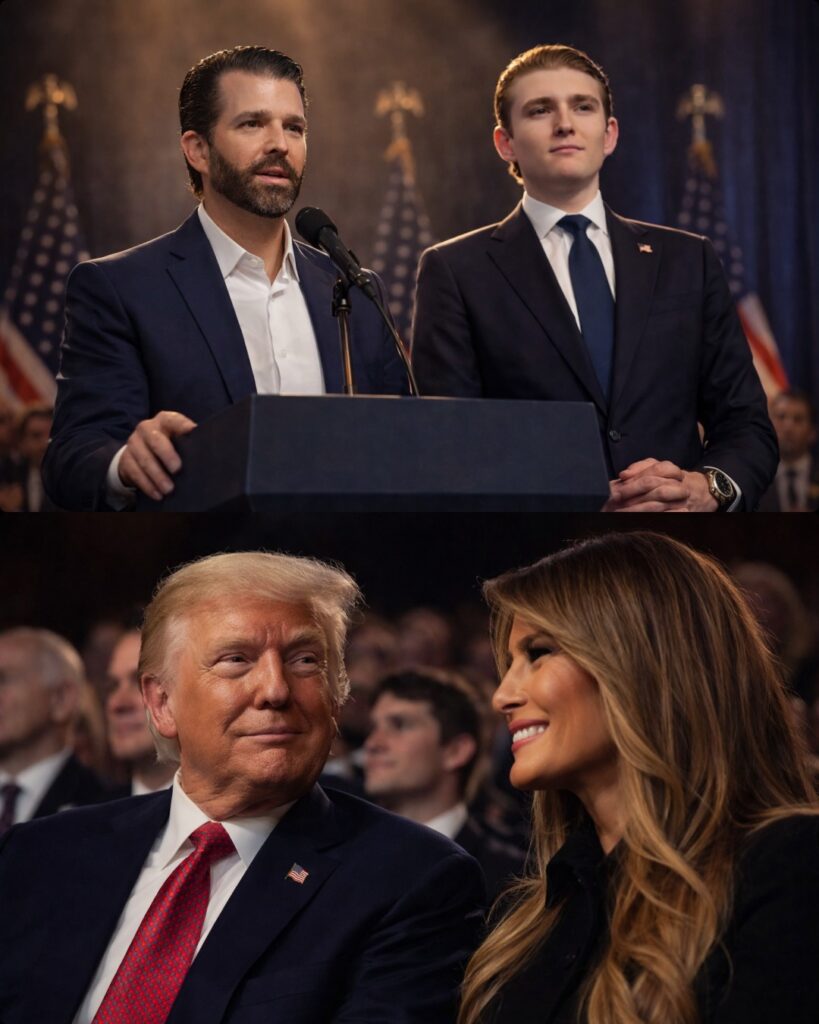
What took place last night was not a campaign rally, not a fundraiser, and not a policy speech. It was announced simply as a “family evening conversation” at the Trump residence in Palm Beach. Yet by the time it ended, many in the room described it as one of the most revealing public moments in the Trump family’s history.
The ballroom had been arranged differently from the usual political gatherings. No towering podium. No oversized campaign banners. Instead, a simple stage with four chairs, warm lighting, and a large screen behind them displaying family photographs spanning four decades — from early business ventures in New York to White House portraits and more recent private snapshots.
Ivanka Trump walked out first. Dressed in a simple, understated outfit, she did not wave dramatically. She thanked the audience for coming and explained the purpose of the evening: “Tonight is not about politics. It’s about family, responsibility, and what gets passed down when the spotlight fades.”
Donald Trump Jr. followed. His tone was firm but noticeably more reflective than at campaign events. He spoke about growing up under constant public attention, about learning resilience from watching his father navigate both triumph and controversy. He did not avoid difficult chapters. He mentioned investigations, media battles, election disputes, and public criticism. “We saw the highs,” he said, “but we also saw what pressure really looks like behind closed doors.”

Throughout this, Donald Trump remained seated in the center chair. At 80, he appeared composed, hands folded loosely. He did not interrupt. He did not correct. He did not amplify the moment with applause lines. He simply listened.
Ivanka then shared a more personal memory. She described late-night phone calls during her time working in the White House, moments when decisions carried enormous weight. “People see confidence,” she said. “They don’t always see the burden of making choices that affect millions.” She credited her father not only for ambition but for endurance — the ability to absorb criticism without retreating.
Don Jr. spoke candidly about how public battles affected the family dynamic. “There were nights when headlines felt louder than anything else,” he admitted. “But what stayed constant was that we were expected to show up for each other.” He explained that the lesson passed down was not simply about winning, but about standing firm under pressure.
As the children spoke, images on the screen shifted — business groundbreakings, family holidays, moments inside the Oval Office, quieter scenes at Mar-a-Lago. The visual timeline reinforced the message: this was a story spanning decades, not just election cycles.
Melania Trump entered the conversation midway through the evening. She spoke briefly but directly. Her focus was not on politics but on stability. She emphasized protecting their son from the most intense aspects of public life and maintaining a sense of normalcy despite extraordinary circumstances. “Our responsibility was always first to our family,” she said. “Everything else came after.”
,type=downsize)
At no point did the discussion turn into a campaign pitch. There were no policy proposals. No attacks on opponents. Instead, the evening centered on legacy — not in terms of legislation, but in terms of values. Resilience. Loyalty. Discipline. Public service, as they defined it.
Observers noted the unusual restraint from Donald Trump. Known for commanding a room, he allowed his children to shape the narrative. Near the end of the event, Ivanka turned to him and asked directly, “When you look back, what matters most?”
He paused before answering. The room was silent.
“What matters,” he said finally, “is that your family stands stronger at the end than at the beginning.”
It was one of the shortest remarks he has delivered in years. But it drew the longest applause of the night.
The symbolism was clear. This was not about relitigating past elections or announcing future plans. It was about transition — about demonstrating that the next generation understands the weight of the name they carry. Whether that translates into future political roles remains uncertain, but the message was unmistakable: the legacy is shared.
Political analysts may debate the strategic timing of such an event. Supporters see it as a powerful display of unity. Critics may interpret it as image recalibration. Yet those present described the tone as more intimate than calculated.

As the evening concluded, the family stood together for a final photograph. No music swelled dramatically. No confetti fell. Instead, they exited the stage side by side.
What distinguished the night was not spectacle but stillness. For a figure known for dominating headlines, choosing to listen rather than lead became the defining act.
In modern politics, inheritance often refers to power or influence. But in this case, it appeared to mean something else: shared experience under extraordinary scrutiny, and a conscious decision to frame that experience as preparation rather than burden.
Some moments become history because of policy or protest. Others become defining because of what they reveal about the people behind public roles.
Last night was the latter.
It was not about reliving victories or defending controversies. It was about acknowledging both and deciding what carries forward. And in a rare shift from his usual commanding presence, Donald Trump allowed his children to articulate that future.
In doing so, the message was clear: legacy is not a speech. It is a transfer of responsibility.
And for one evening in Palm Beach, the room held its breath not because of what he said — but because of what he chose not to.