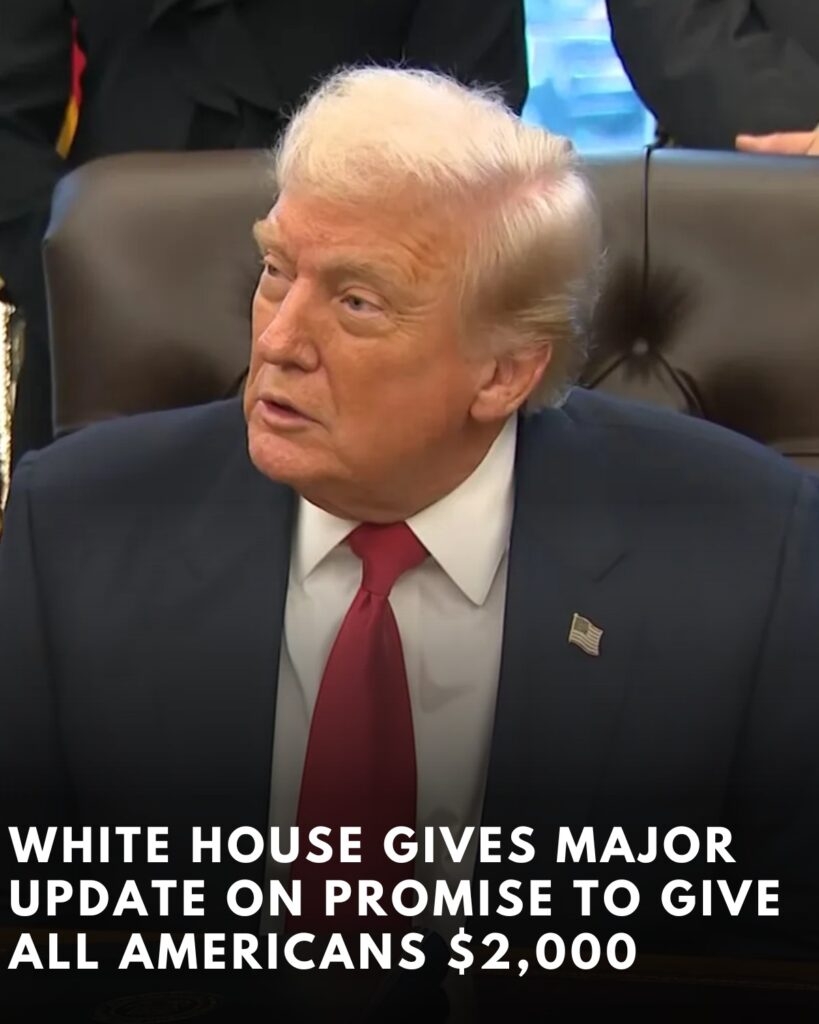
The White House has said President Donald Trump is committed to a plan to send $2,000 payments to most Americans funded by tariff revenue, sharpening attention on a headline-grabbing pledge that economists say would be difficult to deliver and that remains light on practical detail.
The proposal, which the president has described as a “tariff dividend,” first gained traction after a series of posts on his Truth Social account over the weekend. Trump wrote that the United States was “taking in Trillions of Dollars” from tariffs and declared that “a dividend of at least $2000 a person (not including high income people!) will be paid to everyone.” In the same message, he called critics of his tariff strategy “fools” and claimed that the country was “the Richest, Most Respected Country In the World, With Almost No Inflation, and A Record Stock Market Price.”
The comments tied the promised payments directly to the sweeping tariffs Trump has imposed during his second term on a wide range of imports, from steel and cars to pharmaceuticals. Those levies, enacted largely under emergency authorities, have pushed the overall U.S. tariff rate to about 18 per cent, the highest since the 1930s, according to data cited by budget analysts.
After days of speculation about whether the comments represented a concrete policy or a political talking point, the White House moved to clarify the administration’s stance. Press officials said Trump is committed to delivering a $2,000 benefit to Americans using tariff income and that aides are examining mechanisms for how such a programme might work.
The promise comes at a sensitive political moment for the president. Voters have signalled unease about the cost of living despite relatively low core inflation, and Trump has framed the dividend as a direct way to share what he portrays as the gains from his aggressive trade agenda. It also follows Democratic gains in recent state elections and arrives as the Supreme Court weighs whether his use of emergency powers to impose tariffs on dozens of countries and sectors is lawful, a ruling that could reshape the financial underpinning of any payout scheme.
Economists and budget specialists who have examined the numbers say the arithmetic behind the pledge is challenging. Federal tariff receipts have risen sharply under Trump’s policies, but they remain far below the amount likely required to fund cheques of $2,000 for most U.S. adults. Through the end of October, the government had collected about $309.2bn in tariff revenue for the year, up from $165.4bn at the same point a year earlier.

Erica York, vice-president of federal tax policy at the Tax Foundation, estimated that providing a $2,000 dividend to each person earning under $100,000 would involve roughly 150 million adult recipients. In a calculation shared on X, she said that would cost nearly $300bn, and more if children were also covered, exceeding the tariff revenue raised so far.
Other groups have reached similar conclusions. The Committee for a Responsible Federal Budget projected that depending on eligibility and design, the proposal could cost around $600bn, potentially dwarfing the annual inflows from tariffs even if collections continue to rise.
Trump, however, has portrayed tariff revenues in far more expansive terms. In his Truth Social posts he said his administration was “taking in Trillions of Dollars” and suggested the money would not only fund the promised payments but also “begin paying down our ENORMOUS DEBT,” which now exceeds $37tn.
The question of what form the “dividend” might actually take remains unsettled inside the administration. Appearing on ABC’s “This Week,” Treasury Secretary Scott Bessent said the benefit “could come in lots of forms, in lots of ways,” and pointed to a series of tax changes already championed by the White House, including “no tax on tips, no tax on overtime, no tax on Social Security” and expanded deductibility for auto loans. Those measures, he argued, represent “substantial deductions.”
Bessent’s remarks have led some analysts to question whether the White House is contemplating direct cheques modelled on previous stimulus payments or instead repackaging existing tax relief as a version of the promised $2,000. During the coronavirus pandemic, the federal government issued several rounds of stimulus cheques totalling about $814bn; Trump has often cited those payments as evidence he is willing to send cash directly to households.
Trump has raised the idea of sharing tariff revenue with the public before. In July he told reporters that “we have so much money coming in, we’re thinking about a little rebate,” adding that his “big thing” remained paying down the national debt. Around the same time, Republican senator Josh Hawley introduced legislation to provide $600 “tariff rebate” cheques to every American adult and child, though that bill has not advanced in Congress.
The renewed push for a much larger $2,000 figure underscores how central tariffs have become to Trump’s economic and political narrative. Throughout his presidency he has insisted that foreign exporters and governments, rather than U.S. consumers, bear the brunt of the duties. Independent studies have repeatedly concluded that American households ultimately shoulder much of the cost via higher prices, with estimates putting the average annual burden between about $1,600 and $2,600 per household.
Those findings have shaped criticism of the dividend plan. Some economists argue that if the ultimate aim is to boost household finances by roughly $2,000 a year, simply rolling back the tariffs might be more straightforward than collecting the duties and then attempting to redistribute them. Erica York said that because the tariff costs and the proposed dividend are of a similar order of magnitude, cancelling the tariffs would likely be a more efficient way to help families.
Legal uncertainties add another layer of risk. The Supreme Court heard arguments this month on whether Trump overstepped his authority by invoking the International Emergency Economic Powers Act to impose wide-ranging tariffs without explicit congressional approval. Several justices voiced concern about the breadth of the claimed powers and the precedent it could set. Should the court rule against the administration, some or all of the tariffs that underpin the dividend proposal could be struck down, and legal experts say the government might even have to refund certain collections rather than redirect them to new spending.
Trump and his allies have defended both the legality and the economic impact of the tariffs. In one Truth Social post, he complained that it was “ridiculous” for the Supreme Court to question his ability to levy duties when presidents are “allowed … to stop ALL TRADE with a Foreign Country,” and he framed the tariffs as an issue of national security.
Inside Washington, the proposal has not yet taken the form of detailed legislation. Any direct payments structured as cheques or bank transfers would almost certainly require congressional approval, as did earlier stimulus programmes. Joseph Rosenberg, a senior fellow at the Urban-Brookings Tax Policy Center, noted that when lawmakers passed Trump’s signature tax and spending package, they had the opportunity to include a tariff dividend but chose not to do so.
For now, the White House is emphasising Trump’s intention rather than a specific timetable. Officials have said the president wants low- and middle-income Americans to benefit first, with any remaining tariff revenue directed towards reducing the federal debt. Supporters within the administration argue that tying a consumer cash benefit to tariffs could make it politically harder for critics to dismantle the trade barriers, particularly if the Supreme Court upholds Trump’s authority.
The plan has generated a mixed reaction among voters and on social media. Some users on X and other platforms have welcomed the prospect of extra money, drawing comparisons with earlier pandemic cheques and sharing calculations of how a $2,000 windfall could help with rent, groceries or debts. Others have questioned whether the promise will materialise or accused the president of using the pledge as a distraction from concerns over the government’s finances and the impact of tariffs on import-dependent industries.
Trump’s allies cast the idea as part of a broader effort to make his “America First” agenda tangible to households. The White House has touted a series of economic indicators, including a strong stock market, rising blue-collar wages and relatively low petrol prices, as evidence that his approach is working. Official communications have highlighted previous promises that he would “make America affordable again” and deliver “very large tax cuts for workers,” arguing that a tariff-funded dividend would be consistent with those pledges.
Whether the $2,000 payments ever reach Americans will depend on a confluence of legal, fiscal and political factors that are still in flux. The administration must decide whether the dividend will take the form of direct cash, targeted tax relief or some combination of both, and then persuade Congress—or the courts—that the plan is legally sound and financially sustainable. Analysts say those hurdles are substantial, given the gap between tariff revenues and the implied cost of the promise.
For now, Trump’s comments and the White House’s subsequent endorsement have ensured that the idea of a tariff-funded dividend is likely to remain a prominent feature of the national economic debate. Supporters see it as a way to turn trade restrictions into a visible benefit for ordinary Americans, while critics warn that the sums do not add up and that households may already be paying the price through higher costs at the till. As the Supreme Court deliberates and policymakers wrestle with the country’s rising debt, the president’s pledge of a $2,000 payment to “everyone” except high-income earners has become a test of how far his administration can stretch both the nation’s tariff powers and its fiscal resources.