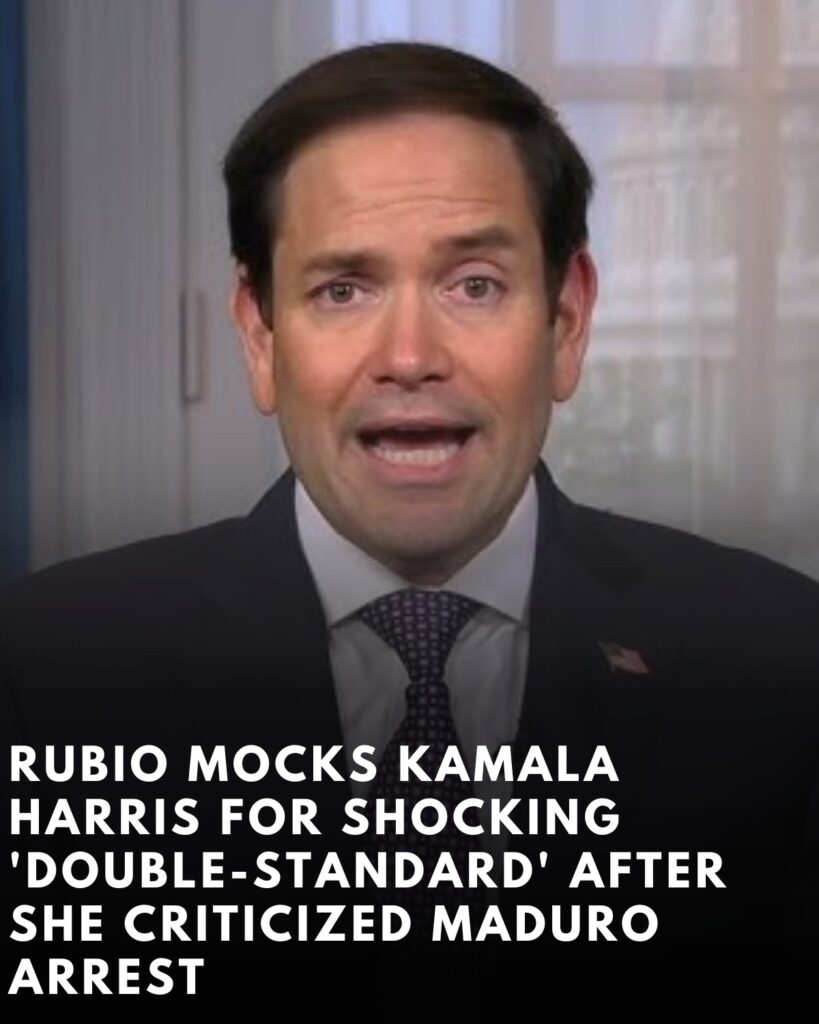
Secretary of State Marco Rubio has accused former US vice-president Kamala Harris and other Democrats of applying a double standard after they criticised the US operation that captured Venezuelan leader Nicolás Maduro, as the legality and consequences of the raid continue to reverberate across American politics and the region.
Speaking on Sunday, Rubio pointed to the longstanding US policy of pursuing Maduro over alleged narco-terrorism and drug trafficking, arguing that Democratic criticism of the capture sits uneasily alongside earlier US efforts to secure Maduro’s arrest through rewards and criminal charges.
Rubio told NBC’s “Meet the Press” that the previous administration had placed a “$25 million reward for [Maduro’s] capture”, framing the current controversy as a question of whether Washington should follow through on a policy already publicly declared. “So, we have a reward for his capture, but we’re not going to enforce it?” Rubio said, before contrasting the current operation with earlier approaches.
The capture of Maduro, and of his wife Cilia Flores, followed a US military action in and around Caracas that President Donald Trump described as swift and decisive. According to reporting on the operation, Trump said US troops were able to breach Venezuelan fortifications “in a matter of seconds”.
The raid was described in accounts of the event as a dead-of-night mission involving substantial air power and strikes around the Venezuelan capital. One report said about 150 aircraft took part and that the incursion lasted just under two and a half hours. Venezuelan officials were cited as saying at least 40 Venezuelans, including soldiers and civilians, were killed, while the US reported no American fatalities and said an undisclosed number of US personnel were wounded.
Harris condemned the operation in a social media statement, acknowledging Maduro’s record while arguing the action breached legal and strategic limits. “That Maduro is a brutal, illegitimate dictator does not change the fact that this action was both unlawful and unwise,” she wrote. “We’ve seen this movie before. Wars for regime change or oil that are sold as strength but turn into chaos, and American families pay the price.”
Harris also suggested the motives for the operation were tied to resources and political posture, rather than a narrowly defined law enforcement goal. In the same statement, she argued the mission was driven by “oil” and “Donald Trump’s desire to play the regional strongman”.
Rubio has rejected the idea that Venezuela’s crude oil was a US objective, saying the United States does not need Venezuelan supplies. In remarks cited from his Sunday appearances, he said the issue was preventing Venezuela’s reserves from falling under the control of America’s adversaries, as the Trump administration positioned the mission as both a security and strategic move.
The dispute has widened beyond the Rubio–Harris exchange, drawing in lawmakers who have called the operation an unlawful escalation. Democratic Senator Chris Murphy said on CNN that Venezuela was “not a security threat to the United States”, arguing there was no basis for what he described as an “invasion” and warning against opening a new conflict without clear authorisation.
Murphy’s comments prompted renewed attention to earlier Democratic statements about Maduro’s legitimacy and US policy towards Venezuela. In a separate example of political whiplash highlighted by Rubio’s allies, a 2020 social media post from then-candidate Joe Biden resurfaced after the capture. “Trump talks tough on Venezuela, but admires thugs and dictators like Nicolas Maduro. As President, I will stand with the Venezuelan people and for democracy,” Biden wrote at the time.
The US government has, for years, publicly linked Maduro to international narcotics trafficking, with reward offers and indictments forming the backbone of its pressure campaign. In 2020, US authorities announced charges against Maduro and offered a reward for information leading to his arrest or conviction, a policy later expanded as the dispute between Washington and Caracas deepened.
A US State Department page on Maduro sets out how Washington has used the Narcotics Rewards Program to pursue the Venezuelan leader, noting that an initial reward offer announced in 2020 was later increased. That history has become central to Rubio’s argument that Democrats who once backed aggressive pressure on Maduro are now condemning an operation that delivered the outcome sought by prior US policy.
Beyond domestic politics, the capture has triggered sharp international reactions, with questions over sovereignty and precedent. Live reporting on Sunday described anger among regional leaders and comparisons by critics to earlier US interventions in Latin America, as governments and observers warned the raid could destabilise Venezuela and reverberate across the hemisphere.
The Trump administration has cast the capture as a decisive step against a leader it portrays as illegitimate and criminally accountable, while opponents argue the action blurred the line between law enforcement and war. A further flashpoint has been Trump’s comments about the role the United States might play in Venezuela after Maduro’s removal, remarks that critics see as implying open-ended involvement.
Maduro, 63, was described in reporting as being flown to the United States and held pending prosecution, with federal narco-terrorism charges expected to be pursued in New York. Accounts said Flores was captured alongside him and transferred under US custody in the same operation.
The allegations against Maduro, and the reward policy cited by Rubio, sit within a longer dispute over Maduro’s claim to power. Maduro rose to the presidency in 2013 after the death of Hugo Chávez, and later declared victory in elections that were widely contested. In 2019, Venezuela’s opposition-controlled National Assembly declared his presidency illegitimate, and the United States was among the countries that refused to recognise him, later repeating that position after a disputed 2024 election.
For Rubio, that record underpins an argument that Washington had already taken a position that Maduro should be removed and prosecuted, and that enforcing it is consistent with stated policy. For Harris and other Democrats, the raid represents a dangerous precedent that could draw the US into an international crisis with unclear legal footing and unpredictable consequences, despite Maduro’s widely condemned rule.
As Maduro’s case moves towards the US courts, the political battle in Washington shows no sign of abating. Rubio’s central charge is that Democrats cannot plausibly denounce the act of capturing a leader they previously labelled illegitimate while having supported policies, including rewards and criminal charges, aimed at achieving that same result. Harris’s counter-argument is that the manner of the capture, and the broader posture implied by the Trump administration, risks repeating past interventions she says ended in “chaos” and cost American families at home.