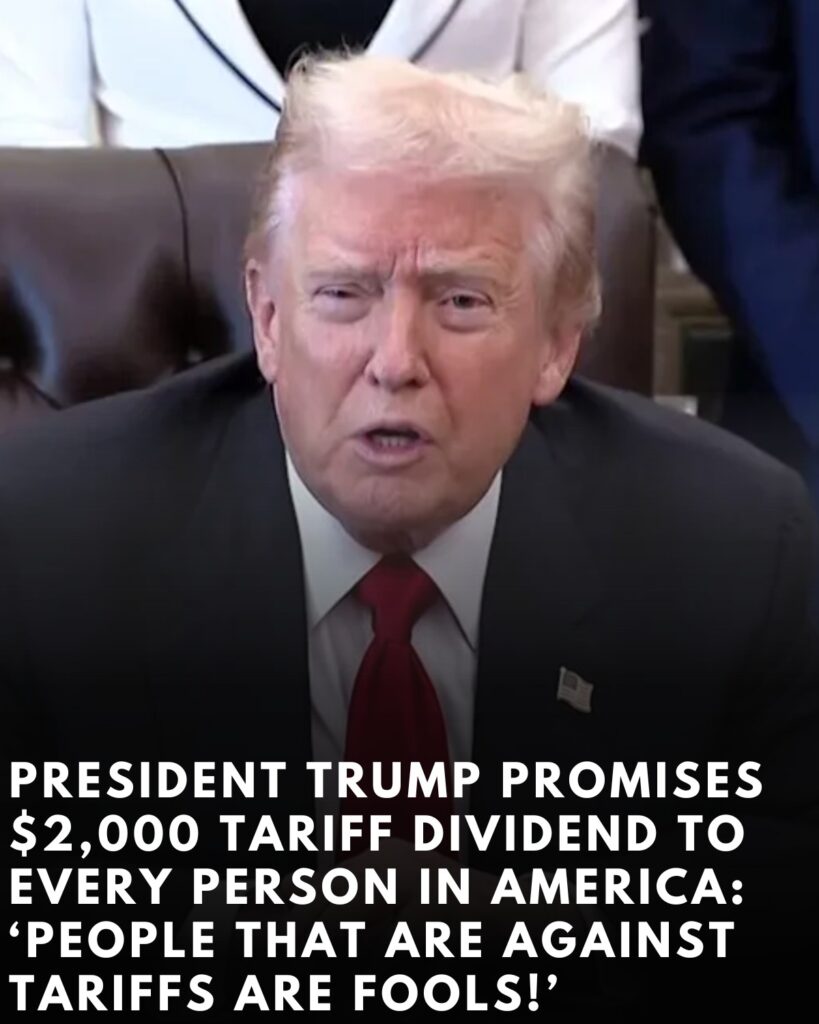
President Donald Trump has said most Americans will receive a “tariff dividend” of at least $2,000 funded from customs revenues collected under his sweeping trade programme, casting critics of the policy as “FOOLS” and insisting the United States is “the Richest, Most Respected Country In the World” with “Almost No Inflation” and a “Record Stock Market Price.” The pledge, made in a burst of weekend posts on his Truth Social account, revives an idea he has floated before and immediately raised questions about timing, eligibility, financing and legality as the Supreme Court weighs whether his use of emergency powers to impose broad tariffs is lawful.
In the messages, the president asserted that tariff collections were bringing in vast sums and could help pay down what he called the “ENORMOUS DEBT, $37 Trillion,” while also funding direct payments to the public. “A dividend of at least $2000 a person (not including high income people!) will be paid to everyone,” he wrote, without specifying when the payments would be issued, what income thresholds would apply, or whether the mechanism would be a cheque, tax credit or some other benefit. The posts repeated a central political claim that factories are “going up all over the place” and that “businesses are pouring into the USA ONLY BECAUSE OF TARIFFS.”
The declaration followed a week in which justices across the ideological spectrum signalled doubts about the administration’s reliance on the 1977 International Emergency Economic Powers Act to justify tariffs that reach far beyond traditional national-security sanctions. During oral argument, conservative and liberal members of the court pressed the government’s lawyer on whether a president may unilaterally impose revenue-raising import taxes—a power the Constitution assigns to Congress—by invoking emergency authority, and questioned the contention that such measures are merely regulatory rather than fiscal. The court’s eventual ruling, expected next year, could determine the fate of hundreds of billions of dollars in duties and define the limits of presidential economic power.
The tariff plan at issue has been repeatedly challenged. Earlier this year a three-judge panel of the U.S. Court of International Trade held that the administration exceeded “any authority granted” by the emergency statute in imposing worldwide reciprocal tariffs, ordering the government to stop collecting them; the ruling was promptly appealed and collections continued pending higher-court review. The dispute is now before the Supreme Court in consolidated cases that ask both whether the law authorises the tariffs and, if so, whether that would represent an unconstitutional delegation of Congress’s taxing power. Legal memoranda and practitioner summaries describe the orders as creating a 10% baseline tariff on most imports, with much higher rates on dozens of countries and separate measures targeting China, Canada and Mexico that the trade court said did not address the stated emergencies.
Even as the president promoted the “dividend,” his own Treasury Secretary, Scott Bessent, suggested the idea might materialise in different ways. Asked about the promise in a television interview, Bessent said such a dividend “could come in lots of forms and lots of ways,” pointing to tax changes the administration has championed—such as exempting tips or overtime—from income taxation, rather than pledging a specific round of direct cheques. In earlier public remarks, Bessent emphasised using tariff receipts primarily to reduce federal debt, a priority he linked to expectations that customs revenue would “rise substantially.” Those statements, while not ruling out rebates, underscored that no formal plan has been released and that senior officials have at times placed other fiscal objectives ahead of mass payments.
Estimates of tariff revenue vary widely between the president’s rhetoric and official accounting. In his social-media posts, Trump said the United States was “taking in Trillions of Dollars,” a characterisation not supported by the latest public data summaries cited in reporting on the proposal. News coverage has pointed to figures in the low-hundreds of billions of dollars collected this year to date, with some outlets noting administration projections of around $500 billion on an annual basis if the tariff regime remains intact. The White House has not published a detailed ledger tying a $2,000 per-person payment to year-to-date collections once exclusions for “high income people” are applied, nor has it explained whether non-filers, mixed-status families, or residents of U.S. territories would be included.
The political framing around the pledge has been uncompromising. “People that are against Tariffs are FOOLS!” the president wrote, continuing a broader argument that tariffs are central to industrial revival, investment and leverage over trading partners. He also questioned from the same platform how a president could “stop ALL TRADE” under emergency authorities but not impose what he called “a simple Tariff,” amplifying his contention that courts are misreading Congress’s intent and ignoring the practical realities of economic statecraft. The administration has previously justified many of the measures by citing fentanyl trafficking and persistent trade deficits as emergency threats; challengers argue that such rationales stretch IEEPA past its historical use and that the Trade Act of 1974 already provides tailored, time-limited tariff tools subject to congressional oversight.
For households, the headline figure would be significant if enacted and delivered as cash. A $2,000 payment to “every person,” even with an income cap, would run to hundreds of billions of dollars in gross outlays, raising questions about whether tariff receipts net of refunds, exemptions and administrative costs would cover the total. The White House has not said how often such a dividend might recur, whether it would be indexed, or whether it would be contingent on sustaining current import levels at higher prices. Economists who have studied past tariff episodes note that duties are typically paid by importers and can be passed through to consumers; the president has insisted tariffs cause “No Inflation,” while critics argue that broad levies act as a consumption tax and raise costs along supply chains. The administration has offered no new analysis to reconcile those competing claims in the context of a universal-style payment.
The idea of converting tariff proceeds into household rebates has appeared before in Republican circles. Reporting on the weekend posts noted that Senator Josh Hawley previously advanced a concept for $600 payments per person funded from tariffs, a smaller-scale version that did not progress through Congress. That history underlines another unresolved point: whether any mass payment from federal coffers would require explicit legislation. Absent a specific statute, it is unclear how the executive branch would distribute funds at the scale implied by a $2,000 dividend while ongoing litigation questions the very legality of the revenue source.
The president’s timing adds to the stakes. His social-media barrage came just days after a high-profile Supreme Court argument that featured sceptical questioning from justices appointed by both parties, including members of the court who have in other contexts been sympathetic to broad executive power. The justices probed whether IEEPA’s text—focused on blocking transactions with foreign entities during national emergencies—can be read to authorise generalised tariffs on allies and rivals alike, and whether the “major questions” doctrine requires Congress to speak clearly when delegating authority with significant economic consequences. A decision against the administration could force a rapid unwinding of the tariff architecture and invite demands for refunds; a decision in its favour could set a durable precedent for unilateral tariff action by future presidents.
In the near term the promise functions as a public signal that the White House feels confident enough about collections to dangle a benefit aimed at most households, while carving out “high income people.” Past stimulus efforts have relied on the Internal Revenue Service’s tax-filing system to reach the majority of recipients and on data-sharing with other agencies for veterans, Social Security and non-filers; officials have not said whether the IRS would be asked to play a similar role or whether the benefit would appear as a refundable credit at filing time. The Treasury Secretary’s comments about alternative forms—such as tax relief on tips, overtime and Social Security—suggest the administration could attempt to present existing or prospective tax measures as meeting the president’s dividend promise if direct payments stall.
The announcement also arrives amid political and economic cross-currents. The administration and allied lawmakers have touted the stock market’s performance and retirement-account gains, even as mortgage costs remain elevated and parts of the labour market cool. Tariffs have generated revenue and afforded leverage in negotiations, but they have also prompted retaliation abroad and uncertainty for import-reliant sectors at home. Business groups and several states joined the legal challenges, telling courts that sudden, sweeping levies upended contracts and raised input prices, while the president’s supporters argue that the programme strengthens domestic industry and deters adversaries. The clash over whether such a regime can be used to finance household payments without Congress’s assent encapsulates those competing narratives.
In his weekend postings, the president linked the dividend to a broader accounting of his policy aims: paying down the national debt, sustaining equity-market records, and accelerating domestic investment. He warned that it would be “devastating for our country” if the high court ultimately strikes down the tariff structure, a view he has repeated in other statements as the litigation has advanced. He also portrayed resistance to tariffs as partisan or ideological rather than technical, casting judges, economists and rival politicians as insufficiently attuned to what he describes as obvious successes. The rhetorical strategy mirrors earlier moments in which he sought to transform legal jeopardy into political momentum by promising immediate, tangible benefits. (CNBC)
For now, the dividend remains a presidential promise without an operative blueprint. No executive order or Treasury guidance accompanied the Truth Social posts, and officials have not published a timetable. The programme’s scope depends on critical uncertainties: the durability of the tariff regime under judicial review, the scale of net collections, and the administration’s willingness or ability to channel those funds into direct transfers rather than debt reduction or tax policy. The White House has not clarified whether the payment would be indexed to household size, how it would treat dependants, or whether it would be taxable income. Absent those details, Americans are left with a headline number and the president’s assurance that a payment is coming, while the courts deliberate on the legal foundation of the revenue he says will fund it.
The stakes of the Supreme Court case extend beyond the payout. A ruling circumscribing presidential tariff powers would push future administrations back toward statutory trade remedies that are narrower in scope and duration, and require findings by independent agencies such as the International Trade Commission. A ruling endorsing broad emergency-based tariffs would set a powerful precedent for using IEEPA or similar authority for macro-economic aims, including potentially financing programmes like the dividend the president has promised. Until that clarity arrives, the $2,000 figure functions as both a political marker and a test of how the administration translates combative social-media rhetoric into policy instruments capable of delivering cash to the public.
Trump’s posts present the idea in stark terms designed to resonate amid cost-of-living concerns: a direct payment to “everyone” except the wealthy, justified as a share of tariff proceeds that he argues have strengthened the economy. Supporters online quickly amplified the message, while detractors highlighted the pending litigation and the absence of an implementation plan. The administration’s top economic spokesperson has left multiple doors open on what form a “dividend” might take, emphasising tax relief that could be claimed to meet the pledge without mailing cheques. With legal and fiscal uncertainties unresolved, the president’s promise stands as the latest high-profile commitment tied to the fate of his trade agenda and the contested proposition that tariffs can both reshape global commerce and underwrite a broad household payout.