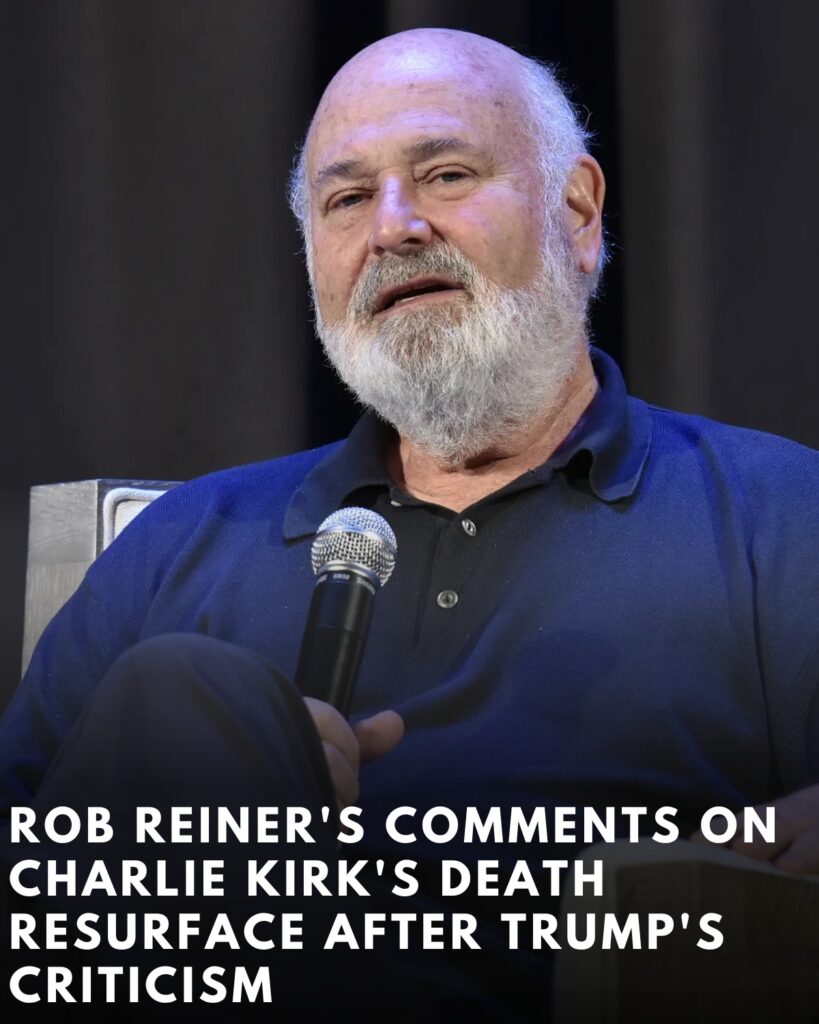
Rob Reiner’s remarks on political violence and forgiveness have resurfaced online after President Donald Trump launched a fresh attack on the late film-maker in the wake of Reiner’s killing, reigniting a wider public argument about how national figures should speak about death, grief and polarisation.
The debate centres on comments Reiner made months earlier during an appearance on Piers Morgan’s programme in which he addressed the assassination of conservative activist Charlie Kirk, founder of Turning Point USA. In that interview, Reiner said he felt “absolute horror” at Kirk’s killing and described the wider climate as “unacceptable,” arguing that political disagreement should not translate into violence.
Those excerpts began circulating again this week after Trump criticised Reiner following news that the director and his wife, former actress and photographer Michele Singer Reiner, had been killed at their home in Los Angeles. The couple, long prominent in American film and political life, were found dead in what police and prosecutors have described as a double homicide.
Authorities in Los Angeles have said Reiner’s son, Nick Reiner, 29, was arrested and accused of murdering his parents. The Los Angeles County District Attorney’s Office said the suspect is charged with two counts of murder and one count of possession of a firearm by a felon. Prosecutors said they would oppose bail, describing the case as “a horrific, tragic” alleged killing that had “shocked the community.”
Multiple reports, citing law enforcement and the charging announcement, have said the suspect was taken into custody after officers responded to a welfare check at the home. The couple’s deaths prompted an outpouring of tributes in Hollywood and political circles, while the criminal case moved quickly into the courts.
Trump’s comments, shared online, referred to Reiner in disparaging terms and mocked the director’s long-running public criticism of him. The president wrote that Reiner “died as he lived, tortured and struggling,” and described him as suffering from what Trump called “Trump Derangement Syndrome.”
The language drew attention because Reiner, a long-time Democratic supporter, had repeatedly criticised Trump in public statements and interviews, and because Trump’s message arrived soon after the murders became public. The result was a renewed online focus on how Reiner spoke about political conflict when addressing the killing of a figure with whom he disagreed.
Kirk, 31, was shot and killed during an event at Utah Valley University in Orem, Utah, in September, in what the state’s Republican governor called a “political assassination.” According to a Reuters account at the time, Kirk was fatally shot during an outdoor event and authorities launched a hunt for the suspect as national leaders condemned the attack.
The Associated Press reported that Utah Gov. Spencer Cox said the shooting was carried out from a rooftop, calling it “a dark day for our state” and adding: “I want to be very clear this is a political assassination.”
The investigation led to the arrest of a 22-year-old suspect, Tyler Robinson. Court filings and subsequent updates have indicated prosecutors intended to pursue severe penalties. ABC News has reported that Robinson faced formal charges including aggravated murder, with prosecutors announcing their intent to seek the death penalty.
In the aftermath of Kirk’s death, the country’s already tense political atmosphere became the subject of broad public debate, with leaders across party lines condemning the violence. Against that backdrop, Reiner’s appearance with Morgan, and his on-air condemnation of the assassination, drew renewed interest after his own death.
In the Morgan interview excerpt cited in the TooFab report, Reiner framed the killing as morally beyond politics. He said he experienced “absolute horror” at Kirk’s death, and argued violence had become “unacceptable.”
In the same discussion, Reiner highlighted what he described as a forgiving response from Kirk’s widow, Erika Kirk. The TooFab account said Reiner pointed to her remarks about forgiveness in the wake of the shooting, using the moment to argue for a different tone in political discourse.
The resurfaced clips and quotations began spreading again as Trump’s post circulated, with social media users contrasting Reiner’s condemnation of Kirk’s killing with the president’s derisive language about Reiner following the murders in Los Angeles. Some users argued the comparison illustrated a double standard in public empathy, while others defended Trump’s rhetoric as political retaliation. The renewed attention has played out amid ongoing arguments about political speech, incitement and the responsibility that comes with holding national office.
Reiner’s public profile straddled entertainment and politics for decades. A director and producer associated with films including “This Is Spinal Tap,” “The Princess Bride” and “A Few Good Men,” he also became an outspoken political activist, using interviews and social media to campaign for Democratic candidates and to criticise Republican leadership, particularly during Trump’s rise. His prominence, and the fact he was killed alongside his wife, ensured the case drew swift national attention.
The criminal allegations have left many unanswered questions, including the motive investigators believe drove the killings and the timeline of events inside the home. Authorities have released limited detail publicly beyond the charging decision and the claim that a firearm was involved, while court proceedings are expected to address evidence, witness accounts and forensic findings.
The Los Angeles County District Attorney’s Office, announcing the charges, emphasised the seriousness of the case and the risk posed by firearms, describing the deaths as a “senseless act of violence.”
The convergence of these events, a political assassination earlier in the year, the killing of a prominent Trump critic, and a presidential message mocking the dead, has amplified a familiar American tension: whether the country’s political language is hardening into something corrosive, and whether calls for restraint can survive a social media environment that rewards outrage.
In the excerpt highlighted by TooFab, Reiner presented his condemnation of Kirk’s killing as independent of ideology. He described the assassination as “absolute horror” and said the broader drift toward dehumanising opponents was “unacceptable,” urging that disagreement should remain nonviolent.
The contrast between that stance and Trump’s remarks has helped drive the story’s renewed traction online, as users continue to share the clips, comment on the rhetoric, and argue over what standards should apply when political adversaries die. For now, the Los Angeles case is set to proceed through the criminal courts, while the cultural fallout continues to play out in public.