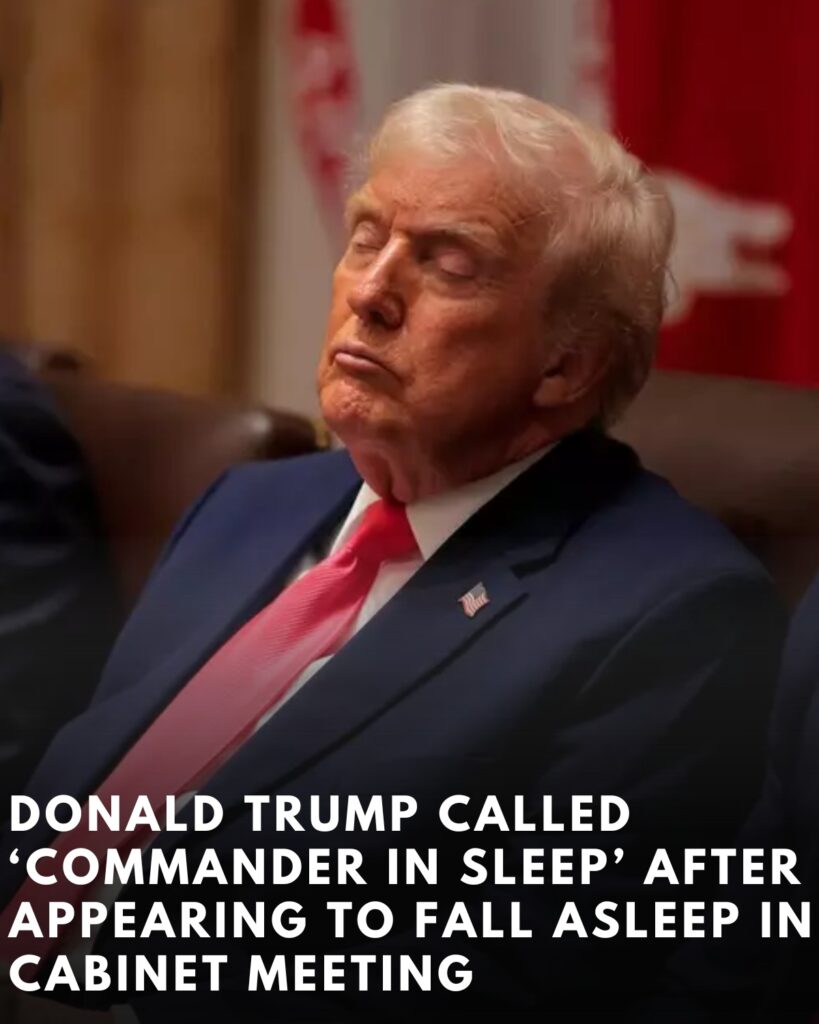
US President Donald Trump faced renewed scrutiny over his stamina and capacity for office after video from a White House cabinet meeting on 2 December 2025 went viral, showing the 79-year-old apparently struggling to stay awake. The footage — aired live and later widely shared — captured moments in which Trump closed his eyes and appeared drowsy while members of his cabinet offered praise and laid out their departments’ recent accomplishments.
The meeting, held in the Cabinet Room of the West Wing, was intended to spotlight what officials described as the achievements of Trump’s second term. As different secretaries spoke, the president, seated at the centre of the long table, was shown on camera at times slumping in his chair, his gaze drifting downward. In one of the most replayed clips, during remarks from the commerce secretary, Trump’s eyes seemed to close for several seconds before he shifted forward and resumed what appeared to be a more attentive posture.
Social media reaction was swift. On X and other platforms, users zeroed in on the imagery — slow motion replays and zoom-ins emphasised the moments where Trump’s eyes closed, or his head dipped. One post accompanying a video clip dubbed him “commander in sleep,” a play on his formal title of commander in chief. Others echoed the jibe, suggesting the president was literally asleep as his cabinet praised him.
Not all who watched saw the scene the same way. Some supporters argued that Trump may simply have been looking down at notes, listening with his eyes shut, or resting briefly in a room flooded with bright lights. No close-up audio or other evidence confirmed any snoring or audible sleep. The broadcast’s fixed camera angle left ambiguity: while Trump’s eyes were closed, it could not be established whether he was disengaged or merely concentrating behind closed lids.
The administration pushed back firmly against the suggestion that the president had dozed off. In a statement, the White House press secretary said Trump had “listened attentively and run the entire three-hour marathon Cabinet meeting.” According to the statement, his subsequent performance at a press conference served as proof of his energy and engagement. The press secretary added that the meeting was one of a series of “historic meetings” meant to underscore accomplishments the administration claims to have delivered for Americans.
Critics, however, pointed to the timing of the clip for context. The president had reportedly posted over 160 times on his social media platform the night before, continuing early the next morning shortly before the cabinet meeting — a pace some observers said could scarcely allow for adequate sleep. For these critics, the viral footage was not an isolated incident but the latest in a string of episodes that raised serious questions about the concentration, alertness, and stamina of the oldest person ever elected U.S. president.
Indeed, this was not the first time Trump’s alertness during public appearances has come under scrutiny. During his 2024 criminal trial in New York, multiple court observers described him as nodding off — his head drooping and mouth slack — while proceedings droned on. At the time, Trump responded publicly by rejecting media descriptions, saying he was merely closing his “beautiful blue eyes” to listen more intensely.
More recently, footage from an Oval Office event on drug pricing and other official occasions showed him reclining with his eyes shut, prompting jibes at the time from critics including senior political figures. The repeating pattern of images in which the president appears drowsy has drawn alarm from opponents who argue that even the perception of a president sleeping during critical meetings can undermine confidence in his leadership.
Supporters, in turn, have defended him robustly. They emphasise that he remains active on social media, travels extensively, convenes long, detailed sessions with his advisors, and continues to lead public appearances. Some have argued that the moments of closed eyes reflect nothing more than brief rest or intense concentration — not a lack of capacity to govern. The White House has also pointed to recent medical statements asserting that Trump remains in excellent health, and to his own claims that he recently completed a “perfect” physical exam and “aced” a cognitive test.
The incident has intensified ongoing debate in Washington and beyond about the demands of the presidency when held by a septuagenarian. At 79, Trump is already the oldest person ever to assume the office — and by the end of another full term would be in his early eighties. Allies insist age has not diminished his ability to manage the workload, while detractors repeatedly argue that repeated episodes of apparent fatigue raise legitimate concerns about whether he can sustain the rigours of leadership.
At present, the “commander in sleep” label remains a term of public derision rather than a formal evaluation of fitness for office. No medical evaluation or official statement has as yet raised credible concerns about any sleep disorder or impairment. Nor have any cabinet members publicly suggested that Trump’s performance at the meeting was compromised. The meeting proceeded without disruption, and the cabinet members delivered their remarks in full.
Yet the episode underscores how intensely the President’s every public moment is scrutinised, especially in an era where short clips and social media can define public perception within hours. For some observers, the cabinet meeting was another example of a president enduring hours of detailed briefings and public praise — proof of continued dedication. For others, the same images have become shorthand for concerns that a leader of advanced age may be showing signs of diminished alertness. As the debate over Trump’s vitality and capacity continues to swirl, the line between personal stamina and public confidence remains sharply contested.