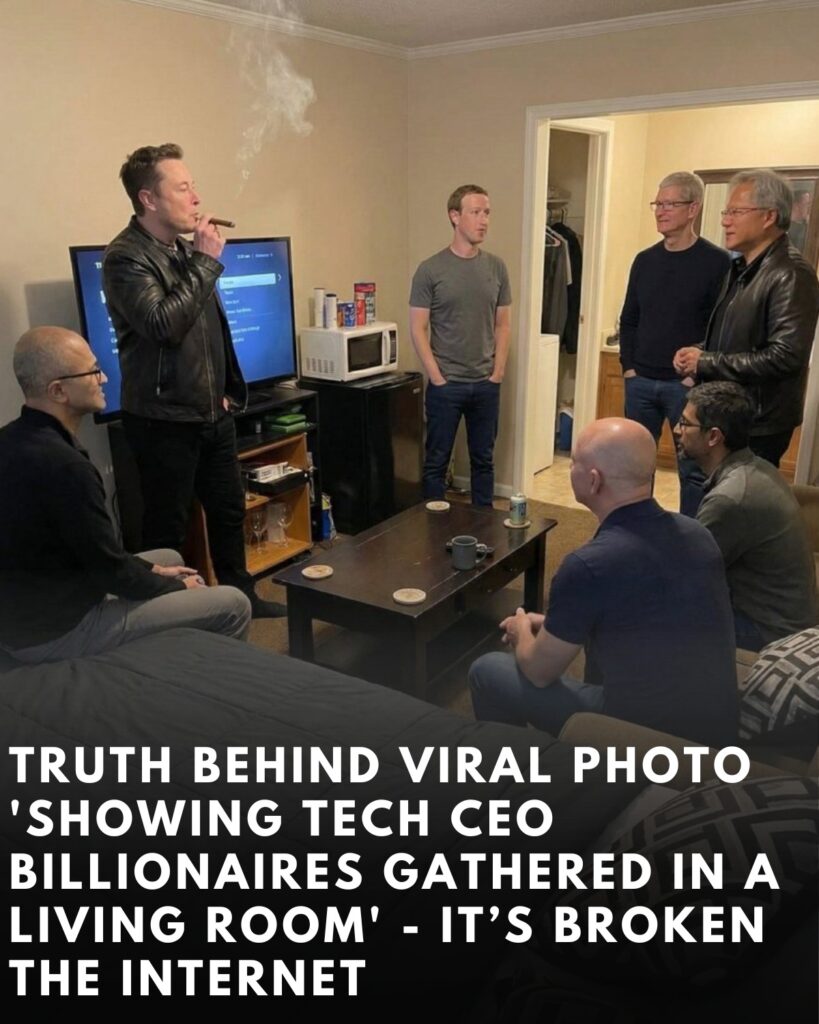
An image of several leading technology-industry figures standing together in a living-room setting has become a viral sensation online, though investigations show the photo is the product of artificial intelligence. The image, circulated across platforms such as X and Reddit, allegedly features individuals including Elon Musk, Mark Zuckerberg, Sundar Pichai, Satya Nadella and Tim Cook casually gathered around a coffee table in what appears to be a modest, poorly furnished room. One version shows a microwave in the background and plastic-chairs and mismatched furniture. According to coverage, it has been dubbed the “$1 trillion squad” photo because of the combined wealth and corporate value of the individuals portrayed.
Social-media users noted the uncanny nature of the scene, writing that the setting looks more like a budget motel hang-out than a meeting of technology titans. One version carried the caption: “Just a chill gathering with the homies.” The realism of the image—down to lighting, smoke effects, and body posture—spurred debate about its authenticity and led to widespread sharing, memes and comment-threads about the power and mystique of the technology elite.
Although the image circulated with little context, media outlets and independent analysts traced it to AI-image generation tools, concluding that it is not a genuine photograph of a real event. For example, an article described how AI-generated images of “the world’s most powerful tech leaders hanging out or taking selfies” went viral, with the image described as one that “features the world’s most powerful tech leaders hanging out or taking selfies.” The reporting noted the characteristic signs of synthetic imagery, including subtle inconsistencies in facial features and backgrounds. Social-media posts by users also suggested that the image’s uncanny realism and eerie glow were tell-tale signs of AI manufacture.

The original version appears to show the group in a dimly lit parking-lot among luxury vehicles, another variant places them indoors in a wood-panelled room, the juxtaposition of billion-dollar individuals and run-down surroundings amplifying the surreal nature of the image. In describing the indoor variant, one outlet noted that the “cheap, cramped motel-style room with a microwave, plastic chairs and mismatched furniture” adds “contrast between trillion-dollar influence and a 50-dollar-a‐night room.”
Breaking down the context, the individuals featured (or visually implied) are among the most influential in global technology: Elon Musk (space, automotive and AI), Mark Zuckerberg (social media), Sundar Pichai (search and cloud), Satya Nadella (enterprise software) and Tim Cook (consumer electronics). Their combined corporate empires, market capitalisations and global influence have made them the subject of cultural fascination and criticism. The appearance of them casually “hanging out” in a living-room environment is part parody, part mythmaking, and part commentary on their power.
Social-media users seized on the image almost immediately. On X, one post described it as “AI Image of Tech CEOs’ Cigar Hangout Goes Viral” and noted that the image “racked up 1.5 million views.” The viral loop was fuelled by memes, mockery and cultural commentary—viewers joked that it looked like the “Avengers in real life,” that the individuals were “tech gangs of back street,” or “the brokest dudes on the planet.”
The broader significance of the phenomenon lies in how it reflects changing perceptions of elite power and the role of AI in shaping imagery. The image functions as both a meme and a commentary: by placing the ultra-wealthy in a low-rent setting, it exaggerates the contrast between their economic standing and the visual absurdity of the scene. Some analysts argue the popularity of the image underscores the public’s fascination with and scepticism of elite tech executives, while also highlighting the growing sophistication of AI image-generation tools. One piece asserts that though “the picture is not real, its cultural impact absolutely is.”
The technology underpinning such viral content is at the core of the story. One article noted that as AI-generated imagery becomes more accessible, images like the “$1 trillion squad” photo may no longer be seen as jokes but as ambiguous artefacts blurring the boundary between real and fake. The phenomenon raises questions about trust, influence, and how visual culture is being reshaped in the digital era.
While the image itself is a fabrication, the individuals depicted are real and have made no publicly verified statement confirming they were present at any such gathering. In the absence of credible evidence of a real photo or event, the consensus among journalists and analysts is that the scene never took place. The conversation instead has moved to what the image represents. Some viewers interpreted it as a representation of tech’s monoculture, others as satire of billionaire fraternities. A few viewed it as an entirely absurd piece of internet folklore made possible by machine-learning.
In conclusion, the viral image of technology-industry leaders casually assembled in an unlikely setting is not an actual photograph but a digitally manufactured visual that captured global attention. It reflects how digital tools and culture are intersecting: AI imagery, internet meme-culture, elite tech personalities and public perceptions of power all meet in a single frame. The image may have been fabricated, but the conversation it generated is very real.