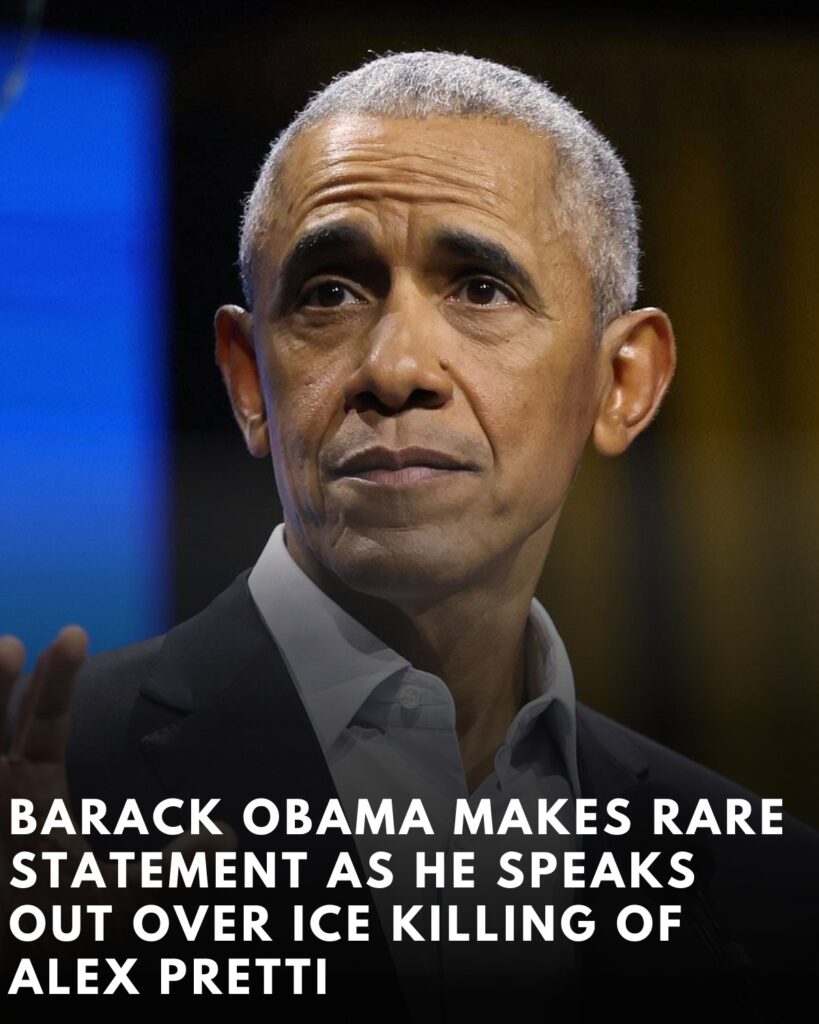
Former US President Barack Obama has issued an unusually direct political statement criticising the Department of Homeland Security after the fatal shooting of Alex Pretti in Minneapolis, as Democratic officials demanded an investigation and the Trump administration defended federal agents operating in the city.
Pretti, described by multiple outlets as a 37-year-old intensive care nurse at a Minneapolis Veterans Affairs hospital, was shot and killed during a federal immigration enforcement operation on Saturday. The incident, captured in witness and media video, has intensified tensions in Minnesota after another fatal encounter involving federal agents earlier this month.
In a statement posted on social media on Sunday, Obama said the killing was “a heartbreaking tragedy” and “a wake-up call to every American, regardless of party”, arguing that “many of our core values as a nation are increasingly under assault.”
“People across the country have been rightly outraged by the spectacle of masked ICE recruits and other federal agents acting with impunity and engaging in tactics that seem designed to intimidate, harass, and provoke and endanger the residents of a major American city,” Obama wrote, adding: “This has to stop.”
Obama said immigration agents have “a tough job” but accused the current administration of encouraging “lawless tactics” and escalating a volatile situation in Minneapolis. He also criticised public accounts offered by federal officials in the aftermath of the shootings, saying explanations had been made without “any serious investigation” and that claims appeared to be contradicted by video evidence.
The Department of Homeland Security and political allies of President Donald Trump have described Pretti as a dangerous agitator who confronted officers while armed, a characterisation disputed by some Democrats and challenged by analysts who have reviewed footage from the scene.
Homeland Security Secretary Kristi Noem called Pretti a “domestic terrorist” and argued his actions met the definition of domestic terrorism, linking the allegation to violence against government for ideological reasons. White House deputy chief of staff Stephen Miller also used the term in social media posts, according to US media reports.
The shooting has been widely described as the second fatal incident in Minneapolis this month involving federal law enforcement during immigration operations, following the death of Renée Good. Good’s killing has remained a focal point for protesters and state officials who say federal deployments have destabilised the city.
According to accounts published by US media, Good was shot earlier in January during an encounter connected to an immigration operation. Video analyses cited in reporting describe a brief confrontation before an agent fired multiple shots into a departing vehicle.
In the wake of Pretti’s death, Minnesota Governor Tim Walz has sharply criticised the federal presence in Minneapolis, calling it an “occupation” in social media posts and demanding that federal agents be withdrawn.
President Trump has blamed Democratic leaders for unrest in the city and accused them of inciting violence. In a post on his Truth Social platform, he said the governor and Minneapolis mayor were “inciting Insurrection” with “dangerous” rhetoric, according to the New York Post and other outlets reporting on the remarks.
The mayor, Jacob Frey, has been quoted in coverage as using profane language to tell federal immigration agents to leave, comments repeatedly cited by administration allies as evidence that local officials are inflaming tensions.
The core dispute centres on what happened in the moments before Pretti was shot.
DHS officials have said Pretti was legally carrying a handgun but that agents believed they were in danger as an arrest attempt unfolded. Some reporting says officers took the weapon from Pretti before shots were fired, and that video does not clearly show federal agents facing an imminent threat at the instant gunfire began.
News footage reviewed by broadcasters has also highlighted competing interpretations by politicians and legal experts. In one report, an attorney argued that the mere possession of a firearm does not necessarily establish an imminent threat, particularly in a state where lawful carry is permitted, while acknowledging that the videos provide only partial angles of a chaotic scene.
The political response has widened beyond Minnesota.
ABC News reported that some Republicans have called for a deeper investigation and urged de-escalation, while still backing federal law enforcement’s authority to conduct immigration operations. The report quoted Oklahoma Governor Kevin Stitt describing the shooting as “a real tragedy” and saying Trump should define an “end game” for the federal posture in Minneapolis.
At the same time, Democrats have demanded accountability and portrayed the shootings as evidence of excessive force and a breakdown in oversight. Rep. Ilhan Omar, who represents Minnesota, has condemned the operation in public statements and demanded that immigration agencies leave the state, according to reporting.
Obama’s intervention is notable because former presidents have typically avoided frequent direct attacks on sitting administrations. His statement, made in his own name and circulated widely online, framed the Minneapolis shootings not only as a local crisis but as a test of national values and democratic accountability.
In his message, Obama said Americans were witnessing a “spectacle” of agents “acting with impunity,” and suggested that tactics used by federal personnel were “designed to intimidate, harass, and provoke and endanger” residents.
The White House and DHS have not backed away from their depiction of Pretti, with Noem repeating the “domestic terrorism” label in comments circulated by US outlets, even as questions about the shooting sequence and the handling of public information continue to mount.
For residents in Minneapolis, the immediate impact has been visible in street protests, heavy policing and a widening confrontation between federal authority and local leadership. Video of the shooting has circulated widely online, with warnings about graphic content, fuelling demands for transparency and intensifying claims and counterclaims about what it shows.

As investigators review evidence, including multiple recordings from different angles, the shootings of Pretti and Good have become political flashpoints in a national argument over immigration enforcement, the use of force by federal agents, and the limits of protest and resistance in cities where local officials are openly hostile to federal operations.