The landscape of American immigration enforcement is currently undergoing a period of intense scrutiny and emotional upheaval. In the early weeks of 2026, the Twin Cities of Minneapolis and Saint Paul have become the epicenter of a national debate regarding the methods used by Immigration and Customs Enforcement (ICE) and the resulting impact on community trust.
At the heart of the current tension are two distinct but overlapping incidents: the tragic shooting of Renee Nicole Good, a 37-year-old mother of three, and the subsequent viral footage of a disabled woman being forcibly removed from her vehicle during an enforcement operation. Together, these events have sparked a conversation that transcends local politics, touching on the fundamental rights of individuals and the psychological toll of aggressive policing within residential neighborhoods.
Part I: The Aftermath of the Renee Nicole Good Incident
To understand the volatility in the Twin Cities today, one must first look back at the events surrounding Renee Nicole Good. A mother of three, Good’s death sent shockwaves through the community, not just because of the loss of life, but because of the circumstances that led to the fatal encounter.
The Climate of Fear
Following her death, the Minneapolis–Saint Paul area has seen a massive deployment of federal agents. The administration has categorized these as “targeted enforcement operations” intended to secure the interior of the country. However, for the residents of these neighborhoods, the presence of armored vehicles and tactical gear on residential streets has turned everyday activities—like driving to work or taking children to school—into high-stakes maneuvers.
Community Impact and Emotional Depth
The emotional weight of this situation is heavy. Neighborhoods that were once vibrant hubs of community activity have become quiet and apprehensive. Local advocates describe a “cascading effect” of trauma:
- Economic Displacement: Fear of checkpoints has led to a decrease in local commerce as residents avoid leaving their homes.
- Educational Disturbance: Schools have reported a spike in absences, as parents fear that a routine drop-off could result in a permanent separation.
- Psychological Toll: The constant presence of federal authorities creates a state of “hyper-vigilance,” a psychological condition where the body remains in a constant fight-or-flight mode.
Part II: Analysis of the Recent Enforcement Footage
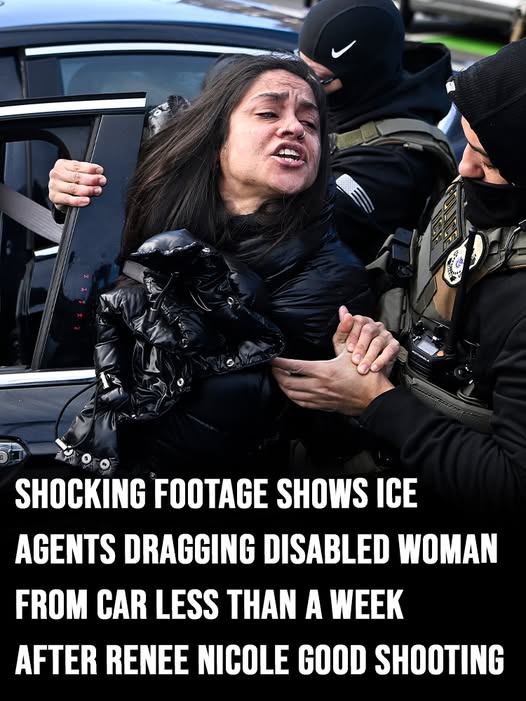
Less than a week after the community began mourning Renee Nicole Good, a new video surfaced that has intensified the local outcry. The footage shows ICE agents engaging with a vehicle whose occupant identifies as disabled.
Deconstructing the Encounter
In the video, agents are seen demanding that the driver exit the vehicle. The woman repeatedly states that she has physical disabilities that hinder her movement. Despite this, agents proceed to force the door open and physically remove her from the car.
The Official Stance
U.S. Customs and Border Protection and ICE officials have defended the operation. They cite the “necessity of enforcement” and claim that agents are often met with “impending resistance” from activists and bystanders. In this specific operation, officials noted that dozens of arrests were made for allegedly impeding federal agents in the performance of their duties.
The Civil Rights Perspective
Legal experts and human rights organizations, however, are raising serious questions about the Americans with Disabilities Act (ADA) and the Fourth Amendment. They argue that:
- Reasonable Accommodation: Law enforcement is required to make reasonable accommodations for individuals with disabilities during an arrest or detention.
- Excessive Force: The use of physical force against an individual who is not presenting a violent threat and has disclosed a disability is being scrutinized as a potential violation of civil liberties.
Part III: Health and Wellness – The Body’s Response to Stress
While the social and political implications of these events are vast, there is also a biological component to living in a community under such high levels of stress. The physical manifestations of chronic anxiety often go unnoticed until they become visible.
One such visible sign that many people in high-stress environments notice is the appearance of purple or blue veins on the legs.
If You Have Purple Veins on Your Legs, It Means You Are…
While political tensions rise, the health of the community remains a vital concern. If you have noticed dark, branching veins appearing on your lower extremities, it is important to understand the medical context behind them.
1. Experiencing Venous Insufficiency
The appearance of purple veins—commonly known as spider veins or varicose veins—is typically a sign of Chronic Venous Insufficiency (CVI). This occurs when the valves in the veins that push blood back up to the heart become weak.
2. The Link to Stress and Lifestyle
In communities experiencing “neighborhood-wide trauma,” physical health often takes a backseat, yet the body keeps score:
- Cortisol Levels: Chronic stress increases cortisol, which can lead to inflammation. While inflammation doesn’t directly cause varicose veins, it can exacerbate the discomfort and swelling associated with them.
- Prolonged Standing or Immobility: Whether it’s standing at a protest for hours or being afraid to move freely, stasis is the enemy of vascular health.
- Deoxygenated Blood: The purple color in these veins is simply blood that has lost its oxygen and is “pooling” because the valves aren’t closing properly.
3. Management and Recovery
For those dealing with the physical ache of these veins, doctors recommend:
- Compression Garments: These help the valves close and move blood more efficiently.
- Elevation: Raising the legs above the heart for 20 minutes a day can provide significant relief.
- Low-Impact Exercise: Walking or swimming helps the calf muscles act as a “second heart” to pump blood upward.
Part IV: The Erosion of Public Trust
The “shocking footage” from Minneapolis–Saint Paul represents a moment where the state’s interest in enforcement collided with a community’s need for safety and dignity.
A Battlefield Atmosphere
Sidewalk bystanders in the footage are heard shouting a “different verdict” than the official reports. They describe a government that treats residential blocks like battlefields. When children watch adults being thrown to the ground, it creates a generational trauma that is difficult to heal.
The Breakdown of Cooperation
Public safety relies on a partnership between the community and those who swear to protect it. When a community views enforcement as an “unchecked power” that does not respect disability or parental status, they are less likely to report crimes, serve as witnesses, or cooperate with local police. This creates a “safety vacuum” that can lead to higher crime rates and further instability.
Broad Context: National Immigration Policy in 2026
These events are not happening in a vacuum. They are part of a broader national shift in 2026 toward high-intensity interior enforcement. As the federal government seeks to fulfill mandates for “zero-tolerance” policies, the friction between federal agents and local jurisdictions (often referred to as “Sanctuary Cities”) has reached a breaking point.
Part V: Moving Forward – Accountability and Dialogue
Whatever the internal investigations into the Renee Nicole Good shooting or the recent vehicle extraction decide, the damage to the social fabric is undeniable. “Trust has been torn away in those few violent seconds,” as the original report noted.
The Path to Restoration
For the Twin Cities to move forward, several steps are likely necessary:
- Independent Oversight: Many are calling for civilian-led boards to review federal enforcement actions within city limits.
- Increased Training: Enhanced training for agents on interacting with vulnerable populations, including those with physical and mental disabilities.
- Community Healing Spaces: Providing mental health resources for families directly impacted by these enforcement actions.
Conclusion
The story of the Minneapolis–Saint Paul enforcement operations is a complex tapestry of law, emotion, and physical reality. From the grief of a family missing a mother to the visual evidence of a disabled woman’s struggle, the events of 2026 serve as a stark reminder of the human cost of policy.
While the “purple veins” on the legs of the community members may be a sign of physical pressure and age, the “scars” left by these high-tension encounters are signs of a social system under immense strain. As the nation watches these videos and reads these reports, the ultimate question remains: How can a society balance the firm hand of the law with the soft heart of human compassion?